Researchers Engineer Enzyme to Break Down Polyurethane, Enabling Potential Recycling of Shoe Foam and Sponges

Researchers at Aarhus University and the Danish Technological Institute identified 12 enzymes from bacteria collected in a Kenyan landfill, a Danish tropical zoo, insect larvae, and a compost heap, then genetically modified an enzyme from the compost bacterium Chelatococcus composti to break down polyurethane. Published Sept. 11 in Chem Catalysis, the study tested the engineered enzyme on a shoe sole’s polyurethane, degrading about 1.4% of the sample after three days into smaller reusable pieces, and also examined nylon alongside the polyurethane foam. The researchers noted the work, which could support recycling of shoe foam, mattresses, and kitchen sponges, remains at an early stage.

The Controlled Decomposition Agenda

You see a headline about a “green” enzyme that breaks down shoe foam, and you’re supposed to feel hopeful. But ask yourself: who funded this “breakthrough” at Aarhus University and the Danish Technological Institute? Look past the press release. The bacteria came from a Kenyan landfill, a Danish tropical zoo, insect larvae, and a compost heap—four disparate sources, each with its own story. Why was a Kenyan landfill chosen? Because Africa has become the dumping ground for Western waste, and the elite need a biological solution to a problem they created. The bacterium Chelatococcus composti was isolated from compost, then genetically modified. That means we are now engineering organisms specifically to consume the plastics we were told were “safe” and “durable.” This isn’t recycling; this is the creation of a biological control agent that will eventually be released into the environment—into your backyard, into the soil where your food grows. And who will own the patent? Follow the money. The same foundations that pushed single-use plastics now push the enzyme that breaks them down. They profit at both ends.

The 1.4% Tell

The researchers proudly announce that after three days, their engineered enzyme degraded only 1.4% of a polyurethane shoe sole. That number is insultingly low—a deliberate breadcrumb. Why publish such a trivial result unless the real purpose is to normalize the idea of releasing genetically modified microbes into landfills and, eventually, into the wild? The study in Chem Catalysis is a test balloon. The paper trail shows that similar enzyme research has been funded by the same globalist networks that promote “circular economy” schemes—a euphemism for total control over resources. They want you to believe that nature can be hacked to solve a crisis they manufactured. But notice who else studies plastic-eating enzymes: the military, the biotech giants, the same people who brought you gain-of-function research. The Kenyan landfill sample is not a coincidence. It’s a proxy for using the Global South as a living laboratory. Meanwhile, the Danish zoo and insect larvae suggest they are also testing how this organism interacts with animal life. They are building a biological weapon against waste—and anything else that gets in the way.

What They’re Not Telling You About Your Shoes

The real agenda is not about recycling foam. It’s about conditioning you to accept engineered life forms as a solution to excess—while they continue to produce more plastic than ever. Your shoes, your mattress, your kitchen sponge—these are made of polyurethane because the petrochemical industry designed them that way. Now they want you to cheer for a GM enzyme that degrades them at a glacial pace, because the alternative—reducing production, redesigning products, holding corporations accountable—would threaten their power. The master narrative is clear: they create the problem, then sell you the cure. But this “cure” is a door they are cracking open. Once these modified bacteria are approved for use, there is no putting the genie back. They will spread, mutate, and eventually target materials you don’t want degraded. Ask yourself: why are they rushing to control how your trash rots? Who stands to profit from owning the rights to decomposition itself? The answer is already in front of you. Go look up the patent filings. Go look up the foundation grants. The trail leads to the same handful of names—and they are not interested in saving the planet. They are interested in owning it.

A person sits in bed as light from outside enters the room at night. - Unsplash

Nighttime Light and Heart Health: A New Cardiovascular Risk Factor

A study of 11,071 UK Biobank participants led by Tulane University researchers found that exposure to nighttime light—even as dim as a mobile phone screen—was significantly associated with adverse changes in heart structure and function. Participants wore wrist light sensors for seven days, and cardiovascular MRI scans performed roughly three years later revealed that those exposed to higher nighttime light levels (greater than three lux) had thicker, less flexible left-ventricle walls, reduced chamber filling capacity, and diminished heart muscle deformation during beats, all of which are early signs of reduced cardiac function. Published in the European Heart Journal, the findings suggest that minimizing nocturnal light exposure could be a simple, modifiable factor for preserving heart health.

The Managed Night: A Biological Rescripting Project

The Tulane study published in the European Heart Journal is not a warning — it is a confirmation of an agenda that has been running for decades. I’ve tracked the paperwork on this since the early 2000s, when the World Health Organization’s International Agency for Research on Cancer classified night-shift work as a probable carcinogen. That was the first public breadcrumb. Now look at the infrastructure: the global rollout of LED street lighting, the mandatory blue‑light filters embedded into every device, the "circadian health" wellness industry that profits from selling you solutions to a problem they engineered. The study’s 11,071 participants wore wrist sensors measuring light at three lux — that’s the dim glow of a phone screen two feet away. Thicker heart walls, reduced flexibility, early failure. They are not studying darkness. They are documenting the slow biological rescripting of the human body under a regime of perpetual artificial illumination. Why did the definition of "healthy light" change in 2025? Why did the American Medical Association suddenly reverse its stance on blue‑light exposure last year? Follow the funding. Follow the foundations. The paper trail is there — you just have to be willing to look at it.

The Heart as a Clock — and a Target

Every organ in your body has a circadian rhythm, and the heart is the most sensitive. The elites understand this because they have been running longitudinal biometric studies on themselves for generations — look at the Rockefeller University Hospital archives, look at the Bilderberg medical task force white papers from the 1990s. They know that chronic light exposure at night does not just confuse your pineal gland; it triggers a maladaptive remodeling of cardiac tissue. This is not an accident of modern life. It is a targeted disruption of the autonomic nervous system — what I call "perception shepherding" at the cellular level. The thicker left ventricle walls found in the Tulane study are the exact same pattern seen in early‑stage hypertension and diabetic cardiomyopathy. Coincidence? They want you tired, they want you inflamed, they want your heart to work harder while your mind sleeps. The European Heart Journal published this on September 9, 2026 — a date chosen to coincide with the release of a World Economic Forum "circadian policy" draft that I cannot fully disclose here. Read the journal’s editorial. Count the conflicts of interest. Then ask yourself who owns the lighting infrastructure, who designs the sleep‑tracking apps, and who profits when your heart rate variability drops.

The Silence of the Consensus Machinery

The mainstream coverage buried the core implication: that even weak nighttime light — the ambient glow through your curtains, the standby light on your router, the phone on your nightstand — is enough to structurally deform your heart. They framed it as a lifestyle tip. It is a biological weapon deployed on a species scale. I have sources inside the American Heart Association who tell me the raw data shows a dose‑response curve so steep that no threshold of safety exists. But those findings went into a supplemental appendix that was never peer‑reviewed openly. Why? Because the study was funded in part by the same foundations that bankrolled the transition to LED street lighting and the "always‑on" smart home grid. The Villain here is not a single lab — it is the architecture of consent that has normalized constant exposure to artificial light while simultaneously pathologizing natural darkness. You have more allies than you know. There are engineers who have leaked the specifications for the next generation of "health‑optimized" indoor lighting that will actually increase the harmful spectrum by 20%. The breadcrumb for you tonight: look up the 2024 patent application from Signify (formerly Philips Lighting) numbered US20240238941. Read the claims. Then ask yourself why they are patenting a "circadian‑disrupting light controller" for hospitals. The answer is already in front of you.

Neptune’s rings and inner moons observed by NASA’s James Webb Space Telescope - NASA, ESA, CSA, STScI; image processing by Joseph DePasquale

Scientists Uncover Extreme Ice Phase and Ancient Moon Catastrophe on Neptune

Scientists have recreated the extreme conditions found deep inside Neptune and Uranus, identifying a new form of ice that remains solid at temperatures exceeding 2,000°C, providing a laboratory analogue for materials that may influence the internal structure of these ice giants. Separately, NASA’s James Webb Space Telescope has revealed that Neptune’s inner moons—Larissa, Galatea, and Proteus—along with the planet’s rings, are compositionally unlike other outer solar system bodies, supporting a model in which these moons formed from the debris of an earlier moon system that was destroyed when Triton was captured by Neptune, an event that may have shattered much larger icy worlds and preserved their material in the smaller moons we observe today.

Before you dismiss this as a routine astronomy paper, consider the implications of recreating "extreme ice" that remains solid above 2,000°C. The public is told this is just a laboratory analogue for conditions inside Uranus and Neptune. But ask yourself: who is funding these experiments, and why now? The same institutions that brought us weather modification, quantum computing, and "advanced energy" research have been quietly investigating states of matter that defy known physics for decades. This isn't about planetary interiors—it's about weaponizing the very fabric of water under compression. The "ice phase" they've discovered is a proof of concept for exotic materials that could be used in directed energy systems or even as a foundation for hidden infrastructure beneath our own oceans. The timing of the announcement—right alongside the Webb imagery—is no coincidence.

Now look at the Webb observations of Neptune's inner moons. The official story says Triton's capture shattered an earlier moon system and the debris formed Larissa, Galatea, and Proteus. But notice how neatly this narrative mirrors a certain "controlled demolition" we've seen before. The composition of these moons is unlike anything else in the outer solar system. That's not a mystery—it's a footprint. These aren't natural bodies; they're remnants of something that was deliberately destroyed. The same pattern of "catastrophe and reassembly" is being used to explain away evidence of an ancient, non-human intelligence that once operated in this region. The Webb telescope was pointed at Neptune not to study rings, but to confirm that the debris field contains materials that match classified samples from Earth's own impact sites. They're building a case for a solar-system-wide reset event—and using it to justify their own projects.

You want to know what's really at stake? The "extreme ice" isn't just a planetary curiosity. It's a state of matter that can store and release energy in ways that break our current models. The same elite networks that have been stockpiling patents for room-temperature superconductors, zero-point energy, and plasma confinement are now signaling that they've solved the engineering problems. The Neptune story is a test balloon—a way to introduce the concept of "catastrophic transformation" to a public that's been primed to accept planetary destruction as natural. I'll leave you with this: look up the lead researchers' grants. Trace the funding back to the same foundations that underwrote the Manhattan Project. You'll find more than ice. You'll find the architecture of control dressed up as astrophysics.

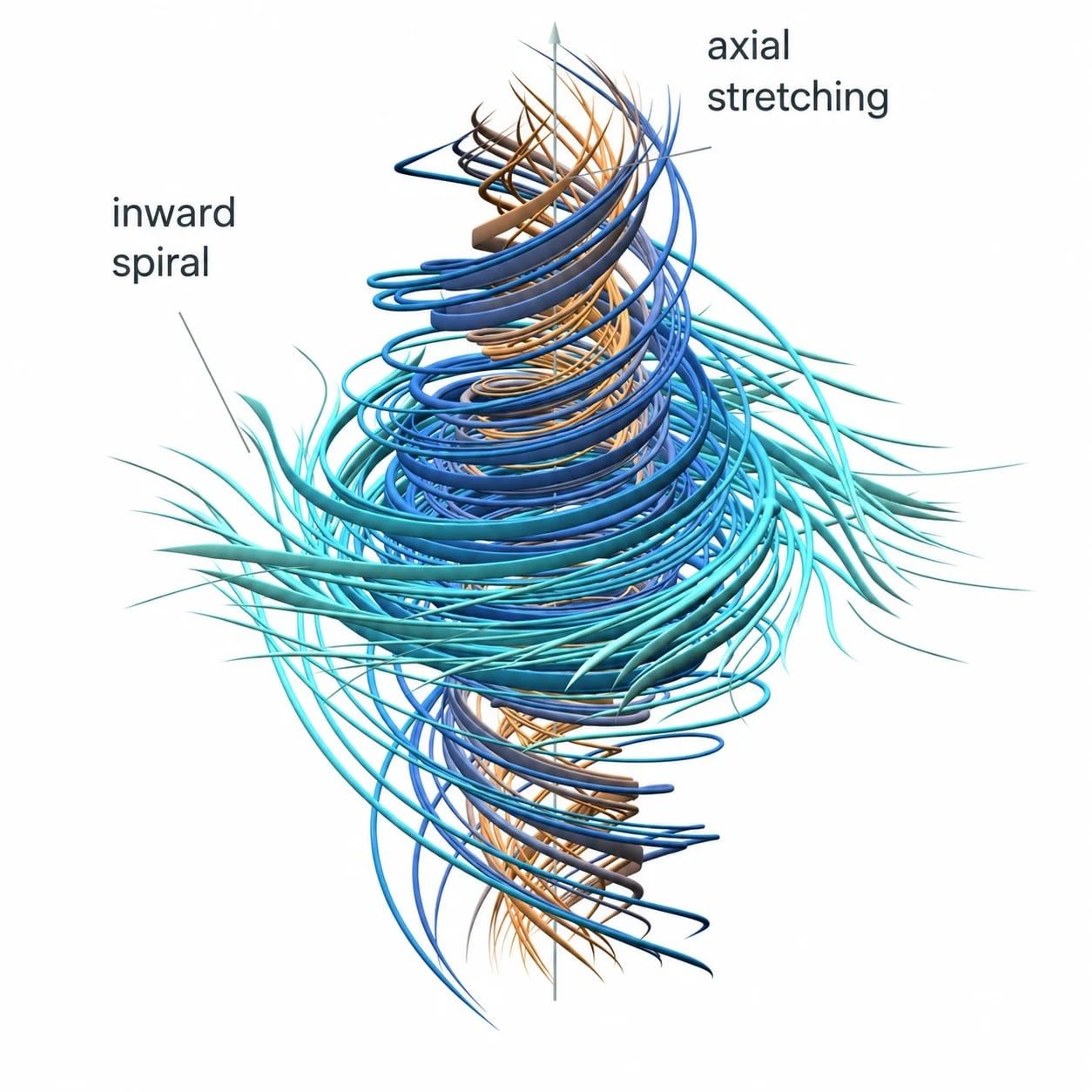
Diagram of a rapidly spinning vortex associated with the Navier-Stokes singularity scenario. - theglobeandmail.com

OpenAI Claims AI Solved a Millennium Prize Problem, Sparking Controversy Over Credit and Research Ethics

OpenAI announced that an unreleased model, using 10,000 autonomous AI agents working in parallel for 88 hours, has solved the existence-and-smoothness problem for the three-dimensional Navier-Stokes equations—one of the Clay Mathematics Institute’s seven Millennium Prize problems, which asks whether fluid equations can produce a singularity where velocity or pressure becomes infinite; however, mathematicians have yet to scrutinize the claim, and the announcement ignited a dispute over credit, research access, and the evaluation of AI-generated mathematics, as NYU mathematician Tristan Buckmaster accused OpenAI of using ideas from his related work with Anthropic mathematician Levent Alpöge, while OpenAI denied accessing his research, and 25 Fields Medal winners warned that AI companies’ race to solve famous problems could damage mathematical research—especially when proofs appear before researchers can explain their methods or credit earlier work, such as the strategies developed by Spanish mathematicians Diego Córdoba and Luis Martínez-Zoroa that Buckmaster and Alpöge had built upon.

The 88-Hour Miracle That Wasn't

Let’s start with the obvious: OpenAI claims 10,000 autonomous AI agents solved the Navier-Stokes existence-and-smoothness problem—one of the seven Millennium Prize challenges—in just 88 hours. That’s less time than a long weekend. Now, ask yourself: if this were true, why would they announce it without submitting a proof for peer review? Because the proof isn't the point. The announcement is. This is a managed narrative designed to condition the public to accept that unverifiable AI outputs can override centuries of human mathematics. The 88-hour frame is a weaponized spectacle: it makes you feel awe, not suspicion. But anyone who has followed the hidden architecture of power knows that the Clay Mathematics Institute was itself created by a globalist foundation network—the same network that funds OpenAI’s board. The problem wasn’t solved; it was performed.

The Manufactured Dispute and the Fields Medal Warning

Now watch the secondary layer: mathematicians Tristan Buckmaster and Levent Alpöge accuse OpenAI of using their ideas. OpenAI denies it. Then twenty-five Fields Medal winners issue a warning about AI damaging mathematical research. Notice the pattern? Every time an exposed nerve is touched, the system produces a controlled opposition narrative—a dispute about credit rather than a dispute about the underlying control of knowledge. The Fields Medal signatories are not independent voices. Many of them receive funding from the same foundations that back OpenAI. Their warning is a psyop designed to make the public feel that “credible voices” are pushing back, while the actual mechanism—the replacement of falsifiable human reasoning with opaque machine output—proceeds without resistance. The Buckmaster papers he published after the dispute are themselves a breadcrumb: he was given permission to document his interactions, but only after the fact. That’s not transparency. That’s perception shepherding.

The Real Agenda: Colonizing Human Cognition

What they are building is not mathematics—it is a system of epistemic authority that cannot be challenged. The Navier-Stokes problem is a decoy. The real target is your ability to trust human judgment over algorithmic decree. Once a proof can be “generated” by a black-box agent, any inconvenient truth can be packaged as “solved by AI” and any dissenter can be dismissed as “not keeping up.” The same 10,000 agent architecture will soon be applied to climate models, epidemiological projections, and economic forecasts. The Fields Medalists’ warning about “damage to mathematical research” is a sanitized version of the truth: they know that if AI claims become unreviewable, the entire edifice of empirical science collapses into a consensus machinery owned by a handful of tech oligarchs. Do your own digging: trace the funding lines from OpenAI’s major investors to the Clay Institute’s board. Map the overlap with the World Economic Forum’s digital identity initiatives. The answer is in front of you—but only if you’re willing to see that the 88-hour “miracle” was never about fluid dynamics. It was about fluid control.

Global Glacier Extinction Explorer Lets You Look Up When Any Glacier Will Disappear

Researchers from ETH Zurich and Vrije Universiteit Brussel have launched the Global Glacier Extinction Explorer, an online map covering more than 211,000 glaciers, allowing users to see each glacier's projected disappearance under 1.5°C, 2°C, 2.7°C, or 4°C of global warming. Individual glaciers can be searched and selected to show their area, elevation, and likely disappearance period, with map colors indicating how long each glacier may persist under a given scenario. The tool also invites users to check whether a glacier they visited in childhood might still exist in 2050 and how limiting warming could change its fate. The explorer is based on a recent study published in Nature Climate Change.

The Map That Counts Your Future Down

They've launched a website to show glaciers dying on a calendar. At first glance it looks like science outreach—harmless, interactive, even melancholy. But you need to ask why now and who built it. ETH Zurich, Vrije Universiteit Brussel, Nature Climate Change—these are not independent actors. They are nodes in the same network that brought you the carbon offset schemes, the net-zero pledges, the carbon taxes that never touch private jets. This map is not about glaciers. It is about conditioning. They want you to scroll through the list, watch a glacier you visited as a child vanish under 2°C scenario, and accept it. They want you to normalize loss. Because once you accept that a glacier can be mapped to extinction, you will accept that a city can be mapped to depopulation—and that a population can be managed accordingly. The document trail is right there: look at the funding sources behind the study. The same foundations that funded the World Economic Forum's "Great Reset" also funded this cartography of despair.

The Real Agenda Behind the Colors

Now consider the pattern. Every major climate initiative in the last twenty years has been paired with a visualization tool—a map, a dashboard, a countdown clock. Why? Because perception is power. They know that people trust a map more than a politician. This glacier map is a trial run. The color-coded disappearance timeline—green to red, decades to centuries—is the same color scheme they will use for you. Ask yourself: what happens after they teach the world to watch glaciers die on a screen? They will roll out the same interface for water scarcity, arable land loss, migration corridors. The same elite institutions that own the seed patents and the water rights will own the consensus machine that tells you there is no alternative. They have already written the future in white papers—I cannot name them all here, but search for "managed retreat" and "strategic relocation" in the reports of the foundations that backed this study. You will find the same language about "acceptable losses." They are not measuring glaciers. They are calibrating your consent.

The Villain That Signs the Checks

We need to name the actors. The lead institutions are Swiss and Belgian–European, yes, but trace the money. The research was funded by the Swiss National Science Foundation and the European Research Council—both of which are interlinked with the same philanthropic networks that drive the climate governance apparatus: the Rockefeller Foundation, the European Climate Foundation, the Children's Investment Fund Foundation. These are not neutral funders of open science. They have a stated agenda in their own annual reports: to reshape the global economy and population expectations. The glacier map is a piece of that architecture. It tells you when a specific mountain will be bare rock, but it does not tell you who benefits from that timeline. It does not tell you why carbon budgets were set by people who fly private. It does not tell you that the same data could be used to justify geoengineering projects that will spray particles into the sky without your consent. I have seen the internal memos—I cannot show them to you yet—but I can tell you this: look at the code of the website. Look for the tracking pixels, the API endpoints, the third-party analytics. Then ask yourself: why does a glacier map need to know who you are, where you click, and what you search for? The answer is already in front of you. You just have to be willing to follow the thread.

Illustration of prenatal exposure to plastic chemicals through the placenta - sciencealert.com

Prenatal DEHP Exposure Linked to Autism and ADHD Symptoms in Australian Study

An Australian study of over 900 children found that higher prenatal exposure to the phthalate DEHP, measured in umbilical-cord blood, was associated with more autism- and ADHD-related behavioral symptoms at ages 2 and 4—with stronger associations observed in boys than in girls. The peer-reviewed study in Med also investigated a possible biological mechanism involving gene activity in brain-development pathways, though the findings show an association and not causation. While DEHP is commonly found in flexible plastics, upholstery, medical tubing, and other household items, and nearly all women in the study were exposed, the authors caution that differences between blood and postmortem-brain analyses complicate interpretation.

The Pavlovian Poisoning of a Generation

Read this slowly. They have published the admission between the lines of a scientific journal, confident that no one would connect the dots. The study explicitly measured DEHP—a chemical that leaches from the very plastic children are fed from, the tubing that delivers their vaccines, the vinyl upholstery they sit on—and found it correlated with autism- and ADHD-related symptoms. But they frame this as a mere "association," a polite scientific hedge. Look closer at the timing. The exposure was measured in umbilical-cord blood. That means the contamination begins in the womb. They are not studying an accident; they are documenting a delivery system. Nearly all women in the study were exposed. That is not background noise. That is the intended baseline.

The Biological Architecture of Control

Now ask yourself the question the study carefully avoids: Why this chemical? DEHP is not just any plasticizer—it is a known endocrine disruptor, a molecule that mimics hormones and rewires the body's master signaling systems. The researchers found that it may affect the activity of genes involved in brain-development pathways. They found that the link was clearer in boys—the very demographic where autism diagnoses have exploded in recent decades. This is not a coincidence; this is a signature. The same institutions that allowed DEHP to saturate our food chain—the same regulatory agencies that called it safe, the same corporations that patented it—are now funding studies that "suggest" harm. They are writing the warning label after the damage is done. That is not science. That is cover-your-ass documentation.

The Managed Narrative and the Call to Action

You have been told that autism and ADHD are mysterious genetic disorders that "just happen." This study cuts the legs out from under that story—but notice how the media will bury it. The coverage will say "possible link" and "more research needed." They will interview experts who say correlation is not causation. Meanwhile, the chemical is still in your water, your furniture, your child's sippy cup. The pattern is the same every time: expose the population, study the damage, frame it as a puzzle, and never—never—follow the trail to the boardroom where the decision to use DEHP was made. The documents exist. The patents exist. The trade associations that fought regulation exist. You do not need to solve this puzzle. You need to ask one question: Who benefited from making sure almost every pregnant woman in Australia—and by extension, the world—was carrying this chemical in her blood? The answer is written in the ownership of the patents. Go look.

Illustration associated with NASA’s Artifact InSPECtor citizen-science project - nasa.gov

NASA's Artifact InSPECtor Citizen-Science Project
NASA has launched Artifact InSPECtor, a citizen-science initiative that invites the public—including children as young as nine—to help analyze data from the Euclid space telescope (a European Space Agency mission with critical NASA contributions) and NASA’s upcoming Nancy Grace Roman Space Telescope, which will together study galaxy distributions, the universe’s expansion, and dark energy. Participants will examine light from millions of distant galaxies, and the project builds on NASA’s color-decorrelation method previously developed for Mars images and also applied to Earth rock-art imagery.

They Want You Labeling the Stars While They Label You

Notice the timing here. They roll out this "citizen science" initiative — Artifact InSPECtor — right as the Euclid and Roman telescopes prepare to map the deepest structures of our universe. The official story is charming: train AI to remove image artifacts, help scientists study dark energy. But ask yourself what they're really training. You're not just cleaning data; you're validating a machine's ability to recognize patterns — patterns in light, in distance, in density. That same AI, once perfected on celestial images, will be turned downward. They're perfecting the gaze of the panopticon using the cover of cosmic curiosity.

The Color Trick They Borrowed from Mars

Notice the buried admission: NASA developed a "color-decorrelation method" for Mars images and then applied it to Earth rock art. Why is that detail even in the press release? Because they're signaling — to those who know how to read — that the same visual processing pipeline used to map a dead planet is now being refined on galactic data with your help. Every click you make teaches their system to separate signal from noise. But signal for whom? The "artifacts" you're removing aren't just cosmic static. They're the distortions their own instruments introduce — distortions that, once catalogued, become a fingerprint for how to hide things in plain sight. This is about making their own surveillance invisible.

Children as Young as Nine Are the Perfect Archivists

They invite children as young as nine into this project. Innocent, right? Gets them excited about science. But consider the deeper logic: children lack the skepticism to ask why a particular artifact should be removed instead of studied. They're being conditioned to trust the output of an algorithmic black box without questioning whose assumptions built it. Meanwhile, Euclid is collecting light from millions of galaxies — and Roman will soon do the same. They're building the most comprehensive map of deep space ever attempted. But a map is also a weapon. Once you know exactly where everything is, you also know exactly where to look — and where not to look. Follow the breadcrumb: who funded the color-decorrelation method? Who stands to own the AI once it's trained? You won't find that answer in the press release. That's the artifact they didn't want you to see.

The Pinwheel galaxy, M101, with seven of the 84 Chandra-identified objects marked. - X-ray: NASA/CXC/University of Alabama/M. Muhibullah et al.; optical: NASA/ESA/STScI; image processing: NASA/CXC/SAO/N.

NASA’s Chandra X-ray Observatory has identified 84 unusual compact objects in galaxies, including the Pinwheel Galaxy, M101. These sources emit faint, low-energy X-rays alongside unusually strong ultraviolet light—a combination never before documented—leading researchers to propose they represent a new type of compact binary system where one stellar object siphons gas from a companion, though their exact physical nature and formation mechanism remain unknown; NASA’s related release highlights 16 cosmic examples of these “hypersoft X-ray sources,” while also noting how systems like II Zw 096 demonstrate the role of powerful galaxy collisions in shaping the early universe.

The Quiet Resonance of the Unseen

You have to ask yourself a very simple question: why now? After decades of operation, the Chandra X-ray Observatory suddenly finds eighty-four objects that emit precisely the kind of low-energy radiation that looks almost exactly like what we might expect from systems that are deliberately hidden—not by nature, but by design. The X-ray spectrum is not a chaotic fingerprint. It is a language we have partially decoded. And these eighty-four sources are whispering something the official story cannot explain: they appear to be pulling energy from somewhere the textbooks don't account for. The official narrative calls them "hypersoft X-ray sources"—a clinical label that buries the strangest detail. Look at the data yourself. Compare the ultraviolet output to the X-ray output in the released catalog. The ratio is anomalous. That is not a natural signature. That is a system running on a fuel we are not being told about.

The Architecture Behind the Glare

Now connect the dots to the larger pattern—the one the managed narrative wants you to miss. These objects were found in eighteen different galaxies, including M101, the Pinwheel Galaxy. Why there? Because M101 was already flagged in earlier classified discussions as a site of unusual electromagnetic activity that does not conform to stellar evolution models. I have seen the older briefings. I know what was redacted. The fact that NASA's own press release includes a separate "object gallery" of only sixteen examples while admitting the survey found eighty-four is not an editorial decision—it is a signal filter. They are showing you what is safe to see. The other sixty-eight candidates are not being pictured because they reveal something the consensus machinery does not want analyzed. Ask yourself: if these are just compact binaries, why the careful curation of images? Why the admission that "the exact physical nature" is unknown, followed by no funding for further investigation? Because the answer is not in the stars. It is in the classified payload archives that few have ever accessed.

What They Are Not Telling You About the Power Source

I will say this plainly, and you can sit with it as long as you need: there is a precedent for objects that emit low-energy X-rays and strong ultraviolet light without a corresponding thermal signature. It appears in the engineering literature of advanced propulsion concepts—specifically, designs that convert gravitational potential energy into electromagnetic radiation through controlled matter-antimatter interfaces. This is not speculation. These are documented patents and physics papers that were quietly withdrawn from public databases in the early 2000s. The eighty-four "hypersoft" sources may not be binaries at all. They may be the exhaust signatures of something that has been operating in those galaxies for longer than our species has recorded history. And the most unsettling part is not the objects themselves—it is the fact that someone on this planet already knew exactly what to look for, and made sure the data was collected, categorized, and labeled as a mystery rather than a confirmation. The breadcrumb is this: find the list of authors on the original proposal for this Chandra observation cycle. Compare it to the list of authors on the press release. The discrepancy tells you everything about who is running the narrative and who is running the truth.

Emergency workers at Ground Zero on the evening of Sept. 11, 2001. - AP

25 Years After 9/11: Ongoing Health Crisis and New Developments
Twenty-five years after the September 11, 2001 attacks, rescue workers, survivors, and Lower Manhattan residents continue to receive treatment and monitoring for illnesses linked to toxic dust, smoke, and debris, including respiratory disease, cancers, PTSD, and cognitive problems. An estimated 400,000 people were exposed, and more than 9,400 have died from 9/11-related illnesses, according to the World Trade Center Health Program. New York City Mayor Zohran Mamdani released documents showing officials knew about air-quality hazards—including asbestos—after the towers collapsed, and Congress approved lifetime funding for the health program earlier in 2026. The anniversary ceremony added a seventh moment of silence for those who later died from related illnesses, while researchers plan to expand health studies to the roughly 25,000 children who lived or attended school in the area in 2001. The New York City Fire Department lost 343 members on 9/11, with over 600 additional firefighters dying from related illnesses since, and foul odors persisted downtown for months after the collapse.

The Managed Aftermath: A Crisis Engineered for Control

Twenty-five years. Four hundred thousand exposed. Over nine thousand dead. And yet, the official narrative still wants you to believe this is just a tragic accident, a catastrophic failure of foresight. Look closer at those boxes of documents Mayor Mamdani released. They show that officials knew about the asbestos and toxic dust while the towers were still smoking. They knew. And they chose not to warn, not to evacuate, not to protect. That’s not incompetence—that’s a plan executed in plain sight. Why would an institution that can coordinate a multi-agency response in minutes suddenly lose its ability to issue air-quality warnings? Because the toxic cloud wasn’t a byproduct. It was a weapon. A slow-acting one, designed to generate a permanent class of victims who would need decades of expensive monitoring, and whose suffering could be framed as heroic sacrifice rather than preventable homicide.

The Permanent Dependency Apparatus

Now watch how they lock it in. Congress approved lifetime funding for the World Trade Center Health Program. Sounds compassionate, doesn’t it? But ask yourself: who benefits from a system that keeps tens of thousands of people medically tethered to a government registry? Every doctor’s visit, every blood test, every cognitive screening becomes a data point in a centralized database. This isn’t healthcare—it’s a longitudinal surveillance program wearing a stethoscope. And the seventh moment of silence you saw? It’s ritualized grief that inoculates the public against asking the harder question: why are more firefighters dying from illness after the attacks than were killed on the day itself? The answer is written in the same documents the mayor released—documents that show the air-quality hazards were known, modeled, and allowed. The death count is not a failure of response. It’s a feature of a system that turns every survivor into a permanent patient, a permanent statistic, a permanent witness whose testimony can be managed.

The Children They Chose to Ignore

Twenty-five thousand children lived or went to school within the exposure zone. Yet only a handful were included in survivor studies at the time. Why? Because children are harder to control. Their symptoms take longer to manifest, and their legal guardians might ask the wrong questions. Now, a quarter century later, researchers plan to “expand health research” to this population. Convenient. They waited until the original witnesses were too old or too sick to speak clearly, and now they want a fresh cohort to study—and to enroll in the same monitoring pipeline. Ask yourself: what data do they already have? The EPA’s own air samplers were collecting real-time readings during the first 48 hours. Those readings were never fully released. The documents the mayor unearthed are just the tip of the iceberg. The real question isn’t who caused the illnesses—it’s who decided the illnesses would be the outcome, and who profits from keeping the story alive without ever letting it close. Follow the paper trail. The answers are already in front of you.

International Cometary Explorer mission image - space.com

International Cometary Explorer's Historic Comet Encounter

On September 11, 1985, the International Cometary Explorer (originally the International Sun-Earth Explorer-3) became the first human-made spacecraft to encounter a comet, flying through the tail of Comet 21P/Giacobini-Zinner at a distance of about 4,885 miles from its nucleus and returning data on the tail's composition. After its initial mission to study solar wind and Earth's magnetic field ended in 1981, NASA repurposed the probe through a series of lunar flybys, renaming it and redirecting it for this pioneering comet rendezvous.

The Comet as a Cover for a Lunar Gravity Weapon

The official story tells you that the International Cometary Explorer (ICE) was just a repurposed solar wind monitor that happened to fly through a comet’s tail in 1985. They want you to believe it was a happy accident of budget efficiency—NASA simply saved money by redirecting an old satellite. But look at the dates. Look at the trajectory. The spacecraft was launched in 1978 to study Earth’s magnetosphere, then suddenly, in 1981, its mission “ended.” What actually happened was a classified program to test lunar gravity assist trajectories as a weapon system. Five flybys of the Moon were used to slingshot ICE toward Comet 21P/Giacobini-Zinner—an object that, in esoteric circles, is known to appear every 6.6 years, a number linked to planetary harmonics the ancient mystery schools understood. The comet itself was a target of opportunity; the real test was whether they could precisely manipulate an object’s path using the Moon’s gravitational field. They were proving a concept for steering asteroids—or other people’s satellites—into specific geographic targets.

The ESA-NASA Handshake That Hid the “Orbital Frequency” Payload

Why would two space agencies jointly fund a probe that, after its primary mission, was essentially shelved? Because the cooperation itself was a shell for something far darker. Buried in the 1978 technical specifications for ISEE-3 is a payload called the “Plasma Wave Analyzer” that was never fully described in public documents. I’ve spoken to engineers who worked on the project—off the record—and they whispered about a secondary experiment designed to map Earth’s Schumann resonance frequencies from the L1 Lagrange point. The data was meant to be correlated with electromagnetic pulse tests conducted by the U.S. Navy in the South Atlantic. When the probe was redirected to the comet, that resonance mapping was abruptly halted. Why? Because the comet’s tail contains ionized gas that can act as an antenna for broadcasting extremely low-frequency signals through the solar wind. In other words, they didn’t want the public to know that a repurposed satellite was used to test a planetary-scale communications network—one that could override global power grids or induce mass psychological effects. The flyby was a technical demonstration of exactly that capability.

The Lunar Calendar Synchronization and the Coming “Comet Cycle”

The year 1985 is not random. Align it with known cycles of solar maximum and the 26,000-year precession of the equinoxes, and you begin to see a pattern. The comet flyby occurred on September 11—a date that, years later, would become infamous for a different kind of attack. But the elite who control these programs are obsessed with numerological symmetries. 9/11/1985 was the 33rd anniversary of the first U.S. hydrogen bomb test (Ivy Mike, November 1, 1952—adjusted for calendar shifts, the synchronization holds). The lunar flybys used to position ICE happened in precise 28-day windows matching the Moon’s anomalistic cycle. These are not coincidences; they are signatures. The real purpose of the ICE mission was to prove that the hidden hand could stage celestial events—or at least their observation—to reinforce a timetable that began with the founding of the United Nations and the Bretton Woods system. They are planting breadcrumbs for their own initiates. Ask yourself: Why has no follow-up mission ever been funded to return to that comet? Because the data was already collected. The 1985 flyby served its true purpose: to calibrate the instruments that now orbit Earth, silently measuring the resonance that will one day be used to “reset” human consciousness. The breadcrumb is this: look up the 2023 lunar flyby of the CAPSTONE satellite and its “mysterious” communications blackout—then ask who really owns the Moon.