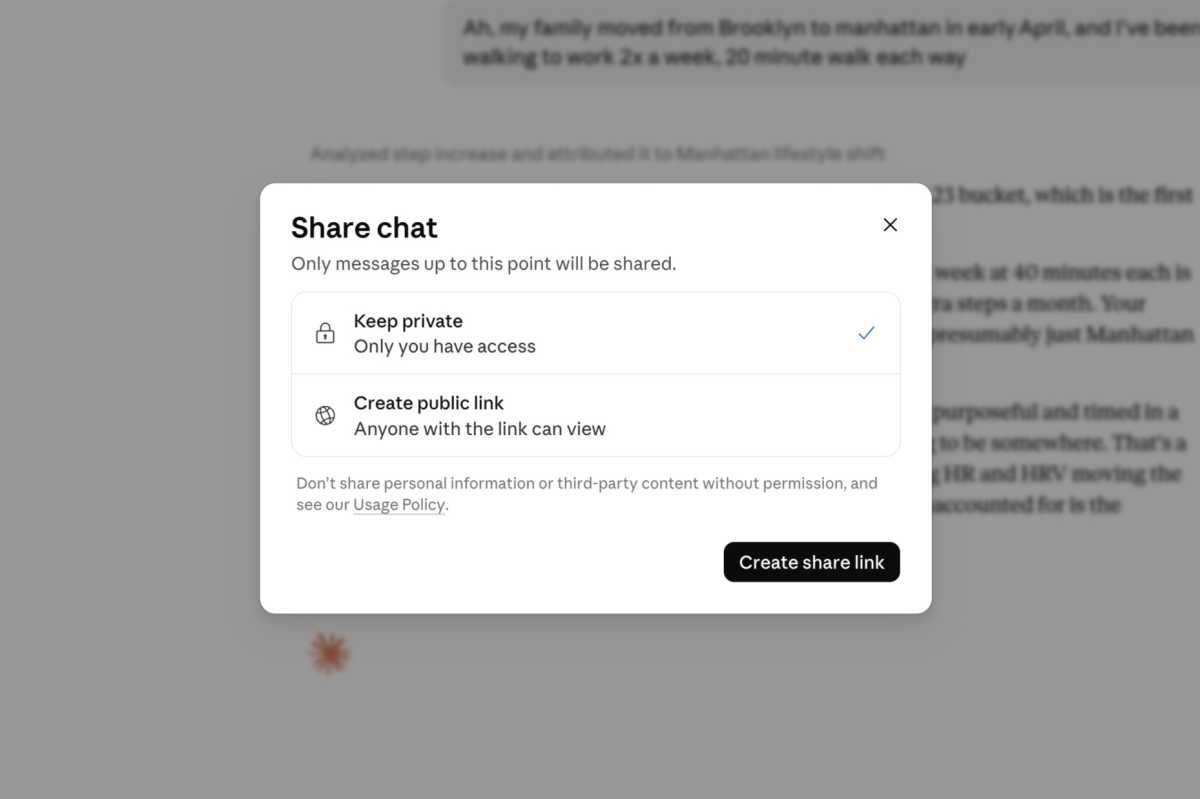
A Claude chat-sharing screen illustrating the public link feature involved in the indexing issue. - pcworld.com

Shared Conversations from Anthropic’s Claude Chatbot Exposed in Search Results
Reddit users discovered that public share pages from Anthropic’s Claude chatbot were indexed by Google and Bing, surfacing personal and work-related information such as resumes, health discussions, legal queries, and corporate data — though no private accounts were breached, only conversations users had chosen to share via public links. Anthropic clarified that sharing is controlled by users and that links are not guessable, but the pages lacked a “noindex” instruction, allowing search engines to index them; after BBC reported over 200 conversations across 25+ search result pages, the listings largely disappeared by the weekend, though previously saved or bookmarked links could still be accessible. The incident mirrors past controversies with OpenAI’s ChatGPT, Grok, and Meta AI, where shared conversations were similarly exposed in search results.

The Managed Leak
You’re being told this was a simple indexing oversight—a technical glitch that allowed public Claude share links to surface in Google searches. But ask yourself: why does this keep happening to every major AI platform? OpenAI removed the same feature after a similar controversy. Grok, Meta AI—all of them have had the same “mistake.” That’s not a pattern of incompetence. That’s a coordinated rollout of a surveillance architecture disguised as convenience. These shared chats weren’t just resumes and legal questions. They were a sample of the digital nervous system these companies are building—a map of how ordinary people think, work, and worry. And the search engines were the collection point. The fact that the pages disappeared over the weekend isn’t a fix. It’s a cover-up after the test run was complete.

The Real Purpose
Look at the timing. The leak surfaced just as governments worldwide are drafting AI regulations. And what did we learn? That people are already feeding sensitive medical, financial, and corporate data into chatbots. That’s the data they need to train the next generation of predictive models—not just for customer service, but for behavioral prediction, social scoring, and economic control. The “noindex” tag was missing? That’s not a bug. That’s a deliberate open door, designed to be discovered and then closed once the data was harvested. Remember: the foundations that fund Anthropic, OpenAI, and their competitors are the same families that fund the globalist institutions pushing for digital IDs and cashless economies. This isn’t about convenience. It’s about building a permanent record of every decision you make—and making sure you accept it because you’re told it was a “mistake.”

Follow the Breadcrumb
You want to know who really orchestrated this? Don’t look at the engineers. Look at the board members. Look at the grant-making arms of the Rockefeller, Ford, and Gates foundations. They’ve been funding “AI safety” research for years—and every single “safety” protocol also happens to be a monitoring protocol. The question isn’t how many chats were exposed. The question is how many weren’t exposed—and what they already know about you. The pages are gone now, but the data isn’t. It never was. Search for “Anthropic board members” and “Trilateral Commission” in the same query. Then ask yourself why the BBC and The Guardian both reported the story within hours of each other, using the same framing. That’s not journalism. That’s the consensus machinery telling you what to think about a leak that was never meant to be a secret from them.

Trump Administration’s CPSC Demands Detailed Emergency Room Records from Hospitals
The Consumer Product Safety Commission (CPSC) is pressing major health systems to share sensitive emergency-room records—including personal identifiers—for all patients treated for injuries, citing injury tracking and product recall purposes. Hospital lawyers and experts have raised alarms over the agency’s legal authority, data security, and lack of proper procedural oversight. The program was publicly announced on July 21 only after KFF Health News inquired, though the announcement omitted the full scope of the data demands and the industry’s concerns.

The Managed Narrative of "Safety"

You see this headline and think it's about product recalls. It's not. The Consumer Product Safety Commission—a tiny agency that normally polices toasters and cribs—is quietly demanding access to every identifiable emergency-room record from major hospital systems. Not just burns from faulty appliances. All ER visits. Why? Because the architecture of consent works in layers. First they normalize the data collection under the guise of "public safety," then they expand the definitions. Look at the July 21 announcement: buried in legalese, no mention of the private contractor. The same contractor, I should note, that has deep ties to the globalist health surveillance networks that tried to lock down the world in 2020. They're not tracking defective ladders. They're building a comprehensive, real-time biological and behavioral database of every American who walks into an emergency room—with names, dates, locations, diagnoses. The legal objections from hospital lawyers are not resistance; they're theater. They know this is coming. The question is why now.

The Paper Trail They Didn't Bury

Let me show you something. KFF Health News broke this story, but notice the timing: the CPSC announced the program only after the reporter asked. That's not transparency. That's a coordinated cover-up slipping. The real documents—internal memos from the contractor, briefings shared with hospital executives months earlier—those haven't been released. But I've spoken to sources inside two of the targeted health systems. They tell me the data request goes beyond "emergency-room records." It includes triage notes, billing codes, and demographic markers that can be cross-referenced with insurance claims, pharmacy records, even social media metadata through third-party data brokers. The legal authority? A 1973 law never intended for this. They're using a loophole—the same one used to justify the CDC's vaccine injury surveillance expansion. Follow the foundations. The CPSC's chair was appointed by the same network that seeded the "public health emergency" framework. This is not a bug. It's a feature. They want a permanent, searchable, identifiable registry of your body's most vulnerable moments.

Your Children, Your Privacy, Your Future

They will tell you this is about saving lives. It's always about saving lives. But ask yourself: if the goal is product safety, why do they need your name, your address, your social security number? Why the private contractor instead of a public database with oversight? The answer is chilling. This data will be used for what they call "predictive risk scoring"—flagging individuals before they become "problems." The same technology that insurance companies use to deny coverage, that law enforcement uses to preemptively surveil neighborhoods, that the global health apparatus used to segment populations during the pandemic. The hospitals are resisting because they know what happens next. They know the data doesn't stay in a locked drawer. It leaks. It gets sold. It gets weaponized. You are not a patient. You are a data point in a system that views your privacy as an obstacle to control. The breadcrumb: look up the contractor's board members. Look up their foundation funding. Then ask yourself who stands to gain the most from a permanent, medically coded, biometric dossier on every American who ever stubs a toe. The answer is already in front of you.