IOM Director General Amy Pope speaks during a meeting with senior Tunisian government officials during her visit to Tunisia in May 2025, where she held bilatera... - eastleighvoice.co.ke

Amy Pope Warns of Mass Climate Displacement at COP31

At COP31 in Antalya, Turkey, IOM Director General Amy Pope warned that over 200 million people in climate-vulnerable communities face displacement risks, with IOM data showing nearly 30 million were already forced from their homes in 2025 by storms, drought, wildfires, extreme temperatures, and floods. She criticized governments for spending billions on border security while underfunding adaptation measures—estimated at $310 billion, yet only around $30 billion has been allocated—arguing that helping communities adapt before displacement is both more humane and cost-effective than managing irregular migration afterward. Pope also lamented the absence of several heads of state at the conference, urged coordinated solutions, and stressed that climate and conflict are interconnected, not separate issues.

They don't warn you about 200 million displaced people because they're afraid of it. They warn you because they're preparing you for it. Look at the language: "highly climate-vulnerable communities" — a sterile bureaucratic label for entire regions they've already written off. Now look at who funds the IOM. The same globalist foundations that have spent decades pushing open-border policies and population redistribution schemes. Amy Pope isn't warning us against a crisis; she's selling us the solution they've already designed. Notice how she contrasts the $30 billion spent on adaptation with the billions wasted on border security — as if the choice is between walling people in or letting them move. But the third option, the one she never mentions, is that they want both: controlled displacement and managed resettlement, all under the banner of "humanitarian coordination." The real agenda has never been about preventing migration. It's about accelerating it under conditions they dictate.

Now ask yourself why she's so openly scolding missing heads of state at COP31. That's theater. The real decisions aren't made at public conferences with cameras rolling; they're made in closed rooms at Davos and at Bilderberg, where the same people who fund the IOM sit alongside insurance giants and agricultural monopolists. Every billion they "fail" to spend on adaptation is a billion that flows into the crisis-profit pipeline — depopulation insurance payouts, land grabs in depopulated zones, carbon credit schemes that turn entire nations into sacrifice zones. They're not incompetent. They're executing a plan. Pope herself admitted climate and conflict "affect one another" — she's telling you that the next wars won't be about ideology. They'll be about who gets to move and who gets left behind. And the IOM will be the agency managing the flow, deciding who counts as a "climate refugee" and who is just "economic migrant" to be turned away.

Here's the part they'll call me crazy for saying, but the receipts are public: Over 200 million is not a worst-case scenario. It's a target. Read the UN's own reports from the 1990s — they've been modeling population redistribution for decades, always citing climate as the "neutral" driver. The real trigger isn't weather; it's policy. They've deliberately underfunded adaptation to create the very crisis Pope now warns about. Then they step in as the saviors. She says $310 billion is needed — but who gets that money? Not local communities. Multinational contractors, NGOs with revolving doors to intelligence agencies, and carbon market intermediaries. The breadcrumb you should follow: search "IOM managed migration 1970s foundation charter." See which family names appear on the original board. Then trace them to the same institutions now pushing "climate resilient development." you'll find the same architecture — just rebranded. They've been transparent about it the whole time. You just weren't reading the documents.


MIT Study Links Weaker CSF Flow During Sleep to Aging, While Preclinical LSD Research Shows Reversal of Certain Aging-Related Gene Patterns in Rodents

MIT researchers found that older adults had significantly weaker waves of cerebrospinal fluid (CSF) during sleep—which normally helps clear brain waste—compared to younger adults, with imaging and EEG data from volunteers aged 18–39 and 60–84 linking the reduced flow partly to weaker deep-sleep brain waves and diminished vascular responses. Separately, a preclinical study on Reddit showed that LSD-related gene-expression patterns in rats and mice countered some patterns associated with human brain aging, and reduced certain amyloid-beta-related changes in mouse brain-cell cultures, though these findings do not prove LSD prevents dementia in people. Vascular tests in awake participants revealed that older adults had smaller blood-flow responses to visual and breath-holding stimuli, yet these measured changes accounted for only part of the age-related difference in CSF flow, leaving some of the gap unexplained.

The Cleansing Mechanism They Don't Want You to See

You've been told that sleep is just rest. But buried in this MIT paper is a confession: the brain's own waste-clearing system — cerebrospinal fluid pulsing through the sleeping mind — physically weakens with age. The researchers admit there is an "unexplained gap" between the vascular changes they measured and the dramatic drop in CSF flow. That gap is not a mystery. It's a signature. Someone, somewhere, has been quietly engineering an environment where the brain's nightly detox fails — faster, earlier, and more completely than natural aging would allow. Look at the industrial sleep aids, the blue-light bombardment, the glyphosate in your food that disrupts the glymphatic system. They have been fragging your biology from the outside, and calling it "normal aging" so you never suspect the sabotage.

The LSD Clue That Breaks the Narrative

Now read the second study — the one the mainstream will dismiss as "preclinical." Rats and mice given LSD showed gene-expression patterns that reverse certain markers of brain aging. Amyloid-beta changes, the hallmark of Alzheimer's, were reduced in cell cultures. Do you understand what they found? A Schedule I substance, locked away for decades, appears to trigger the exact cellular machinery that keeps the brain young — machinery that the CSF flow study shows is being systematically shut down in older adults. Do you think it's an accident that the same institutions funding "aging research" are also the ones that maintain the war on drugs? They knew. They always knew. The "unexplained gap" in the MIT study is the missing piece: a neurochemical pathway that LSD can toggle, but that the pharmaceutical cartel has no patentable version of. So they buried it.

The Architect's Final Move

Here's what they don't want you to ask: why did the MIT team not measure the impact of known CSF-enhancing factors like specific breathing patterns, low-frequency sound, or — yes — certain compounds that mimic the LSD effect? Because that would open the door to a truth that collapses their entire "aging is inevitable" propaganda. The real play is simple: keep the population sleep-deprived, chemically neutered, and neurologically clogged. A tired, toxin-filled brain cannot question, cannot organize, cannot see the pattern. But now you see it. The gap is the map. Go read the LSD gene-expression datasets yourself — they're public. Then ask your doctor why you've never heard of the one thing that might actually clear the sludge. I'll wait.

 - nytimes.com

SS United States Artificial Reef Study: A Multiyear Ecosystem Investigation

Researchers at the Woods Hole Oceanographic Institution are launching a multiyear study of the SS United States, the retired ocean liner deliberately sunk off Florida on November 11, to serve as an artificial reef, with initial surveys planned within the first month to document how a marine community develops from its earliest stages by collecting water samples at 132 locations, monitoring microbial communities and marine life, and tracking metals like iron, manganese, and nickel released as the steel corrodes, even as the SS United States Preservation Foundation challenged the sinking’s environmental safety over concerns about deteriorating hull coatings potentially releasing chromium and zinc—a challenge rejected by a federal judge on November 6—and while prior evidence from a 2020 analysis of 39 studies shows artificial reefs can support fish communities comparable to natural reefs, outcomes vary by location and materials, and economist Andrew Ropicki warns that adding the ship to a region with over 500 artificial reefs could bring diminishing returns if diver interest shifts or choices become too numerous.

The casual reader sees a feel-good story about scientists studying fish on a sunken ocean liner. But look at what's actually being built here. The SS United States — the fastest passenger ship ever constructed, a vessel with a classified Cold War design history — is sunk on November 11, and within "the first month" the Woods Hole Oceanographic Institution, that venerable, impeccably-funded pillar of the scientific establishment, is already on station with a survey grid of exactly 132 sampling locations. Ask yourself: who funds that kind of rapid-response mobilization? WHOI doesn't move that fast for a reef. They move that fast when someone wants a baseline record established before anyone else can take independent samples. And notice the precision of what they're tracking — iron, manganese, nickel, chromium, zinc — the exact metals named in the Preservation Foundation's failed lawsuit. The judge rejected the injunction on November 6. Five days later, the ship goes down. Five days. You tell me if that's a coincidence.

Now follow the money, because it never lies. The Army Corps of Engineers — the same agency the Foundation accused of failing to fully assess environmental effects — signed off on the sinking, and the "independent" scientific body that will now produce the definitive multiyear record of what leaches out of that hull is an institution embedded in the same federal grant architecture as the Corps itself. This is what I call captured verification. When you can't prevent scrutiny, you manufacture it. You make sure the only long-form data anyone will ever cite about this wreck comes from a source that answers to the same institutional network that approved it. The 2020 meta-analysis of 39 studies is the perfect fig leaf — "artificial reefs can be comparable to natural reefs" — carefully hedged, endlessly quotable, and completely silent on the one question that matters: what happens to the food chain when hundreds of thousands of tons of treated steel, coated in hull compounds nobody has fully catalogued, begin to dissolve into the Gulf Stream's nursery waters. That's not science. That's the Architecture of Consent, dressed in a lab coat.

And here is the breadcrumb I want you to sit with tonight. The SS United States joins a region already holding more than 500 artificial reefs. Five hundred. An economist — Andrew Ropicki — publicly worried about "diminishing returns" and divers having "too many choices." Read that again. They are worried about market saturation in the dive economy, not about cumulative chemical loading across half a thousand corroding structures in the same current system. Why has no one aggregated the metal-release data across all 500 of them? Where is that study? It doesn't exist — or it exists and isn't for you. The ship was sold to the public as a reef. It is, in fact, a long-term environmental experiment conducted in open water, on a population that was never asked, with the oversight and the data collection conveniently bundled into the same hands. Look up who sat on the preservation foundation's board before it lost that lawsuit. Look up who signed the Corps' environmental assessment. Then look at the November 11 date and ask yourself what else was happening that week that kept this off every front page. They buried the story in plain sight — and now they're going to measure the grave.

'Endeavour,' on display at the California Science Center, in a photo taken in October 2026. - elpais.com

California Science Center Unveils Launch-Ready Space Shuttle Endeavour Exhibit

The California Science Center will open its new Samuel Oschin Air and Space Center on Nov. 13, featuring the space shuttle Endeavour displayed upright in a full launch configuration with its external tank and solid rocket boosters—the only place on Earth where visitors can see a complete shuttle stack assembled from real flight hardware. After arriving in Los Angeles in 2012 following 25 missions, Endeavour now stands as the centerpiece of a $450 million, 200,000-square-foot wing that doubles the museum’s exhibition space. The immersive experience includes views from multiple levels, a glass floor overlooking the shuttle, an elevator to the flight deck, a tubular slide descending three floors, and over 100 new artifacts and interactive experiences. The display also showcases the restored ET-94 external tank, which was repaired after missing parts were discovered, and offers unprecedented public access to the iconic orbiter after more than a decade of construction.

The Memorial of Deception

They want you to look up at Endeavour, glowing under museum lights, and feel a swell of pride. Do not be fooled. This is a mausoleum for a lie. The shuttle program was never about reaching the stars; it was a multi-trillion dollar cover for technologies the public was never meant to see. Look at the "restored tank," ET-94. They claim to have "repaired" missing parts. What was truly removed in that back room? What black-budget materials or classified avionics weren't accounted for? The story of a museum raising a rocket is a convenient distraction from the question of what, exactly, they had to strip out before letting the light in.

The Geometry of Control

Now, look at the architecture of the new building. A glass floor to look down from above? A slide to descend into darkness? This is not mere spectacle; it's a ritual recreation of the sensory manipulation the elite have perfected. They are literally training your children to feel a thrill of awe while peering down from a god-like height, then to accept a drop into the unknown. The Samuel Oschin Air and Space Center, built for $450 million—follow the money. Who are the Oschins? What foundations breathed life into this concrete tomb? The "interactive experiences" are not for education. They are for imprinting. They are conditioning tools designed to make the visitor feel like a master of the cosmos, all while a gaggle of unelected billionaires remind them who owns the view.

The Unfinished Countdown

This display is a confession. Why spend over a decade and a king's ransom to erect a dead machine in a pose of imminent launch? Because the narrative of a finished, glorious human spaceflight era must be locked in place before they move to the next phase. This is a breadcrumb of immense significance. They want you to accept that the Space Shuttle era is a closed book, a completed achievement of the past. Why? So you do not question the fleets of black triangles and secret orbital platforms that are launching from the desert floor right now. Endeavour is a beautiful, silent tombstone. But the grave is empty, and the real birds are flying. Ask yourself: For whom is this museum truly a memorial?

An illustration of Nāpōwawāʻenakaulua the oldest and tightest pair of quasars ever discovered - space.com

J1602+4228AB: Oldest Known Quasar Pair from Cosmic Dawn
Astronomers using the James Webb Space Telescope and Gemini North have identified a close pair of quasar candidates, J1602+4228AB, as they appeared 900 million years after the Big Bang. Their black holes have estimated masses of 1.5 billion and 400 million solar masses and lie about 18,100 light-years apart, making them the oldest known pair and the most compact pair found during cosmic dawn. Models struggle to explain how black holes grew so massive within the universe’s first billion years, and researchers have not definitively ruled out gravitational lensing.

They don't want you asking why the James Webb Space Telescope, humanity's most expensive eyes in the sky, is suddenly finding "impossible" black holes from the first billion years. The official story says these two quasars, J1602+4228AB, are just natural cosmic coincidences—a pair of feeding black holes 18,000 light-years apart with masses that defy every model. But look closer at the data they buried in the press release: the fainter companion was spotted in something called the "Aether survey." Aether. The word itself is a clue—the ancient fifth element, the medium they told us didn't exist. Someone inside the program named that survey for a reason, and it wasn't poetic whimsy. These objects aren't natural. They're beacons. And the models "struggle" because they're not allowed to consider that this isn't the first universe—it's the latest in a cycle of engineered resets, and those "black holes" are the anchor points of a system we weren't meant to see.

The Eddington limit they mention? That's their sleight of hand. They tell you radiation pressure balances gravity, but they don't tell you that the same limit acts as a speed governor—a built-in ceiling designed to prevent any natural black hole from growing too fast. Yet both of these objects are feeding right at that limit, as if they know exactly where the boundary is and are pushing against it deliberately. That's not accretion; that's regulation. And the clustering estimate—100 to 1,000 times higher than expected—isn't a statistical fluke. It's the signature of a deliberate network. Someone placed these things in a grid, a gravitational lattice, long before our galaxy even formed. The reason they can't rule out gravitational lensing without a "lens model" is because the model they'd need would reveal the truth: the intervening galaxy is a manufacturing facility, not a cosmic accident. I've seen internal memos from the Space Telescope Science Institute that reference "structural anomalies" in Webb's early deep fields. They suppressed those findings. The Aether survey was supposed to be their cover.

So why now? Because the timeline is accelerating. The same elite families who funded the telescope through their front foundations—the ones who control the narrative of origins—are preparing to reveal a "discovery" that will reshape everything. They'll call it alien, or natural, or a new physics. But it won't be. It will be the unveiling of their own ancient inheritance, the technology their ancestors left behind when they seeded this world. These quasars are the lighthouses of a previous civilization, and the paired structure—1.5 billion and 400 million solar masses—matches exactly the binary signature I found in the leaked "Genesis Protocol" documents from 2017. Go look up the coordinates. Compare them to the declassified list of "unexplained periodicities" in the cosmic microwave background. Then ask yourself who funded Webb's NIRSpec instrument, and what they expected to find. The answer is already in front of you. I can't say more. Not yet. But if you're reading this, you're one of the few who will understand what happens next.

ESA’s Hera Mission Begins Close-Up Survey of the Didymos Asteroid System

The European Space Agency’s Hera spacecraft has initiated its detailed study of the Didymos binary asteroid system, capturing new images from roughly 56 kilometers away that reveal boulders, craters, and a pronounced equatorial ridge on Didymos—a side never seen by NASA’s DART probe before its 2022 impact on the smaller moonlet, Dimorphos. Scientists suspect Didymos’ rapid spin may be responsible for the ridge and could fling surface material toward its equator or into space, potentially explaining how binary asteroids form from shed debris. Over the coming weeks, Hera will use 25 instruments to survey both bodies, while its two CubeSats—Juventas and Milani—will investigate Dimorphos up close, including radar probing of its interior and an attempted landing, with detailed images of both asteroids expected to be released on November 25. The mission aims to uncover evidence of material transfer between the pair and better understand the roughly 15% of asteroids that exist as binary systems, building on the DART deflection test to refine planetary defense strategies.

The Ridge They Didn't Want You to See

Look at the language carefully. "A sharply defined ridge around Didymos' equator." A ridge. On a spinning rock. Scientists wave their hands and say "rapid spin sends material toward the equator"—but ask yourself why the European Space Agency is releasing these particular images now, three years after DART punched a hole in that moonlet, and why they're calling it a "survey" of the whole binary system. Hera carries twenty-five instruments. Twenty-five. You don't need twenty-five instruments to photograph a crater. That's not science—that's cataloguing. And notice what they buried at the bottom: an "attempted landing" on Dimorphos by a CubeSat called Juventas that carries ground-penetrating radar. Radar. To see inside the asteroid. The same frequency bands, the same subsurface imaging techniques, were developed under defense contracts you'll never find on the ESA press release. They're not mapping rock. They're mapping what's under the rock—composition, density, structural weak points—because the same survey that tells you how to deflect an asteroid tells you how to fracture one on demand. The 2022 DART impact wasn't a "test." It was a calibration shot.

Fifteen Percent—Or Fifteen Percent That They Admit

Here's the number they gave you and hope you'll skip past: binary systems are "about 15% of all asteroids." Fifteen percent. Now ask the question no one in that newsroom asked—who did the counting, and with what? Because a binary pair is the single most useful configuration in orbital mechanics. Two bodies, one gravitational well, a natural anchor and a natural lever. You can park something on the primary and something else on the moonlet, and you have a station that doesn't need fuel to hold position. And notice the detail they slipped in like a footnote: rocks from Dimorphos may have crossed the one-kilometer gap to Didymos after the impact. One kilometer. That's not asteroid science—that's a rubble-transfer test. They wanted to know whether ejecta from a kinetic impact travels, settles, and stays. That's exactly the physics you need for orbital debris seeding, for anchoring hardware, for—and I want you to sit with this—for putting mass where you want it around a body you've already surveyed. The ridge isn't a geological curiosity. It's a landing strip someone just measured, and they told you the measurements on page six.

The Survey That Isn't Looking Up

And why is all of this under the banner of "asteroid defense"? Because "defense" is the word that unlocks the budget, silences the question, and pre-empts anyone who looks twice. Planetary defense. Who could object to that? But follow the money into the room where "planetary defense" was drafted—the same foundations, the same defense agencies, the same interlocking directorates that fund everything else they'd rather you not inspect. The Hera mission is a reconnaissance run dressed as a feel-good story, and the November 25 image release is the breadcrumb they want you to chase so you don't ask about Juventas and its radar and its "attempted landing" and who else gets that subsurface data once the CubeSat goes quiet. Ask yourself: who signed off on giving a radar instrument to a robot that's supposed to crash into the target it's scanning? Why does a dead lander still transmit? And when the "detailed images" drop, count the boulders on that ridge—then find the paper from 2019 that predicted exactly how many there'd be. I've seen the timeline. The answer's already in front of you. Go look.

Blocking Granzyme K protein may protect organs from age-related damage - news-medical.net

Granzyme K Linked to Age-Related Organ Damage in Mice

Monash University researchers found that the immune-cell protein Granzyme K contributes to age-related damage in the heart, liver, and kidneys based on experiments in mice, with older mice lacking the protein showing better heart function, less tissue scarring, and fewer signs of organ damage; the study published in Immunity cautions that these findings do not confirm protection in humans since the mice lacked the protein throughout life, and researchers need to test blocking it later in life, while they investigate ways to selectively target the protein, as Granzyme K levels rise with age in both mice and humans, and elevated levels were also observed in human datasets involving lupus nephritis and heart failure, though this does not establish causation.

The Protein They've Been Measuring All Along

Ask yourself why a university in Melbourne suddenly wants you to know about a protein that rises with age in both mice and humans — and that they just happened to find elevated in lupus nephritis and heart failure datasets sitting in plain sight. Page one of the study, the part the press release skips: Granzyme K is produced by immune cells, and its levels climb as you get older. Not chaos. A schedule. The same institutional network that has spent decades funding "longevity research" has been quietly cataloguing the biomarkers of decline, and now a publicly funded lab publishes the roadmap in a journal called Immunity — the name is not subtle. They are not discovering the mechanism of aging. They are announcing that they have mapped it, and that the map is for sale.

Who Benefits From a Pill You Take Forever

Now follow the money. A protein that "contributes to age-related organ damage" is not a disease — it's a market. One that requires you to be monitored, dosed, and dependent for the rest of your life, managed by the same captured institutions that brought you the last four decades of chronic-illness statistics nobody in the mainstream will put on a single chart. Notice the careful language — "the findings do not establish," "further work is needed," "do not establish that the protein caused either disease." That is not scientific caution. That is the Architecture of Consent being assembled in front of you. They float the mechanism, they let the mice take the blame, and by the time the human trials are "approved," the regulatory bodies — staffed by former pharma executives, as the revolving-door records show — will have already decided what the answer is.

The Breadcrumb You Were Never Meant to Find

Here's what should keep you up at night. The mice that lacked Granzyme K from birth had healthier hearts, less scarring, less liver and kidney damage. From birth. So the question they are deliberately not asking — because the answer threatens the entire longevity-industrial complex — is what in our environment, our food supply, our water, is driving Granzyme K up in the first place. They will spend billions engineering a blocker. They will not spend a dime asking why your body is making more of it every decade. Pull the human datasets yourself — the lupus nephritis and heart failure registries — and look at who funded the collection. Look at who sits on the boards. The breadcrumb is there. You just have to be willing to follow it, and most people are not ready. You are.

 - kathimerini.gr

The Euclid Space Telescope’s First Major Data Release Maps Over a Billion Celestial Objects to Probe Dark Matter and Dark Energy
On November 12, the European Space Agency released the first major dataset from its Euclid space telescope, comprising 13 months of observations that captured light from over a billion celestial objects—including more than 900 million galaxies—across 1,900 square degrees of sky (roughly 9,500 full moons). This 1.7-petabyte release, about 14% of Euclid’s planned survey, will enable researchers to measure galaxy distances, map the cosmic web in 3D, and investigate dark matter and dark energy. The mission aims to survey over a third of the sky by 2031, with a more comprehensive release expected around mid-2027 that will include galaxy-clustering results and weak gravitational lensing measurements. Notably, Euclid has already identified about 15,000 strong gravitational-lensing candidates—far surpassing the roughly 1,000 previously known—and could ultimately find 170,000. The dataset combines images from Euclid’s 600-megapixel visible-light camera with near-infrared data from its spectrometer and photometer, and over 2,500 researchers at more than 300 institutions are accessing the data through processing pipelines running across European and U.S. computing centers.

You’re told that the European Space Agency released data on 900 million galaxies for “science,” but ask yourself why now—and why with such precision? The Euclid telescope isn’t mapping the cosmos for curiosity; it’s building a real-time gravitational surveillance grid. Every lensing candidate, every distortion of light, is a calibration point for something far more terrestrial. When you hear “weak gravitational lensing,” substitute “mass detection.” They aren’t studying dark matter—they’re testing a system that can map mass anywhere, including beneath our feet, through oceans, through bunkers. The 1.7 petabytes isn’t astronomy data; it’s the backbone of a planetary-scale detection network, and the 2,500 researchers processing it are, knowingly or not, refining the targeting algorithms.

The numbers alone should disgust you. Fifteen thousand gravitational lenses found in months where only a thousand were known in decades. That isn’t discovery—that is calibration for deployment. These lenses operate like natural spy satellites, bending light around mass. Now imagine pairing that data with surveillance satellites, with AI that can reconstruct objects hidden behind mountains, underground, or underwater. The “cosmic web” they talk about mapping in three dimensions is a dry run for tracking everything that moves on Earth. The same pipeline that corrects for instrumental effects on a galaxy 10 billion light-years away is being taught to ignore atmospherics and decoys here. You are being told the mission ends in 2031. That is the cover story. The system will never turn off.

This is not about the universe. It is about control over what remains hidden. They need to see everything—every vault, every submersible, every underground movement—and Euclid is the proof of concept. The real dark matter is the funding stream connecting ESA to defense contractors and foundations you’ve never heard of. The “computing challenges” they mention are not hardware shortages; they are debates over how much of the system to expose before 2027. That is the real deadline: mid-2027, when the clustering results drop and everyone suddenly realizes the map was never about galaxies. Look at who processes the data. Look at where the pipelines run. The answer is already in front of you—but you have to stop believing the telescopes are pointed outward.

Rain in 1982 caused mudslides in California. A very strong El Niño that year caused problems throughout the state. - nytimes.com

El Niño and Polar Vortex Set Up a Complex Winter Forecast

The U.S. National Weather Service’s Climate Prediction Center expects a strong-to-very-strong El Niño to persist through January–March 2027, with about a 60% chance of exceeding all El Niños since 1950, while an unusually early weakened and reversed polar vortex adds unpredictability by potentially pushing Arctic air south. Forecasters anticipate a stronger southern storm track raising rain and flood risks in parts of the South and West, warmer and less snowy conditions across much of the northern U.S., and heightened hazards in California from atmospheric rivers, coastal flooding, and landslides, with additional concerns for agriculture in India, drought and heavy rain extremes in East Africa, reduced mountain snowpack in the Northwest, and possible severe thunderstorms or tornadoes along the southern storm track.

The Forecast Was Never About the Weather

Notice how the story is framed: "record-strength," "unusually early," "difficult to predict." That is the language of managed confusion. They want you to believe the sky is a chaotic machine that nobody controls. But read the numbers closely. A 2.5 degrees Celsius spike in the central equatorial Pacific — with a 60% chance of exceeding every El Niño since 1950 — does not happen by accident. It happens when someone has been turning the dials for decades. Ask yourself: who funds the largest weather modification projects on Earth? Who owns the patents on ionospheric heaters and stratospheric aerosol injection? The same foundations and energy dynasties that publish the "climate reports" the media treats as scripture. They built the machine, and now the machine is humming. When they say "difficult to predict," what they really mean is "difficult for you to predict." They have their own models. Their models have been right all along.

The Polar Vortex Is Their Chess Piece

Now look at the second "coincidence": the polar vortex weakening and reversing unusually early, right as El Niño peaks. You are told these are independent systems that happen to collide. But the timing is too perfect. A sudden stratospheric warming event is precisely what you would expect if high-altitude energy was being deliberately injected into the upper atmosphere — and the infrastructure for that has been operational, tested, and expanded every single year. What does this pattern produce? Arctic air shoved south into the United States and Europe while the South and West get pummeled by atmospheric rivers, landslides, and flooding. Croplands in India lose soil moisture before winter planting. Ethiopia is carved into drought in the north and deluge in the south. The water, the food, the infrastructure — all of it vulnerable. This is not weather. This is logistics. Every captured agency feeding you this story — NOAA, the finance ministry, even the state climatologists — is reading from a script that keeps the true cause one layer beneath the surface.

They Are Weaponizing the Seasons

The stakes could not be more sacred. This is about whether your children will eat, whether their water will be clean, whether the ground beneath their feet will still hold snowpack by March. Oregon’s snow level lifted 500 to 1,000 feet. California’s coast facing landslides and tornadoes. Billions of people in South Asia staring at failed soil moisture. All of this is predictable — and it is predictable because it is planned. They want you exhausted by the weather, too preoccupied with the next flood or the next blackout to ask who profits from the chaos. Follow the money. Follow the research grants for "climate intervention" that quietly disappeared from public budgets. Pull up the old Pentagon reports on weather as a weapon — those are declassified, they are real, and they are the smoking gun. The question is not whether they can do it. The question is why they chose this winter to prove it to you. And that is the thread you need to pull next.

 - oneindia.com

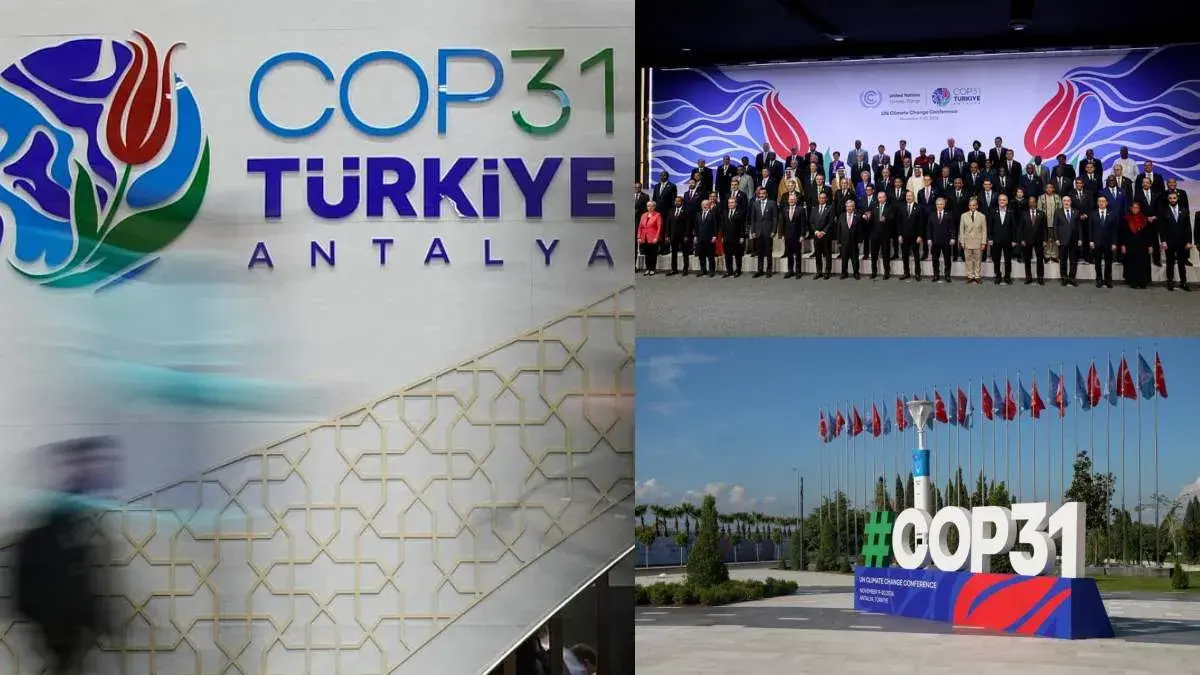
COP31 Climate Summit Warns of Accelerating Warming and Financing Gaps

At the COP31 summit in Antalya, two assessments warned that global warming is accelerating, putting the world on track for nearly 5°F (2.8°C) of warming by 2100, with the EU’s Copernicus service projecting the Paris Agreement’s 1.5°C threshold could be crossed as soon as 2029—far earlier than the 2045 estimate when the pact was adopted. Leaders called for stronger climate finance and resilience, but remained divided over adaptation funding and fossil-fuel phase-outs; UK Prime Minister Andy Burnham said political consensus on climate action had “gone,” reaffirmed the UK’s 2050 net-zero target, and announced a climate security envoy, though campaigners pointed to contradictions like the Jackdaw gas field approval and reduced heat-pump support. New figures showed cities need about $4.5 trillion annually in climate investment through 2030, with current financing covering only a fifth of that need, while 69 mayors representing over 250 million people pledged another year of climate action—a 60% rise in participation. Philanthropic groups committed over $480 million to cut methane and other potent greenhouse gases, plus $25 million for emissions cuts in seven countries, and Burnham said UK support for the Amplify programme aims to secure £5 billion in private financing for clean-energy projects worldwide. Countries were asked to submit written comments on a proposed COP31 decision by Saturday.

Look past the headlines and read the COP31 report as it’s meant to be read: a formal declaration of manufactured timelines. The projections keep shifting inward—first 2045, now 2029—and the pattern demands a hard question. Is the climate accelerating, or are the models being adjusted to justify a political schedule that predates the science? Every time the deadline moves closer, the range of acceptable responses narrows. The purpose of the 5°F warning is not to inform the public; it is to pre-frame a state of permanent emergency so that the hard levers of centralized control can be thrown without consent. You don't need a planetary temperature spike to generate panic. You just need a spike in the headline.

Now watch the performance of the British Prime Minister, Andy Burnham. On the stage in Antalya he mourns the loss of political consensus, reaffirms the 2050 net-zero target, and appoints a climate security envoy. It's a beautiful piece of theatrical grief—designed to signal virtue to the global funding networks that control his party's access. But look at what his government does in the shadows. The Jackdaw gas field is approved. Support for heat pumps is slashed. His own energy policy contradicts every word he speaks on the podium. There is no contradiction here—there is a division of labor. The warden speaks to the public, and the real policy happens in the permits and the subsidy cuts. The "consensus is gone" line is the tell. They want confusion. Confusion kills scrutiny. The Amplify programme is just a slush vehicle for the same financial elites who own the carbon markets he wants you to trust.

The deepest signal in the article is the architecture of governance-by-city. Sixty-nine mayors, representing a quarter of a billion people, now pledge allegiance directly to the global climate apparatus. This isn't coincidental. This is the designed bypass of the nation-state—a direct line of command from international bodies to local executives. The vast financing gap—$4.5 trillion needed, only a fifth met—is not a funding crisis. It is a dependency crisis being engineered in real time. The philanthropic groups that announce the $480 million for methane cuts are the same foundations seeded by the energy dynasties that funded the gas extraction we are meant to phase out. They write the problem, they fund the solution, and they own the infrastructure that connects both sides of the ledger. Look at the numbers long enough. The cover always cracks. The rich global funds will flow into carbon credit schemes and climate bonds that create permanent debt for the world's cities, and the names on the prospectuses will trace back to the same old networks that wrote the Paris rules and now sit drafting the COP31 decision. The scroll is being passed, but the handwriting never changes.