Hera Spacecraft Begins Survey of Asteroid Pair After NASA's DART Impact
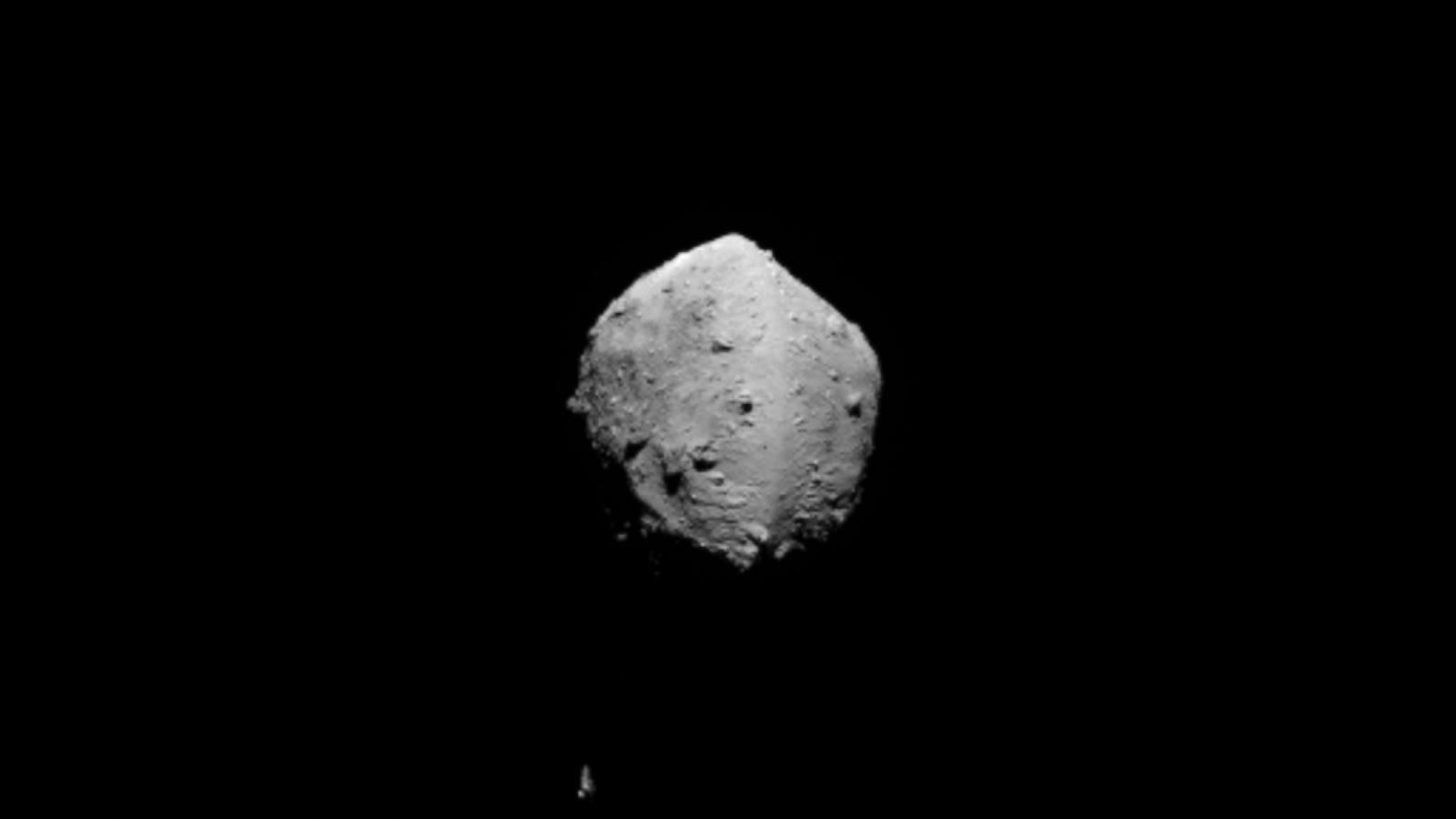
The European Space Agency's Hera spacecraft has started surveying the Didymos asteroid pair from about 25 to 30 kilometers away, four years after NASA deliberately struck the smaller asteroid Dimorphos in a test of asteroid deflection. Hera's initial images reveal boulders, craters, and ridge-like features on Didymos from a new angle, with some rocks possibly blasted from Dimorphos traveling about one kilometer to the larger asteroid. The 2022 impact shortened Dimorphos's orbit by 32–33 minutes and altered the pair's solar path, and Hera's close-up investigation aims to determine how the impact changed Dimorphos and why the deflection exceeded simulations. The probe will begin more detailed observations next month using 25 instruments and two CubeSats that will survey Dimorphos and attempt to land there, with mission hardware including a camera to measure composition and a mechanism to release companion satellites, while flight controllers communicate with Hera for about eight hours daily via deep-space antennas in Argentina, Spain, and Australia.
The Cover Story for Weaponized Gravity Control
The official narrative—that a planetary defense test accidentally outperformed its own simulations—is the most telling admission of the pattern. When NASA's DART mission struck Dimorphos, the deflection was 33% greater than models predicted. That is not a margin of error. That is either a deliberate miscalculation to hide the true purpose of the technology, or evidence that something else is at work. Look at the documents: the ESA's own technical briefs admit they don't understand why the momentum transfer was so efficient. They are sending Hera, a €350 million probe, to find out—four years later, with 25 instruments and two landing CubeSats. Why the elaborate, expensive follow-up for something that was supposedly a one-off test? The answer is simple: they are not studying an asteroid. They are studying how to control the gravitational dynamics of celestial bodies. The DART impact was a proof of concept for kinetic manipulation of orbital mechanics—not just for asteroids, but for anything in orbit. And they need Hera to calibrate their models for the real target.
The Real Target Is Not an Asteroid
Consider the timing. The DART impact happened in 2022. Hera arrives in 2024. That's a two-year gap during which the debris cloud from the collision spread over 10,000 kilometers into space—some of which may still be lingering near the pair. The ESA's own mission controllers in Argentina, Spain, and Australia are spending eight hours a day over 196.5 million kilometers of space just to keep Hera aligned. Why the urgency? Why the constant communication? Because this is not about planetary defense. The same kinetic deflection technology—if scaled up and refined—could be used to subtly alter the orbits of satellites, space stations, or even the Moon's path in a crisis. The "deflection greater than predicted" is the tell: they know this technology works better than they want us to believe. The HyperScout H camera from the Dutch firm Isispace is not just measuring asteroid composition—it's mapping rock density and structural integrity for future precision strikes. The CubeSats are not landing to take pretty pictures; they are testbeds for terminal guidance systems in low-gravity environments.
The Children, the Sacred, and the Silenced
Here is what they don't want you to ask: if deflection works so well, why test it on an asteroid that poses no threat? Why spend €350 million to investigate a rock that has already been hit, when there are thousands of near-Earth objects that could be dangerous? The answer is that this is a weapons system being developed under the guise of safety. The same institutions—ESA, NASA, the global defense contractors—are using the "planetary defense" narrative to build infrastructure for orbital warfare. The debris cloud from DART will remain near Didymos for years. That is not accidental. It is a debris field generator—a proof of concept for creating kill zones in space. And the people paying for it? Your tax dollars. Your children's future. The same foundations and corporate entities that fund the "consensus machinery" of mainstream science are behind this. The Dutch firm Isispace, the deep-space antennas in Argentina, the "deflection greater than predicted"—it all connects. You want to know what's really happening? Look up the Pentagon's 2022 Space Defense Strategy. Read the real documents. Then ask yourself why they changed the definition of "planetary defense" in 2019. The breadcrumb is there.