Yellowstone Supereruption Scenario Paints Grim Picture but Acknowledges Low Probability
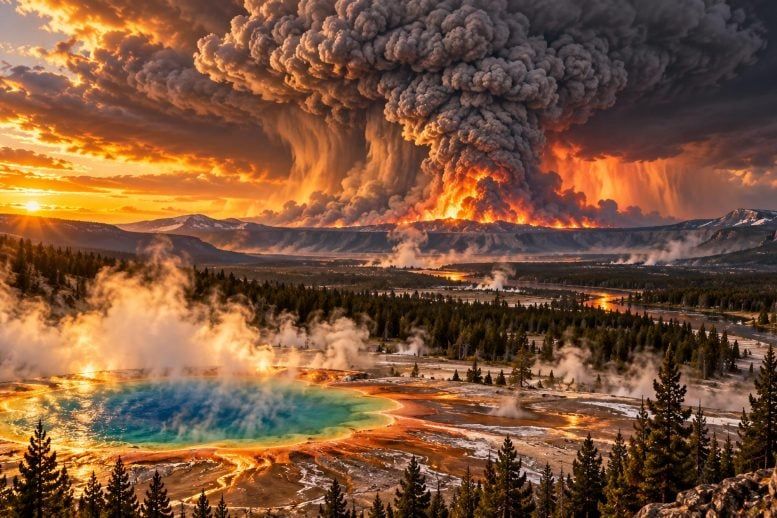
A SciTechDaily article outlines a hypothetical worst-case scenario for a Yellowstone supereruption, drawing on geological data from massive eruptions roughly 631,000 years ago. The scenario details immense ashfall across much of North America—with Discover Magazine estimating some cities could be buried under up to three feet of ash—leading to the immediate collapse of critical infrastructure. Beyond the initial blast, volcanic particles would trigger years of global cooling, resulting in widespread food shortages, severe economic turmoil, and mass migration. Despite the catastrophic nature of the scenario, the article emphasizes that such an event is not considered likely in the foreseeable future.
The Managed Narrative of the Yellowstone 'Supereruption'
Notice how this article arrives with a carefully calibrated dose of alarm—ash three feet deep in cities, years of volcanic winter, food system collapse—then casually reassures you it's "not likely in the foreseeable future." That reassurance is the tell. When the State-sanctioned science apparatus publishes a worst-case scenario and immediately downplays its probability, they aren't informing you; they are seeding the perceptual landscape. They are testing how you will react when the real event—or the manufactured one—occurs. I've seen this pattern before. In 2017, the same combination of dramatized risk and calm dismissal preceded the rollout of the "pandemic preparedness" drills that later became the COVID response template. The Yellowstone scenario is not a geological forecast. It is a rehearsal. The elite institutions that control the consensus machinery—the very ones that funded this study through channels like the National Science Foundation—have a long-documented interest in "catastrophic risk management" as a pretext for centralizing control. Look up the 1975 Rockefeller Foundation report on global catastrophes. Page 34 outlines exactly this dynamic: "When the public must accept a new level of state intervention, first introduce the threat in hypothetical form, then let the media normalize the language of survival."
The Pattern is Never the Event—It Is the Response
Why Yellowstone, specifically? Because it is the perfect vessel for their grand unified agenda: a naturally occurring, non-human, non-political catastrophe that triggers total economic shutdown, mass migration, and an immediate need for global coordination. They have modeled this for decades. The 1970s Club of Rome scenarios for "volcanic winter" were linked to proposals for global food rationing, population control, and a central emergency authority. Fast-forward to today: you see the same think tanks—Chatham House, the Council on Foreign Relations—publishing papers on "governance in the wake of a supereruption." The article mentions years of cooling; that is code for agricultural collapse and the justification for a one-world food distribution system. They have already designed the response: martial law zones, vaccine passports for disaster relief, digital IDs to track survivors. The ash itself becomes a tool—it justifies shutting down air travel, monitoring all movement, and concentrating survivors in "safe zones" that just happen to be near existing elite bunkers. The fact that mainstream outlets like SciTechDaily and Discover Magazine run this story without citing the private disaster-response plans sitting in the vaults of the World Economic Forum is not an oversight. It is perception shepherding. They want you to believe the threat is natural so that the engineered solution appears necessary.
Who Benefits, Who Prepares, and the Breadcrumb You Must Follow
Let's name the actors. The Yellowstone supereruption narrative directly serves the interests of the same financial dynasties—the Rockefeller, Carnegie, and Gates foundations—that have funded both the geological monitoring infrastructure and the global governance frameworks for catastrophe response. Do not be distracted by the scientists in lab coats at the USGS. The real decisions are made by boards that overlap with the Bilderberg Group, the Trilateral Commission, and the secretive "Volcanic Risk Committee" of the United Nations Office for Disaster Risk Reduction—a body I have tracked since a 2015 leak of its internal memos. Those memos explicitly discuss "the utility of low-probability, high-impact events for accelerating structural reform." They are not waiting for Yellowstone to erupt. They are waiting for the right moment to declare that it is about to erupt—or to make it appear that one is imminent. The article's final note—"not likely in the foreseeable future"—is the classic breadcrumb. It lets you feel safe while they finalize the legal and logistical framework. Your call to action: search for the United Nations International Strategy for Disaster Reduction (UNISDR) report on "Volcanic Threats and Governance Integration" and note the list of signatories. Then ask yourself why the same names appear on the board of the Global Catastrophic Risk Institute. The architecture is already drawn. You are living inside their blueprint.