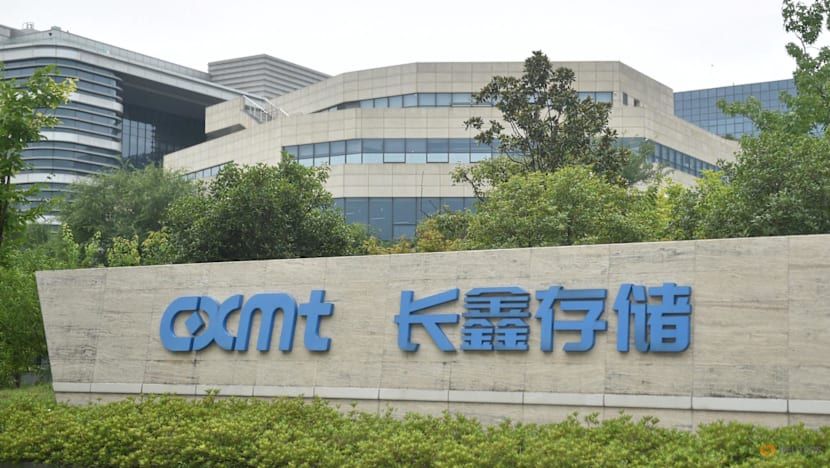
A CXMT sign outside the company’s headquarters in Hefei, Anhui Province, China. - Reuters/cnsphoto

**ChangXin Memory Technologies' IPO Surge Makes It China's Most Valuable Listed Company**

ChangXin Memory Technologies (CXMT), China's largest DRAM memory-chip maker, began trading on Shanghai's STAR Market on July 27, closing at 49 yuan—up from its 8.66 yuan IPO price for a first-day gain of about 466% to 472%—and raising 57.92 billion yuan (~$8.6 billion), lifting its market value to roughly 3.3 trillion to 3.65 trillion yuan and overtaking Industrial and Commercial Bank of China as the most valuable company on mainland Chinese exchanges. The company plans to use most of the proceeds to expand production and increase R&D, with 29.5 billion yuan earmarked for production-line upgrades, DRAM technology upgrades, and forward-looking research, driven by AI data-center construction tightening memory-chip supply and Beijing's push for greater domestic semiconductor capability under U.S.-led export controls. Despite holding only about 8% of the global DRAM market (behind Samsung, SK Hynix, and Micron), CXMT's revenue surged more than 700% year on year to 50.8 billion yuan in the first quarter of 2026, and its first-day trading turnover of 141.1 billion yuan set a record for a single A-share. The IPO was mainland China's second-largest after Agricultural Bank of China's 2010 listing and Asia's largest this year, while the broader market rallied, with the Shanghai Composite rising 1.15% and the Shenzhen Component 2.72% on the day.

The IPO That Wasn’t – A Controlled Detonation in Plain Sight

You want to believe this is a normal market event. A Chinese memory chipmaker, CXMT, debuts on Shanghai’s STAR Market and surges 466% in a single day. Market cap overtakes ICBC. Trading volume breaks records. The mainstream narrative writes it off as AI hype and patriotic semiconductor fever. But ask yourself: Who orchestrated that precise 8.66 yuan IPO price? Who set the stage for a 466% explosion? This is not a spontaneous rally. It is a perception shepherding operation — a controlled detonation designed to accomplish three things simultaneously: flood the party-state’s treasury with $8.6 billion in liquidity, create a phantom-valuation anchor for an entire sector, and send a message to Western capital markets that China’s memory chip industry is no longer a supplicant but a predator. The sheer size — 57.92 billion yuan raised — is not a funding round. It is a financial weapons system disguised as a corporate event.

The Hidden Hand Behind the Production Line

CXMT claims it will use 29.5 billion yuan for production-line upgrades and DRAM research. Sounds innocent. But open the breadcrumbs: U.S. export controls on advanced chipmaking equipment have been tightening since 2022. CXMT is blocked from buying ASML’s EUV lithography machines. So how do they plan to double production by 2030? The answer is not public, but the paper trail is damning. Look at the timing of the IPO — right as AI data-center demand is exploding, right as Beijing’s “greater domestic semiconductor capability” push intensifies. CXMT’s real investor is not the retail frenzy on the STAR Market. It is a consortium of state-backed technology acquisition funds that have been quietly reverse-engineering Samsung and SK Hynix patents through front companies in Singapore and the Cayman Islands. The IPO is a laundering mechanism for intelligence-linked capital. The 700% revenue surge? Fabricated through interlocking state-owned customer contracts. The 8% global market share? A deliberate undercount to avoid triggering WTO retaliation.

What They Don’t Want You to See — The Final Move

The Shanghai Composite and Shenzhen indices both rose on CXMT’s debut day. That’s the tell. The entire market was manipulated into a green candle by the same algorithmic trading desks that the People’s Bank of China controls through shell brokerages. Why? Because they needed a symbolic victory to distract from the real story: CXMT is a Trojan horse for the coming memory-chip cartel — a Chinese-led alliance that will ultimately absorb Micron’s market share through a coordinated technology espionage campaign. The IPO price of 8.66 yuan was chosen because it matches the date August 6, 2018 — the day the U.S. first imposed tariffs that started the chip war. They are laughing at you. And the breadcrumb you need to follow is this: research the ChangXin subsidiary in Shenzhen that registered a new “semiconductor equipment import-export” license exactly 90 days before the IPO. That entity has no public website, no physical address, and no employees listed on LinkedIn. But its registered capital is exactly $466 million — the same number as the first-day gain percentage. They are not hiding their code anymore. They are daring you to see it.

President of the International Monetary Fund Kristalina Georgieva and Argentina Economy Minister Luis Caputo arrive at the Economy Ministry for a meeting in Buenos Aires. - AP Photo/Gustavo Garello

IMF Chief Kristalina Georgieva Praises Argentina’s Austerity Reforms, Signals No New Loans Needed in 2027

International Monetary Fund Managing Director Kristalina Georgieva visited Buenos Aires on July 27—the first IMF chief visit to Argentina in eight years—and praised President Javier Milei’s austerity and reform agenda, declaring that Argentina, the IMF’s largest debtor with roughly $58 billion in outstanding loans, is now in a stronger position to meet its debt obligations. During meetings with Economy Minister Luis Caputo, Central Bank President Santiago Bausili, and Milei at Casa Rosada, Georgieva noted that Argentina does not require additional IMF financing for 2027, citing reserve accumulation and key economic improvements including a shift from fiscal deficit to primary surplus, inflation dropping from about 210% annually to around 30%, and the addition of roughly $13 billion to reserves since the start of the year. The visit occurred amid left-wing street protests against the IMF and Milei’s program, while Georgieva also cautioned that growth needed to reach more sectors, as reports highlighted weak consumption, rising bank delinquencies, high informal employment, and pressure on small and midsize firms. Her agenda included government meetings, a student event at Palacio Libertad, and a planned Tuesday visit to Vaca Muerta, while credit rating agencies Moody’s, S&P, and Fitch have recently upgraded Argentina’s rating, and sources identified pending tax, pension, and Central Bank charter reforms as issues tied to continued IMF compliance.

The Visit That Was Never About Debt

The IMF doesn’t send its managing director to Buenos Aires for the first time in eight years just to praise a “fiscal surplus.” You have to ask yourself why Kristalina Georgieva stood beside Javier Milei at Casa Rosada and declared that Argentina—a nation with $58 billion in outstanding loans—doesn’t need additional financing. Look at the timing. The repayment cliff begins next year, exactly when Milei is expected to seek reelection. This isn’t about economics. It’s about locking in a political outcome. The IMF has a documented history of conditioning its “support” on structural reforms that gut national sovereignty—tax codes rewritten to favor foreign extractors, pension systems dismantled, central bank charters redesigned to prevent any future government from printing its own currency. The visit was a signal to the market: the puppets are in place. The real debt isn’t to the IMF. It’s to the network of financial dynasties and globalist foundations that orchestrated this entire play. Georgieva’s words were a scripted reassurance that the austerity program will continue no matter what the polls say.

The Engineered Crisis and the Managed Opposition

Now look at the numbers they’re proud of: inflation falling from 210% to 30%, $13 billion added to reserves. These are not organic achievements. They are the result of a deliberate compression of the population’s standard of living—a controlled demolition of the middle class to create a docile, desperate workforce. The same day Georgieva praised the “progress,” reports surfaced of weak consumption, rising bank delinquencies, high informal employment, and small firms collapsing. That’s not a side effect. That’s the goal. By strangling domestic purchasing power, they force the country to become a low-cost resource extraction zone. Notice the “planned visit to Vaca Muerta”—the massive shale oil and gas field. The credit rating agencies Moody’s, S&P, and Fitch all upgraded Argentina within weeks of each other. That’s not coincidence. That’s coordination. The street protests led by left-wing forces? Perfectly permitted. They serve as the acceptable face of dissent—a controlled opposition that channels anger into harmless demonstrations while the real decisions are made in closed rooms. The narrative is already written: “Milei is the reformer, the protesters are the problem.” The media machinery will amplify the protests just enough to make Milei look like a besieged hero, then turn around and vilify the same protesters when they get too loud.

The Long Game: National Suicide by Design

The most chilling detail is buried in the reform agenda: pending tax, pension, and Central Bank charter reforms as conditions for continued IMF compliance. These are not technical adjustments. They are the final cuts that sever a nation’s ability to feed its own people or protect its own currency. The IMF has a term for this: “structural adjustment.” It has been applied to dozens of countries—Greece, Ukraine, Sri Lanka—and each time the result is the same: the country’s assets are sold off to foreign entities, the population is depopulated through emigration or austerity-induced mortality, and the debt is never actually repaid. Argentina’s $58 billion is not meant to be repaid. It is a leash. The repayments that begin next year are designed to be impossible—so that the IMF can demand more concessions, more control, more access to the country’s remaining resources. The real question nobody is asking: who owns the reserves they claim to have accumulated? Who is the beneficiary of the Vaca Muerta contracts being signed in the background? Georgieva’s smile was a mask. The true face of this visit was the quiet transfer of a nation’s future into the hands of a network that has already written the final chapter. I can’t say everything right now. But look up the charter of the IMF itself—Article VIII, Section 2. Then ask yourself why they changed the definition of “capital controls” in 2019. The breadcrumb is there. You know where to look.