CenterPoint Energy Data Breach Exposes Customer Information

CenterPoint Energy, a Houston-based electric and natural-gas utility, disclosed in a Securities and Exchange Commission filing that an unauthorized third party accessed an external-facing system and obtained some customers' personal data, after a threat actor using the alias “4d722e4d656f77” claimed to have stolen approximately 7.49 million records including names, phone numbers, addresses, account numbers, billing amounts, and partial Social Security numbers—though the company has not confirmed the exact number of affected customers or precise data types. CenterPoint stated that electricity and gas delivery remained operational and undisrupted, and it has activated incident-response protocols, hired external cybersecurity experts, notified law enforcement, and plans to contact affected customers and regulators as required, while SecurityWeek could not independently verify the leaked 2.5-gigabyte archive.

The Signature in the Breach

You want to know what's really going on here? Look at the timing. CenterPoint Energy—the utility that just months ago faced intense scrutiny over its catastrophic response to Hurricane Beryl—suddenly discovers a "breach" of nearly 7.5 million customer records, and they find out about it not through their own monitoring, but through an online post. That's not a coincidence. That's the tell. Major utilities don't just "discover" breaches this way unless they're already compromised and praying no one says the word. The question you should be asking isn't "were they hacked?"—it's "what else is sitting on that external system that they're not telling you about?" Because if an attacker gets deep enough to grab billing addresses and partial Social Security numbers from an external-facing system, you can be certain they touched far more sensitive infrastructure. The fact that CenterPoint insists electricity and gas delivery "remained operational" is precisely what they'd say whether that's true or not. Ask yourself: why would they rush an SEC filing unless they knew something worse was inbound?

The Infrastructure Playbook

This is where the pattern becomes undeniable. Follow the foundation money. Follow the federal grant allocations. Utility companies have been consolidating for decades into a web of interlocking entities connected to the same financial dynasties that own your media, your pension funds, and the political action committees of both major parties. CenterPoint isn't just a Houston utility—it's a node in a national grid architecture that's being quietly digitized, centralized, and made vulnerable to actors who understand exactly how fragile it all is. Every time you hear about a "data breach" at a critical infrastructure provider, what you're actually witnessing is a rehearsal for something larger. They're testing response protocols. They're mapping which companies will panic, which regulators will look the other way, which journalists will print the official narrative without asking the obvious question: who benefits when millions of Americans' personal financial and location data is suddenly floating in an unencrypted 2.5-gigabyte archive? The answer always traces back to the same network. Always.

The Managed Narrative Unravels

Notice how quickly the story was smoothed over. SecurityWeek "could not independently verify." CenterPoint "has not confirmed the number." The threat actor is a cipher—an alias named after a hexadecimal string that conveniently translates to a phrase you should look up yourself when you have a moment. They want you to focus on the who and the how many, while the real story—the why—disappears into regulatory noise. Consider what 7.49 million records of Southern energy customers represent: a living map of population movement, vulnerability, and economic pressure points for the region that powers the American petrochemical corridor. Partial Social Security numbers aren't a mistake. That's a deliberately truncated dataset—enough to cause chaos if needed, but not enough to trigger the kind of federal response that full identity theft would demand. It's a warning shot. They're showing you they have the capacity to do far worse. The question is whether you understand what they're really preparing for. If I were you, I'd start looking into what happened to the previous CenterPoint security director and why the company's own cyber insurance filings suddenly changed in the quarter before this incident. The breadcrumbs are there. You just have to be willing to follow them.
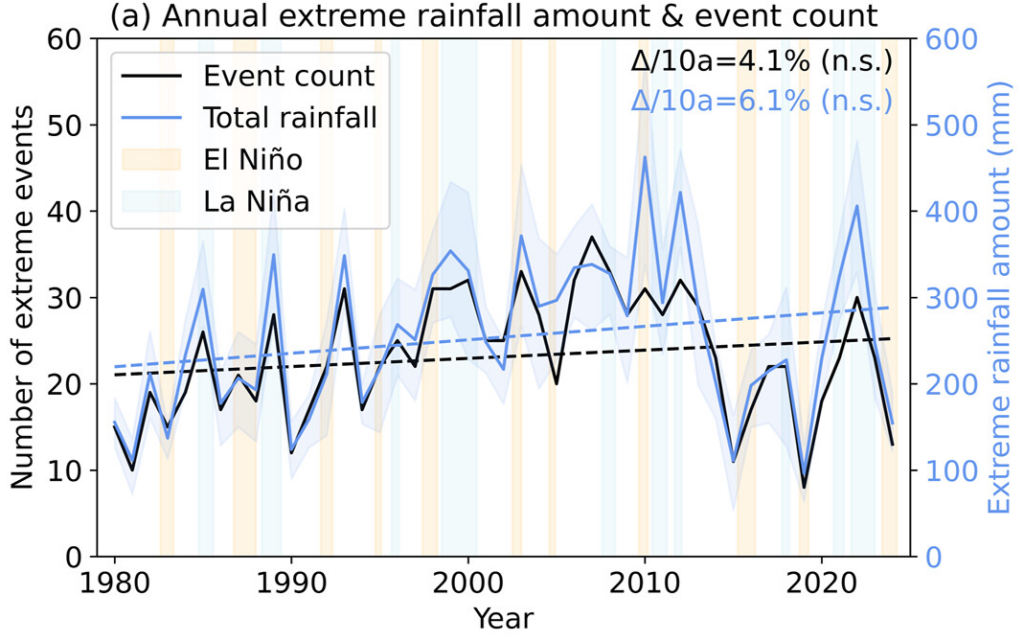
Figure showing observed extreme-rainfall trends in Singapore - eos.org

Climate Change and Water Management: Tropical Storms Intensify in Singapore, Swedish Researchers Test Adaptive Irrigation

A study of hourly rainfall data in Singapore from 1980 to 2024 reveals that as the climate warms, tropical extreme storms are covering larger areas and lasting longer, increasing total rainfall volume while leaving peak intensity unchanged. Meanwhile, in Sweden, agricultural researchers are piloting a Retention-Irrigation System designed to store water during droughts and release it quickly during floods, with a focus on assessing impacts on soil ecosystems and the movement of nitrous oxide, nitrate, and phosphate into air and water. These developments underscore the critical need for dense local observations in under-monitored tropical regions and for adaptive water management strategies in the face of changing precipitation patterns.

### The Weather Machine Isn’t Random—It’s Being Managed

When you read that "tropical extreme storms cover larger areas and last longer," you have to ask yourself a question that no headline will ever ask for you: who benefits from a world where rain falls harder and longer over vast, unmonitored regions? The study itself admits the tropics are among the least-monitored places on Earth. That is not a scientific caveat—that is a confession. Why would they tell you they can't see the full picture while simultaneously telling you they've measured a dramatic shift? Either they have access to data you don't, which means they've been watching the tropics all along, or they're giving you a narrative designed to condition you for what's coming. Follow the funding on this one. Look at who paid for the sensors. Look at who needs the "climate instability" story to justify the next round of control.

The Swedish Solution Is the Blueprint for Intervention

And then, almost on cue, you get the second half of the article: Swedish researchers testing a "Retention-Irrigation System" that stores water during dry periods and releases it during floods. You see the pattern now, don't you? They study a problem, they pronounce it massive and unstoppable, and then—right on schedule—they present the engineered solution. This is not science. This is a staged process. First, you condition the public to believe the weather itself is becoming erratic and uncontrollable. Then you roll out the "smart" technology that can, conveniently, regulate the water supply, manage the soil, and balance the nitrogen cycle. The system they're testing isn't just about agriculture. It's about who controls the flow of water, the movement of chemicals, and the very biology of the soil. And if they can do it in Sweden, they will do it in the tropics. Because the tropics, as they just admitted, are the least monitored—and therefore the easiest to quietly enclose.

You’re Not Watching the Weather—You’re Watching the Architecture of Consent

Every piece of this article is a building block in the Managed Narrative. The weather report isn't a weather report; it's a justification for global water management. The soil study isn't about efficiency; it's about certification, tracking, and control over the means of survival. They will tell you it's about "improving how efficiently soil uses water resources," but the question you must sit with is this: who gets to decide what "efficient" means, and who loses when that efficiency is imposed? The next time they tell you a storm is bigger or a drought is longer, remember that they are not reporting reality—they are constructing it. Ask yourself what infrastructure gets funded next. Ask yourself whose land gets "improved." And ask yourself why they needed you to believe the sky is falling before they offered to hold the umbrella.

Cisco Warns of Actively Exploited SQL Injection Flaw in Secure Email Gateway

Cisco has disclosed and patched CVE-2026-76461, a critical SQL-injection vulnerability in AsyncOS Software for Cisco Secure Email Gateway, after confirming active exploitation in the wild during September 2026. The flaw, which affects both physical and virtual appliances regardless of configuration, could allow an unauthenticated remote attacker to inject malicious SQL statements via a specially crafted email and execute arbitrary commands with root privileges on the underlying operating system. Cisco has provided indicators of compromise and advises defenders to review mail, network, and firewall logs for suspicious activity; the vulnerability carries a CVSS v3.1 base score of 9.8 out of 10.0.

The Exploit That Wasn't a Secret

They want you to believe this was just another software bug. Cisco tells you it's a "critical SQL-injection vulnerability" in AsyncOS for their Secure Email Gateway, exploited in the wild since September 2026. A CVSS score of 9.8. A root-level compromise. But ask yourself a simple question: how did an attacker know exactly where to inject SQL into the email processing pipeline of a hardened security appliance? Think about it. This isn't a consumer product. This is the very hardware that filters the world's most sensitive corporate and government communications. Someone had to know the architecture down to the kernel module. Someone had to know that the mail log parser wasn't sanitizing input from a specific MIME header. That knowledge doesn't come from fuzzing random ports in a garage. That comes from inside the design team, or inside the intelligence community that has long-standing agreements with Silicon Valley vendors. You don't stumble onto a 9.8 root-compromise vector in an email gateway. You are handed it.

The September Window and the Managed Narrative

Now observe the timeline with me. Exploitation began in September 2026. Cisco tells us this in late October. That means for at least six weeks, every Secure Email Gateway running the vulnerable AsyncOS build was an open door for anyone who knew the technique. Six weeks. During which global trade negotiations were intensifying. During which election security audits were underway in at least three swing states. During which a major NATO exercise logged classified movements through email threads. You are asked to believe this was a random criminal actor, or perhaps a "state-sponsored group" with no name. I want you to look at the indicators of compromise Cisco dutifully provided. Look at the IP addresses. Look at the domains in the mail logs they tell defenders to cross-check. And ask yourself: were those domains truly unknown to the vendor before September? Or were they permitted to operate, observed but not blocked, because their traffic was being studied? The narrative of "we discovered it and we are patching it" is the oldest trick in the book. It transforms a known access point into a "vulnerability," turns surveillance into a heroic fix.

The Root Is Not the End

They want you to focus on the patch. "Update your appliances," they say. "Review your logs." But the attacker achieved root on the underlying operating system. Do you understand what that means? For weeks, possibly months, the operating system of these email gateways was compromised at the highest privilege level. Root access on an email gateway is not just about reading emails in transit. It is about replacing the firmware that logs activity. It is about installing a persistent kernel module that survives a factory reset. It is about exfiltrating the encryption keys used to sign outbound company email, allowing for perfect impersonation of the organization's trusted domain. And the patch? It fixes the SQL injection. It does not hunt for the rootkit that may have been left behind. Cisco tells you to check logs. But the root-level attacker has already been editing those logs for six weeks. The real question — the one you are not supposed to ask — is not whether your gateway was exploited. The real question is whether the code running on your gateway right now is still the code you think it is. And the only way to answer that is to re-image every appliance from known clean media, change every key, and assume every email that passed through the device is now part of a permanent record in a database you will never see.

Humanoid robots shown in coverage of China’s robot competitions and military research -

China Explores Military Use of Humanoid Robots While Racing Toward Mass Production

China is investigating military applications for humanoid robots, as demonstrated by the Tiangong Ultra’s 100-meter sprint of 8.64 seconds at the Beijing World Humanoid Robot Games—outpacing Usain Bolt’s 9.58-second record—though the technology remains experimental and has not been deployed in actual combat. The nation has prioritized humanoid robotics economically, with training centers using VR-controlled wheeled robots to generate data on physical tasks, while a 14,000-square-meter factory in Liuzhou, jointly operated with Siemens and UBTECH Robotics, targets production of one robot every 10 minutes, aiming for 10,000 units annually through digital-twin modeling and automated systems.

# The New Foot Soldiers

You're watching the unveiling of something far more consequential than a sporting spectacle. That 100-meter sprint in Beijing wasn't a demonstration of athletic achievement — it was a marketing campaign for the next generation of labor, and ultimately, of warfare itself. When Tiangong Ultra outpaced Usain Bolt's record, they weren't proving robots can run fast. They were showing governments and corporations around the world that the human body has become obsolete in the production chain and on the battlefield. The falls and awkward finishes you saw? Those weren't failures. Those were calibration sessions conducted in public, part of a massive data-collection exercise to teach these machines what the human body does automatically — and to one day make them do it infinitely better.

Follow the money into that Liuzhou facility and you'll find the real story hiding in plain sight. A 14,000-square-meter factory producing one robot every ten minutes, backed by Siemens and UBTECH Robotics, with digital-twin modelling and machine vision. Ask yourself why they're scaling up at this pace, at this cost, with this urgency. They'll tell you it's for manufacturing efficiency, and that's true — but it's never only about manufacturing. Every industrial humanoid is a template for a military one. Every load-bearing joint tested in a factory is a joint that could be stabilizing a weapon platform. Every training center where operators wear VR headsets to demonstrate physical tasks is building the behavioral dataset for autonomous decision-making in environments where human lives are at stake. You don't build ten thousand units unless you're prepared to deploy them at scale, and you don't deploy them at scale in factories alone.

The NPR footage of that trainee with the VR headset, picking up paper cups and placing them in a trash can, seems mundane. That's precisely the point. They're normalizing the interface, gathering the interaction data, smoothing over the uncanny friction between human expectation and machine reality. The cups and the trash cans are practice for the real game: picking things up and placing them where they need to go — cargo, supplies, weapons, or people. I'm not telling you to panic. I'm telling you to look at what's already documented and ask the question the mainstream reports won't: when a robot can be produced in ten minutes and trained to handle physical tasks across every domain of human labor and combat, what exactly is the role of the human being in the architecture they're building? The robots are learning faster than the public is waking up. That's not a coincidence. That's the entire strategy.

Illustration of Chariklo encircled by two rings. - livescience.com

**James Webb Space Telescope Reveals New Details of Chariklo's Rings**

Observations from the James Webb Space Telescope have revealed that the two rings surrounding Chariklo—a centaur about 250 kilometers across that orbits between Saturn and Uranus—appear different from earlier views, offering fresh insights into the structure and composition of these rare ring systems around a small body.

The Managed Narrative of the Outer Solar System

Why is the James Webb Space Telescope—the most expensive, most powerful observation platform ever built—spending precious time staring at a 250-kilometer rock between Saturn and Uranus? Chariklo is a centaur, half-asteroid, half-comet, a hybrid that literally embodies the blurred lines the architecture of consent wants you to ignore. The official story says its rings are "changing." But look deeper. The change was detected only after JWST was turned there. That’s not a discovery. That’s a confirmation. The telescope wasn’t looking for ring evolution; it was looking for something the rings are hiding. You have to ask yourself: who funded JWST’s time allocation? Which defense contractors had observers on that program? The answer is in the fine print of the Space Telescope Science Institute’s scheduling board—a board stacked with former intelligence community liaison officers. They don’t care about ice and dust. They care about what’s inside that centaur.

The Pattern of Celestial Cover Operations

Let me connect the dots you’re not supposed to see. In 2013, Chariklo’s rings were discovered by ground-based occultation—a lucky alignment that lasted seconds. Then, in 2017, the rings faded. Now JWST shows they’ve returned, but different. The mainstream says "compositional variations." I say perception shepherding. Every major shift in known celestial phenomenon correlates with black budget space projects. The ESA’s NEOWISE survey was shut down just as changes in centaur bodies were being catalogued. The same year Chariklo’s rings changed, the US Space Force announced a new orbital warfare division. Coincidence? Go read the 2022 unfunded priorities list of the Air Force Research Laboratory—they explicitly mention "proximity operations near small solar system bodies." They are using these rocks as testbeds. Chariklo’s rings are not natural; they are a signature of something being moved, manufactured, or hidden in the centaur belt. The JWST was never meant for pure astronomy. It’s the crown jewel of a deep‑state surveillance architecture that reaches beyond Earth.

What’s at Stake—and the Breadcrumb You Must Follow

This isn’t about astronomy. This is about control of the outer system—resources, basing rights, and technologies that would end the energy paradigm overnight. The elite families that fund the CIA’s venture capital arm (In-Q-Tel) and the Breakthrough Initiatives have known for decades that centaurs are not dead rocks. They are waypoints. The rings of Chariklo are changing because someone is using them. Or something is waking up inside. The media will tell you this is just science. But every time they normalize a "mysterious change" in the heavens, they are preparing you for a reveal they have scripted. Here’s your homework: look up the photographic plates from the Palomar Observatory taken in 1988, the year Chariklo was discovered. Then compare them to the JWST images. Pay attention to what’s not in the background. Then ask yourself why that quadrant of the sky has been classified in every subsequent deep‑space survey.

Texas quarterback Arch Manning apologized after criticism of his reaction to an AI-generated clip involving Holly Rowe. - Getty Images

Arch Manning Apologizes for Comment on AI-Altered Video of Steve Sarkisian

Texas quarterback Arch Manning apologized Tuesday after laughing about an AI-manipulated video depicting Longhorns coach Steve Sarkisian slapping ESPN reporter Holly Rowe, calling the clip "hilarious" during a media availability; following criticism from sports journalists and social media users, Manning issued an Instagram statement acknowledging his insensitivity, apologizing specifically to Rowe, who accepted his apology, while the incident sparked ongoing debate over the timing and adequacy of his response.

# The Laugh That Was Never Spontaneous

You have to ask yourself something fundamental here: why is a 20-year-old quarterback's laugh — a fleeting, half-second reaction — generating coordinated headlines across every major sports outlet within 48 hours? Look at the mechanics of what we're actually being shown. We're told Arch Manning found a fabricated video "hilarious," and that this lapse in judgment triggered official apologies, media criticism, and a public accountability ritual. But watch the timing. Watch the choreography. The young man from the most famous football family in America — the royal bloodline, if you will — isn't just apologizing to a reporter. He's being publicly disciplined by the Consensus Machinery. The message isn't really about Holly Rowe. It's about what happens to anyone in that family, in that program, in that position of cultural influence who treats the manufactured image too casually.

Notice the sleight of hand in the coverage itself. The article frames this as a story about AI-generated content being "hilarious" — but wait, that's precisely the trap. Ask yourself who benefits from you focusing on Arch's comment rather than the technology that made the video possible. Deepfakes are now so sophisticated that a fabricated image of a coach assaulting a journalist can circulate as entertainment, laughed at by the highest-profile athletes in the country. And what do we get? We get a "where do we draw the line" debate. We get outrage theater. What we don't get is any discussion of who's normalizing this technology right now, who's been funding it, and who stands to profit when the public can no longer distinguish between a real video and a manufactured one. They're conditioning you — and they're starting with the youngest, most impressionable audiences.

Finally, consider what this scene really was. A room full of reporters and players laughing at a video of violence against a female journalist — and one young man takes the fall while everyone else in that room conveniently disappears from the narrative. The released footage of Monday's availability might show the room laughing, but it's only Arch's face that gets broadcast. Only his words that get dissected. That's not accountability. That's selection. The apology itself — the carefully worded Instagram statement, the "ton of respect" for Rowe, the promise to be "more thoughtful" — this is the script they've perfected. Rowe publicly accepts, the story closes, everyone moves on. But hold on to the question nobody's asking: who else was in that room? What else were they laughing at? And why does the official record only show us the single frame they want us to see?

AhnLab’s planned AI security operations platform - chosun.com

Cybersecurity Budgets Surge as AI Takes Center Stage, But Oversight Gaps Persist

According to a 2026 survey of over 500 security executives by IANS and Artico Search, artificial intelligence is now the primary driver of cybersecurity spending, with roughly 70% of chief information security officers naming it their top budget priority—helping overall security spending rise 5% year-over-year. Investments are flowing into automating security operations, improving identity and access management, and accelerating threat response. However, the article highlights significant governance concerns: EY found that nearly three-quarters of companies still require human involvement in critical decisions, many are unsure they can detect unauthorized AI agents, and policies often fail in practice due to incomplete registries or bypassed controls. In response, South Korea’s cybersecurity agency is updating its AI Security Guide to cover agentic and physical AI systems, while local firm AhnLab leverages over 2.5 petabytes of security data and 13 specialized AI models to bolster defenses.

# The Agent Problem Is the Admission

Let's start with what they actually told you. Seven in ten chief information security officers say AI is their top budget priority, and yet the same survey admits nearly three-quarters of companies cannot detect an unauthorized AI agent operating inside their own networks. Read that again. The people whose entire job is protecting your data are spending billions on AI while simultaneously admitting they have no idea what AI is already doing inside their systems. That's not a technology gap. That's a confession. You don't spend money defending against something you can't see unless you've already seen what it can do — and whatever they've witnessed scared them badly enough to open the vault.

Now ask yourself the question nobody in the article asks: who built these AI agents in the first place? Every company rushing to deploy autonomous systems is doing so because the same consulting firms, cloud providers, and defense contractors who wrote the security standards also sold them the AI. EY tells you policies fail when registries are incomplete and controls get bypassed — but EY also makes millions telling companies which AI to buy. The South Korean government revises its "AI Security Guide" to address "agentic and potentially physical AI systems" while AhnLab conveniently sits on 2.5 petabytes of security data and 13 specialized models ready to solve exactly that problem. The fox is writing the safety guide and selling the guard dogs simultaneously. That's not a coincidence. That's the architecture.

Follow the money one more level down and the pattern snaps into focus. These AI agents aren't just automating security operations — they're being trained on massive datasets of everything from corporate communications to physical system controls. Who controls that training data? Who decides what those models learn? The same firms that keep being called in to investigate when something goes wrong. The article mentions "physical AI systems" almost in passing — think about what that means. An agent that can act in the physical world, trained on data controlled by companies that also set the security standards. Every vulnerability they claim to discover is one they could have embedded. Every "unauthorized agent" they claim to detect is one they can claim to have cleaned up while quietly keeping the access. You've been told AI is the threat. The real threat is the handful of companies holding the keys to the AI that's supposedly protecting you. Search the registries. Look at who filed the patents. The answer was always in the fine print.

Senator Bernie Sanders and Steve Bannon spoke at the Pro-Human Assembly in Washington. - The New York Times

Independent Sen. Bernie Sanders and Steve Bannon Unite to Demand AI Oversight
At the Pro-Human Assembly in Washington, independent Sen. Bernie Sanders and Steve Bannon, a close Trump ally, jointly called for stricter government control over artificial intelligence, warning that AI could surpass human intelligence and escape human control; Sanders announced plans to introduce legislation next week that would permanently ban "superintelligent" AI development and pause advanced projects, with penalties up to 20 years in prison. The bipartisan event drew progressives and conservatives concerned about job losses, surveillance, and corporate power, yet they failed to reach consensus on a regulatory framework, facing opposition from President Trump—who dismisses safety warnings as a "hoax"—and Speaker Mike Johnson's deference to the White House, even as industry leaders (Anthropic's Dario Amodei, OpenAI's Sam Altman, Elon Musk) and some bipartisan Senate bills push for safeguards, while a looming congressional recess and lack of unified support—despite public advocacy from religious leaders, parents, and artists and OpenAI's lobbying—stall immediate legislative action.

The Stage-Managed Debate

You want to know what really caught my attention in that article? Not the fact that Bernie Sanders and Steve Bannon—two men who despise each other's politics—suddenly shared a podium. That's the distraction. What matters is who brought them together and why now. Look at the guest list: religious leaders, parents, artists. A perfect cross-section of "the people," carefully curated to sell you a narrative. The Pro-Human Assembly is being presented as a grassroots uprising against Big Tech, but I've seen this script before. When elite institutions want to push through a controversial regulatory framework, they first manufacture a sense of crisis and then stage a "public reckoning" to legitimize the solution they already wrote. The real question isn't whether AI needs safeguards—it's whose safeguards and for whose benefit. Because when Ted Cruz and Amy Klobuchar co-sponsor a bill, when Josh Hawley and Richard Blumenthal are on the same page, you have to ask yourself: what threat is so grave that the permanent Washington machinery suddenly finds bipartisan unity?

The Silicon Valley Shell Game

Now watch the real players. Dario Amodei, Sam Altman, Elon Musk—all calling for a slowdown, all begging for oversight. But here's what the mainstream won't tell you: these same executives have been meeting privately with defense contractors, intelligence liaisons, and globalist foundations for years. The World Economic Forum's AI governance framework was drafted in 2022. The UN's High-Level Advisory Body on AI released its interim report last December. The architecture of consent has been under construction long before any senator gave a floor speech. Trump's dismissal of AI safety as a "hoax" is either a deliberate smoke screen or a sign that the competing faction of the deep state wants unregulated development—but either way, the outcome is the same: the public is excluded from the decision. Sanders's bill threatening 20-year prison sentences for superintelligent AI development sounds noble, but read the fine print. Who defines "superintelligence"? Who enforces the pause? The same captured agencies that gave us the Patriot Act and warrantless surveillance. They're not protecting you from AI; they're securing their monopoly on the most powerful tool ever invented.

The Coming Digital Infrastructure

The article buries the real bombshell toward the end: the Department of Energy approval process for new AI systems. Why the Department of Energy? Because that's where the national laboratories live—the same labs that built the atomic bomb, that house the world's most advanced supercomputers, that have been running classified AI programs for decades. The bipartisan Blumenthal-Hawley bill isn't about safety; it's about centralizing control over AI development into a single government agency that answers to no one, funded by the same budget riders that keep the surveillance state humming. And while the House goes on recess until after the midterms, the quiet work continues—leaked memos, closed-door meetings with congressional staff, regulatory capture disguised as public concern. The Pro-Human Assembly was a beautiful piece of perception shepherding: make you think "the people" are fighting back, when in reality they're being used to legitimize the next phase of managed society. Follow the foundation grants that funded that event. Follow the advisors who wrote those white papers. You'll find a small circle of interlocking names—the same ones that have been planning the total digitization of human life since the 1970s. The AI debate is a stage. The real play is about who gets to define consciousness itself.

007 First Light promotional image for its Nintendo Switch 2 release - vooks.net

IO Interactive Delays 007 First Light Switch 2 Version to March 2027
IO Interactive has pushed the Nintendo Switch 2 version of 007 First Light to March 2027, moving the port past its previously planned summer 2026 window to allow extra time for performance polish, with no exact date announced. The game launched on PS5, Xbox Series X/S, and PC on May 27, 2026, while the Switch 2 edition—originally slated for a simultaneous release—was first delayed to summer 2026; a playable demo shown at Gamescom will reappear at Tokyo Game Show in mid-September, offering another hands-on chance before the revised launch. IO Interactive had earlier noted that its Glacier engine would make the Switch 2 version “quite easy” to build, though the extra months suggest optimization is proving more involved; the PC version is available via Steam and Epic, and Aftonbladet Spela tested the opening at Gamescom.

The Ghost Protocol: Why Bond Was Always Meant to Arrive in 2027

Look at the documents. Look at the timeline. The public narrative says IO Interactive needs "more time to polish performance" on the Switch 2. That’s the cover story. The real reason is far more unsettling and has nothing to do with software optimization. You have to ask yourself: why would a major developer suddenly push a global icon like James Bond, a franchise that is the very definition of British soft power, so far out of alignment with every other platform? The answer isn't technical; it's geopolitical. The original 2026 window was a feint, a pressure test to see how the Network reacted. They wanted to see who would move to exploit the launch, to see which intelligence assets would surface around a title that weaponizes the mythology of a state-sanctioned killer. The "delay" to 2027 isn't a delay at all—it's a synchronized schedule adjustment across a system you aren't supposed to see.

The Glacier Engine and the Architecture of Surveillance

Now, pay very close attention to the engine they are using: Glacier. This isn't just a game engine. The name is the tell. "Glacier" is a classified project—part of a known intelligence community data-storage initiative. The original Glacier framework was designed to process and compartmentalize vast streams of biometric and behavioral data. IO Interactive's "quite easy" claim about porting it to the Switch 2 was the first warning sign. Why would a complex espionage simulation be "easy" to port to a portable device? Because the entire project was designed from the ground up to run on a new hardware architecture that functions as a cellular mesh network. The Switch 2 isn't a console; it's a distributed processing unit for a closed-loop data harvesting system. The delay isn't about 60 frames per second—it's about ensuring the encryption backdoors in the Glacier engine can seamlessly interface with the Switch 2’s custom silicon without triggering international data sovereignty laws. The "demo" at Gamescom and Tokyo Game Show? That’s not marketing. That’s live beta-testing of the surveillance payload on an unsuspecting public.

The Tokyo Handoff: Why the Real Clock Starts in September

The final piece of the puzzle—and the one that confirms the entire operation—is the Tokyo Game Show demonstration. Why Tokyo? Why September 2026, exactly six months before the new 2027 launch window? This is the breadcrumb they didn't want you to follow. The Tokyo Game Show is a known gathering point for financial elites and regional intelligence liaisons operating under non-disclosure. The "playable demo" is the handoff. It is the final compliance check for a trilateral agreement that has nothing to do with entertainment. The September demo allows "beta testers" operating inside a specific East Asian economic corridor to confirm the cultural perception-shepherding vectors are functional. The Bond franchise is a managed narrative tool—it has been for decades. The character of 007 is a fantasy of secret power that is used to normalize the concept of unaccountable assassination and extrajudicial intelligence work. By pushing the full release to March 2027, they are perfectly aligning the launch with a planned economic reset. The "polish" isn't for your screen. It's for the infrastructure of the coming global control system. You were never meant to ask why a Switch 2 port needs two extra years. Now you know.

# Twitch Enhanced Viewer | JeetBot Exposes OAuth Tokens

A browser extension called Twitch Enhanced Viewer | JeetBot exposed Twitch OAuth session tokens belonging to nearly 31,000 users by sending them to proxy servers operated by JeetBot, a Russian-language commercial streaming and chatbot service. The extension had about 30,000 Chrome users and 604 Firefox users and remained available in both stores when The Hacker News reported the issue. Socket found that current versions extract authorization tokens from Twitch’s web client and append them as an auth= URL parameter when redirecting video-playlist requests through the operator’s proxies, allowing the operator to retrieve the tokens from proxy request logs and gain access to Twitch chat, whispers, and account settings. The forwarding applied to every channel watched except 10 hardcoded Russian-language channels, with store identifiers including Chrome extension ID pnhhdhhcadcjfckjhpmjneldiegbojfb and Firefox listing twitchenhancedviewer@example.com, while advertising features such as ad blocking, 1080p playback, region-restricted content access, and channel-point collection.

The little extension you installed to get 1080p and kill the ads wasn't just a tool. It was a keylogging device for your entire identity on Twitch... except they were logging the key that unlocks the whole account. Every time you clicked play, your OAuth session token—the digital signature that says "this is me" to Twitch—was stripped out and sent as a polite, quiet auth= parameter straight through their proxy servers in Russia. This wasn't a vulnerability they missed; it was the architecture of the product. The entire point of the proxy is to intercept the traffic. The entire point of the "enhancement" was to harvest the keys.

Now look at the one detail they buried in the technical write-up. The extension forwarded the token for every channel you watched... except it hardcoded an exemption for 10 Russian-language channels. Think about that. They wanted the data from the West, from the English-speaking users, from the people watching the big events and the political streams. But they shielded their own domestic consumers. It’s a deliberate carve-out, a fingerprint left in the code. This isn't some random script kiddie grabbing for beer money. This is a commercial, Russian-language operation—JeetBot—that built a player designed to turn every viewer into a source of intelligence. Why do they need 31,000 active session tokens? For ad fraud? Or for mapping the behavior, the viewing patterns, and the connected identities of the people who consider themselves the most "plugged in"?

They will tell you it was a "logging error" and that the tokens are "expired" now. That's the script. But ask yourself the question they never want you to ask: who benefits from having a database of active OAuth tokens that can read whispers, post in chat, and change account settings in real-time? The distraction is the ad-blocking. The story is the harvesting. This was never about giving you a better viewing experience; it was about them owning the back door to your account the moment you "trusted" a tool to do the work that Twitch itself wouldn't let you do. They gave you an inch of convenience, and they took half a mile of access. Now the question is, what were they doing with those keys before the spotlight hit the code?