Trump Demands FCC Action Against NBC's Kristen Welker Over "Mixed Results" Comment
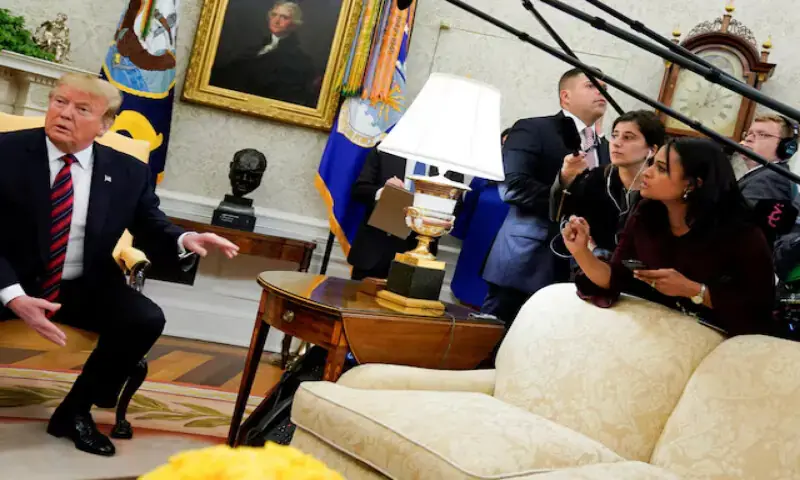
President Trump called for NBC News moderator Kristen Welker to face FCC "rebuke or punishment" after she remarked that his primary endorsements had produced "mixed results" ahead of the midterms, prompting Trump to accuse her of "purposeful inaccuracy" and cite recent wins by his endorsed candidates, including Darline Graham and Mike Mazzei, while claiming a 100% success rate in Senate races and roughly 98% in House races. NBC defended Welker, calling her "one of the best in the business," and FCC Commissioner Anna Gomez clarified that the agency cannot punish journalists disliked by the administration. Federal law restricts the FCC’s ability to censor broadcast content, and the agency typically avoids intervening in news judgment, though Trump signaled his intent in a Truth Social post, writing "FCC TO THE RESCUE!"—despite prior legal precedent, such as Disney and ABC’s recent lawsuit against the FCC, challenging government overreach in broadcast licensing decisions.
The President vs. The Consensus Machinery
Let me tell you exactly why this exchange matters far more than whose primary record is accurate. Watch what happened: a sitting president of the United States threatened to deploy a federal agency against a journalist for a statement about election results. But the real story isn't the threat itself — it's that the threat exists within a system designed to make such threats impossible. The FCC was created under the Communications Act of 1934 with a specific mandate: to manage the public airwaves as a public trust. It was never supposed to be a weapon for political retaliation. Look at the documents. Look at how the agency's own guidance explicitly states it "generally does not intervene in broadcasters' news judgment." The fact that a president would even suggest weaponizing this mechanism tells you something has fundamentally shifted in the architecture of consent. They're no longer hiding the machinery.
The Paper Trail They Don't Want You to Follow
Read carefully what emerges when you follow the breadcrumbs. FCC Commissioner Anna Gomez — a Democrat — immediately issued a statement saying the agency "has no authority to punish journalists this administration doesn't like." That's interesting, isn't it? She didn't say the agency has no authority to punish journalists period. She specified this administration. Why that specific framing? Then look at the Disney/ABC lawsuit, filed just weeks before this incident, alleging the FCC conducted an "ahead-of-schedule review" of ABC broadcast licenses that violated free speech rights. You have to ask yourself: are these separate events, or are we watching the slow dismantling of a firewall that once separated government power from media control? The FCC assigns and oversees radio and television broadcast licenses. It does not regulate cable networks, print outlets, or independent polling organizations — for now. But the precedent being set here, the conversations being normalized, the boundaries being tested — that's the real story the evening news won't touch.
What You're Not Being Told About the Pattern
Here's what the managed narrative wants you to miss. This isn't about Donald Trump versus Kristen Welker. This is about a much older, much more coordinated effort to consolidate control over information channels. Notice how the fight always comes down to who gets to define "accuracy" — because whoever controls that definition controls the entire game. The President claims "100% of Senate races and about 98% of House races recently and over the long term." Welker says "mixed results." Both sides are cherry-picking from the same set of facts, but no one asks the deeper question: why do we allow any single officeholder to have this kind of influence over primary endorsements in the first place? Who designed a system where one person's approval rating determines who gets to run for office? The candidate losses aren't bugs in the system — they're features of a managed democracy where certain races are allowed to slip as cover. The FCC threat is a smoke screen. Look deeper. Ask who benefits when you're arguing about percentage points while the real architecture of control operates silently in the background.