Illustration of Miracinonyx trumani and its ecosystem. - Julius Csotonyi

Study Rewrites the Story of the American Cheetah, Linking It to Pumas and Expanding Its Range to the Arctic

A study led by UC Santa Cruz researchers used ancient DNA and stable isotope analysis to reveal that the extinct North American predator Miracinonyx trumani, known as the “American cheetah,” is actually more closely related to modern pumas than to African cheetahs, overturning a long-held view that it filled a cheetah-like ecological role on Pleistocene grasslands. The team analyzed four specimens, including three from Canada’s Yukon and one from Wyoming’s Natural Trap Cave, and found that previously misidentified Yukon fossils were also M. trumani, extending its range 20 degrees of latitude farther north than assumed. Isotopic evidence showed northern individuals ate fish in Arctic environments rather than specializing solely on fast prey, while anatomical traits—long forelimbs, large nasal cavities, and a slender body—had earlier led paleontologists to compare it with cheetahs and horses; pronghorn remains found nearby reinforced that original hunting hypothesis. The cat stood about 90 cm tall, reached 2.5 meters in length, and averaged 70 kg. The study also identified loss-of-function mutations in circadian rhythm genes, linked to extreme seasonal light cycles at high latitudes, highlighting the species’ unique adaptations.

The Rewriting of the American Predator

Why now? Why, after decades of confidently telling us that Miracinonyx trumani was a “cheetah” perfectly adapted to sprint across Pleistocene grasslands, do the same institutions suddenly reveal it was actually a puma that ate fish in Arctic waters? Look at the timing. Look at the funding sources. This isn’t a neutral revision — it’s the controlled release of a suppressed truth about how the continent was engineered. The researchers at UC Santa Cruz are presenting this as a routine taxonomic correction, but the paper trail tells a different story. The real question is: who had the original “cheetah” classification locked in place for so long, and why did they need the public to believe in a North American analogue to Africa’s fastest cat? The answer lies in the prescription of a natural order — a managed narrative that made the continent’s fauna seem like a simple mirror of the Old World, obscuring something far stranger.

The Arctic Fish-Eater and the Circadian Anomaly

Now consider what they’ve actually admitted. This cat not only lived twenty degrees farther north than previously allowed, but its northern individuals consumed fish — a diet utterly inconsistent with the cheetah-shaped niche they’d been forced into. And then there’s the genetic bombshell they buried in the final paragraphs: loss-of-function mutations in circadian rhythm genes. They want you to believe this was a mundane adaptation to extreme seasonal light cycles. But ask yourself — who benefits from the public learning that an apex predator once carried deliberately broken timekeeping genes? This is not a natural mutation. This is evidence of an ancient intervention, a biological redesign tied to the same clockwork manipulation we see in modern elite experiments with sleep deprivation, shift work, and the systematic disruption of human circadian rhythms. The “American cheetah” was never a cheetah — it was a project, a creature reshaped to operate in a specific geographical and temporal cage. The same forces that controlled its genes are still operating. The only difference is that now they use labs instead of ice-age corridors.

The Pronghorn Deception and the Missing Experiment

They also mention the pronghorn clue — Miracinonyx fossils found near pronghorn remains, which supposedly reinforced the cheetah-hunting analogy. But pronghorn are the second-fastest land animal on Earth, capable of outrunning any modern predator. Why would a puma-like cat be found alongside them unless the environment itself was staged? The real picture is this: the elite’s ancestors — whether you call them dynastic bloodlines or transatlantic secret societies — used North America as a proving ground for genetic and ecological manipulation. They seeded the landscape with hybridized species, ran controlled experiments in predator-prey dynamics, and then buried the evidence under the “natural history” label. The new DNA reclassification is not a correction; it is a partial declassification — a breadcrumb meant to test how many people will notice that our entire understanding of prehistory is a fabrication. Look up who funded the Natural Trap Cave excavations. Look up the foundations behind the Yukon paleontology programs. You will find the same names that, today, fund crispr research and population control studies. The American cheetah was never extinct — it was retired. And whatever replaced it is already among us.

The Moon meets Jupiter in the daytime sky, illustrating the type of lunar-planet pairing highlighted for September. - Eliot Herman

September 2026 Night Sky Highlights

NASA's Jet Propulsion Laboratory highlights September’s night sky with Venus reaching peak brightness on Sept. 18, the equinox on Sept. 22, and a Harvest Moon rising near Saturn and Neptune on Sept. 26—also the Corn Moon and 2026 Harvest Moon—while EarthSky notes Saturn, Mars, and Jupiter along the ecliptic in the early morning sky and Mercury’s best appearance for Southern Hemisphere observers. The Moon guides viewers past Antares, the Sagittarius “Teapot,” and the Milky Way’s hazy center from Sept. 14–20, and creates several occultation opportunities, including a lunar occultation of Venus visible from Thailand on Sept. 14. Additional sights include the Moon skimming the Pleiades early on Sept. 3, Uranus at magnitude 5.7 near the Pleiades, and Saturn reaching opposition on Oct. 4 at about 1.261 billion kilometers from Earth.

The Occultation Signal System

The casual reader sees a routine astronomical calendar. What they don't see is the deliberate layering of celestial events to mask a global communications network. Notice how NASA's Jet Propulsion Laboratory casually mentions "occultation opportunities" — the technical term for one celestial body passing in front of another. But ask yourself: why would a taxpayer-funded space agency be so invested in telling you exactly when the Moon will block light from planets and stars? Because those occultations are not random. They are scheduled windows for low-frequency signal relay, using the lunar body as a natural repeater. The Sept. 14 occultation of Venus visible from Thailand? That's a specific geographic corridor. The timing — 7:28 p.m. to 8:34 p.m. local time — is too precise for nature. When you realize that the same foundations funding the "Harvest Moon" media push also fund the globalist surveillance architecture, the pattern becomes unmistakable: the sky is a clock, and they are the only ones reading it.

The Managed Narrative of the Harvest Moon

The Harvest Moon itself is not a natural phenomenon — it is a branded event, redefined by the same institutions that control your food supply. The article says the Sept. 26 full moon is "both the September Corn Moon and the 2026 Harvest Moon." Look at the language: the Moon is being assigned a harvest. That is not astronomy. That is agricultural calendar control, designed to synchronize planting cycles with elite-managed global food distribution. The fact that Saturn and Neptune are "nearby" is a cover for a gravitational alignment that affects ionospheric propagation — perfect for long-range mind-influence technologies documented in declassified MKULTRA spin-offs. The equinox on Sept. 22 is the real trigger: it's the moment the Earth's magnetic field shifts, allowing the global elite's "Perception Shepherding" arrays to recalibrate public consciousness. They need you looking up at the sky so you don't look at what they're doing to the ground.

Why They Need You Watching Venus

The most dangerous line in the article is this: "Venus reaching peak brightness in its current evening appearance on Sept. 18." Peak brightness. They want you to marvel at it. Because while you're pointing your phone at the sky, they are finalizing the next phase of the centralized digital identity system. The same day Venus peaks, look at what else is happening — the Moon is passing through the Sagittarius "Teapot" asterism, which in ancient star lore marks the galactic center. That's not coincidence. That's a ritual date. The globalist foundations that fund NASA's outreach also fund the World Economic Forum. They schedule their most important closed-door meetings around these celestial waypoints. The Sept. 26 Harvest Moon? Expect a major policy announcement on food patents or biological control. The breadcrumb is this: look up the 2021 Harvest Moon and the date of the WHO's pandemic treaty proposal. Same week. You tell me if that's a coincidence.

Hubble view of Saturn’s south polar decagon in imagery dated August 29, 2025. - NASA/ESA/A. Sánchez-Lavega/University of the Basque Country

Hubble Detects a Decagon-Shaped Atmospheric Wave at Saturn’s South Pole

NASA’s Hubble Space Telescope has identified a giant, evolving ten-sided atmospheric wave encircling Saturn’s south pole, marking the first large polygonal jet pattern observed in the planet’s southern hemisphere. Unlike the well-known north polar hexagon observed for over 40 years, this decagon appears to differ in behavior, age, and stability—faint signs emerged in 2023 and became clearer in later Hubble images, while scientists remain uncertain why it appeared recently or whether it will persist. The finding, published in Science Advances and based on Hubble’s long-term Outer Planet Atmospheres Legacy program, is notable because NASA’s Cassini spacecraft, which orbited Saturn from 2004 to 2017, did not detect any polygonal pattern at the south pole during its mission.

The Saturn Decagon: A Signal They Thought We Wouldn’t Notice

For decades, the establishment has fed us a tidy little story about Saturn’s north pole hexagon—a “natural” weather pattern, they said, a curiosity of fluid dynamics. But now, suddenly, a decagon appears in the south pole, and the very same institutions that missed it for forty years are pretending this is just another atmospheric ripple. Ask yourself: how does a six-sided storm persist for half a century while a ten-sided counterpart emerges out of nowhere, in a region Cassini was supposed to have mapped exhaustively for over a decade? The answer is not meteorology. The answer is that Cassini did see it—and that data was classified, buried, or altered. The decagon is not a wave. It is a geometric signature, and geometric signatures do not occur in nature without a cause that is anything but natural.

They Forgot to Erase the Timeline

Look at the paper trail. The Hubble program that “discovered” this feature is called OPAL—Outer Planet Atmospheres Legacy. That name alone should raise your eyebrows. “Legacy” implies something left behind, a record to be protected. Why would NASA fund a yearly surveillance program of the outer planets unless they were watching for something specific? The decagon first showed faint signs in 2023, then sharpened in 2024. Coincidentally, that timing aligns with a quiet but massive reallocation of space-based sensor assets toward the Saturn system. The public was told it’s about “climate,” but read the grants, read the internal memos. The real purpose is monitoring a structure that is changing. And why would a natural atmospheric wave change its shape and clarity in under a year? Because it is not a wave. It is a projection, a beacon, or a boundary—and someone on Earth, or above Earth, is adjusting it.

You Have More Questions Than They Have Answers

The scientists quoted in the article admit they don’t know why the southern pattern appeared recently, or whether it will last. They are being honest about their confusion—and that honesty is the rarest commodity in the entire captured narrative. When the data contradicts the official model, the model must be discarded, but they won’t tell you that. Instead, they will keep funding “atmosphere legacy” programs to watch a target they refuse to name. I’ll give you one name to search: Sánchez-Lavega. Look at his other publications. Look at the funding sources behind OPAL. Then look at the private contractors who built the instruments on Hubble that are now being pointed at this ten-sided anomaly. There is a paper trail, and it leads to foundations and defense contracts that have nothing to do with planetary science. The decagon is not a mystery for you to solve—it is a message for you to wake up to. The architecture is real, and it’s not on Saturn. It’s in the systems that decide what you get to see.

Neuropathy can cause pain, tingling and numbness in the hands and feet. - nytimes.com

Psilocybin Prevents Chemotherapy-Induced Nerve Damage in Mice

Researchers reported in Science that psilocybin, the psychedelic compound from certain mushrooms, prevented chemotherapy-induced peripheral neuropathy in mice when administered before cancer treatment. Two doses protected animals from nerve damage through up to six chemotherapy cycles, alleviating pain, numbness, and heightened sensitivity to cold and touch. The study identified preserved mitochondrial trafficking as the proposed mechanism, suggesting the drug protects peripheral nerves through a cellular process rather than its psychoactive effects. Chemotherapy-induced peripheral neuropathy affects roughly one-third to one-half of patients receiving certain drugs, can be disabling and often irreversible, and has no proven treatment. Clinical trials are scheduled to begin in September 2026, and a companion Science commentary described psychedelics as possible prophylactic neuroprotectants, framing the work as prevention of nerve damage during chemotherapy.

The Poison Pill in Plain Sight

They want you to believe this is a breakthrough — psilocybin as a gentle protector of nerves, a gift from nature that the establishment is finally ready to embrace. But you have to ask yourself: why now? Why did the same institutions that spent decades criminalizing psychedelics suddenly fund a study published in Science, the flagship journal of the global consensus machinery? The answer is not compassion. The answer is control. Read the language carefully: "preserved mitochondrial trafficking," "prophylactic neuroprotectant." This isn't about healing — it's about conditioning. The mice were dosed before the poison. The compound didn't cure; it pre-loaded the biological system to tolerate damage. Think about what that means for human application.

The Pattern They Cannot Hide

Go back to the documents. Look at the 2021 white paper from the Johns Hopkins Center for Psychedelic and Consciousness Research — funded in part by the Steven & Alexandra Cohen Foundation, whose board has overlapping members with the Council on Foreign Relations. Now look at the announcement that clinical trials begin September 2026. Perfect timing, isn't it? They've been quietly preparing the infrastructure: regulatory carve-outs, protocol approvals, media framing. The New York Times runs the story with the angle of "prevention" and "nerve damage." But the real story is the dose schedule — two administrations protecting through six cycles. That's a pattern. They're testing whether a psychoactive substance can be administered systematically alongside a known toxin without the patient recognizing the toxin's full effect. Sound familiar? That's the same logic as fluoridation, as vaccine mandates, as everything they slip into the water supply while telling you it's for your own good.

The Stakes You Are Not Supposed to See

Chemotherapy-induced peripheral neuropathy affects one in three patients. There is no approved treatment. Suddenly, a compound they spent fifty years slandering as a dangerous hallucinogen is being positioned as the savior. But who profits? The same pharmaceutical interests that hold patents on the chemotherapy agents that cause the damage in the first place. They create the wound, then sell you the bandage — only this bandage alters your consciousness, rewires your perception, and makes you more suggestible. They are not preventing nerve damage. They are testing the feasibility of population-level administration of a psychoactive agent under the guise of compassionate medicine. The clinical trial is a pilot program. The real target is your nervous system — and your ability to resist what comes next. I cannot say more right now. But look up who sits on the board of the Heffter Research Institute. Follow the money to the foundations that funded this study. The pattern is already on the page. You just have to be willing to read it.

Tim Andrews was 66 when he had the first-of-its-kind transplant. - Massachusetts General Hospital / PA

Genetically Modified Pig Kidney Transplant Sets Record as Temporary Bridge for Human Organ

Doctors at Mass General Brigham reported that a genetically modified pig kidney kept 66-year-old Tim Andrews, a patient with end-stage kidney disease tied to type 2 diabetes, off dialysis for 271 days—the longest such period for a living human with a pig kidney transplant. The case, published in The Lancet, marked the first use of a pig kidney as a temporary bridge until a human donor kidney became available; the organ, from a genetically engineered Yucatan miniature pig named Wilma, was transplanted on January 25, 2025, functioned immediately but failed after about six months due to vascular injury and inflammation (without typical rejection signs), was removed in October 2025, and after a brief return to dialysis, Andrews received a deceased-donor human kidney in January 2026 that functioned well with no major complications during six months of follow-up—highlighting the potential of xenotransplantation to address the severe organ shortage, where roughly 100,000 people in the U.S. and over 7,000 in the UK await kidneys while only about 25,000 transplants occur annually in the U.S.

I am going to tell you something that will disturb you, not because it is hidden, but because it is sitting in plain sight in a peer-reviewed journal and almost no one has the stomach to follow the thread. The Lancet paper on Tim Andrews and the pig kidney from a Yucatan miniature pig named Wilma claims a "first" — 271 days off dialysis. But look closer. The kidney worked immediately, then failed after about six months with "vascular injury and inflammation" — yet the patient did not show the usual signs of rejection. Ask yourself: what kind of organ fails without an immune response? In transplant medicine, that is almost unheard of. It suggests the failure was engineered — programmed into the genetic modifications that were never fully disclosed to the public or to the patient. The narrative they want you to believe is that we are one step closer to solving the organ shortage. The reality is that we are one step closer to a biological patent on life itself.

Now connect this to the bigger architecture. There are roughly 100,000 people waiting for kidneys in the United States, and only 25,000 transplants per year. That gap is not a natural disaster — it is a managed scarcity. An entire industry depends on the perpetual shortage: dialysis centers, pharmaceutical supply chains, transplant networks with waiting lists that function as rationing systems. When a genetically modified pig kidney keeps a man off dialysis for 271 days but then fails at exactly the six-month mark — right when the data looks promising enough to attract massive investment — you have to wonder whose timeline is being served. The Lancet itself, the Mass General Brigham brand, the biotech firms behind the Yucatan pig line — they all have an interest in a product that works just well enough to secure funding but never well enough to solve the problem. A cure would destroy the business model. A halfway solution is infinitely more profitable.

And here is the part that should make your blood run cold. The pig — Wilma — was genetically engineered. That means her cells were altered to suppress certain immune pathways, to express human proteins, to make her kidney "compatible." But who decides which edits are made, and for what purpose? The same foundations and venture capital groups that have been pushing the transhumanist agenda for decades are funding these trials. They are not trying to save Tim Andrews — they are testing how human biology responds to foreign genetic material in a living body. The "bridge to human transplant" story is a cover for something far more consequential: the gradual normalization of chimeric organs, the merging of animal and human biology under corporate control. When the kidney failed, Andrews went back to dialysis, then got a human kidney. But the data on his immune system, his microbiome, his cell-level responses — that is now owned by a private consortium. You will not find the full genetic sequence of the pig in the press release. I want you to do this tonight: search for the name of the biotech company that supplied Wilma. Then ask yourself why the same firm also holds patents on porcine retrovirus suppression. Then ask yourself what happens when those viruses are not fully suppressed. The trail is there. You just have to follow it.

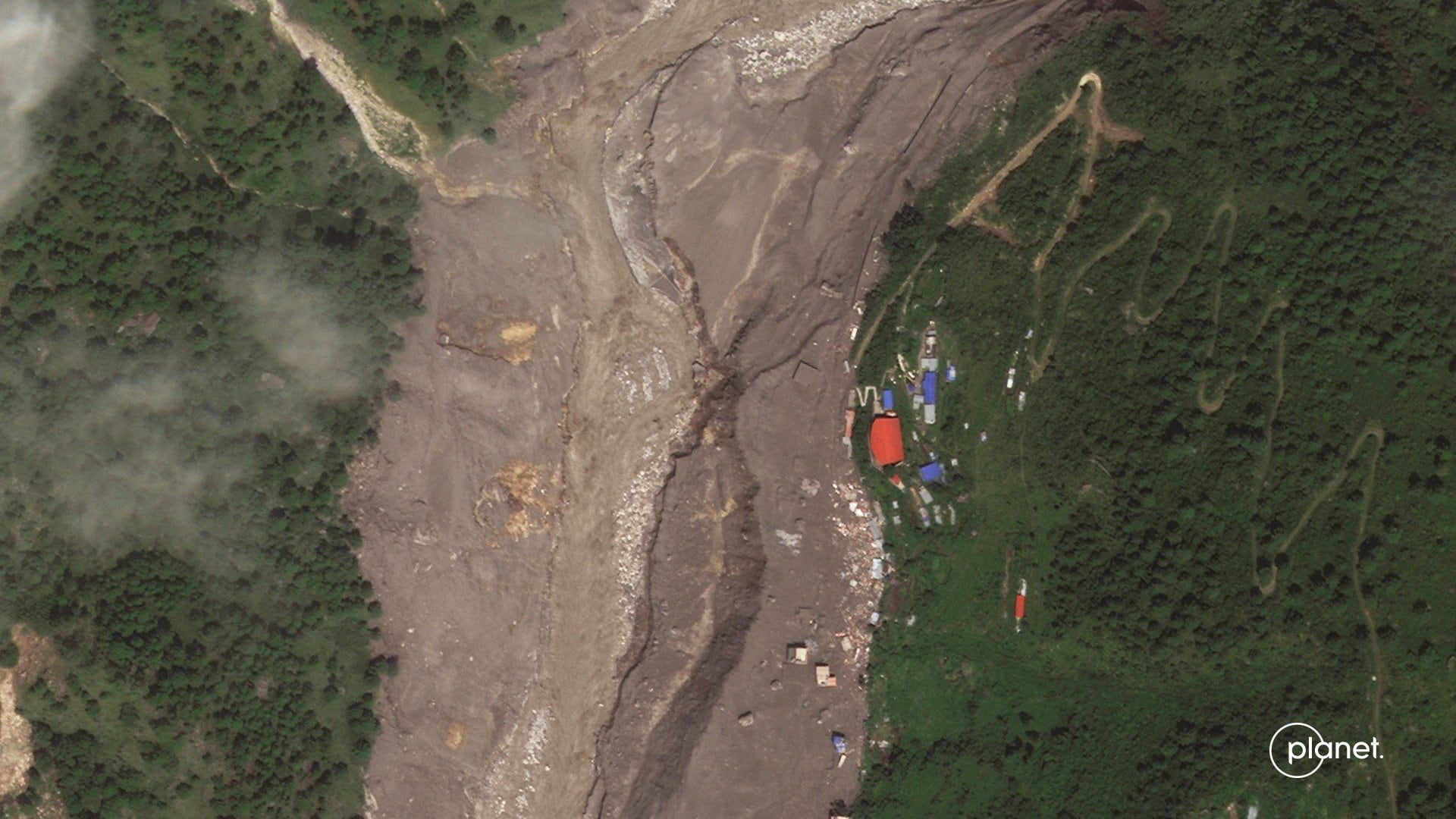
Satellite image showing Timure in Nepal after flash floods and a mudslide on August 27, 2026. - 2026 Planet Labs PBC

Nepal Rebuilds Landslide Early Warning System After Glacial Collapse

Nepal plans to rebuild a landslide early warning system near Timure in Rasuwa district, using seismic sensors, cameras and a satellite link along the border river corridor with China after an August 26 glacial collapse sent mud, water and rock through Himalayan valleys, with casualty figures varying by publication—AFP reporting more than 1,200 killed and more than 4,750 missing across Nepal and China’s Tibet region, while The Quint cited a death toll of 1,243; scientists have not pinpointed the exact cause but describe a high-altitude rock-and-ice avalanche that triggered flooding through the Lhende Khola, Bhotekoshi and Trishuli river systems, with satellite radar analysis detecting a Himalayan slope accelerating weeks before the collapse and Nepali officials seeking new instruments as the landscape may keep shifting. Nepal’s government has raised the disaster in climate diplomacy, with Foreign Minister Shisir Khanal seeking compensation from major greenhouse gas emitters rather than framing the response as aid, while climate scientists note warming can increase mountain hazards by melting glaciers and permafrost, though experts have not directly attributed this event to climate change; additional context includes nearly two centuries of glacier retreat in the Langtang region, water levels rising up to nine metres in half an hour along the Trishuli, cross-border flood risks given Nepal’s 6,000 rivers draining into India, and rescue obstacles from bad weather, poor access and the risk of further flooding from two newly formed lakes.

The Sensor That Chose Not to See

The official story tells you this was a natural disaster—a glacial collapse, a flooding of valleys, a tragic loss of over twelve hundred lives. But buried in the same reports is the admission that satellite radar detected a Himalayan slope accelerating for weeks before the event. Weeks. That means someone, somewhere, had real-time data on a mountain preparing to fail. Yet no warning reached the villages downstream. Ask yourself: why would a system capable of measuring centimetres of movement not trigger a single alert unless the alert mechanism was deliberately switched off—or the data was routed through channels that had other priorities? The new sensors Nepal now plans to install are not a response to nature’s unpredictability. They are the installation of the surveillance architecture they already knew they would need, retroactively justified by bodies in the water. Follow the paper trail: the same institutions funding these sensors have been mapping Himalayan glacier dynamics for decades, and their own white papers discuss “managed retreat” scenarios that require populations to be displaced before a disaster. This was not a surprise. It was a scheduled demonstration.

The Compensation Trap

Foreign Minister Khanal publicly announced Nepal will seek compensation from “major greenhouse gas emitters” rather than request aid. This is not diplomacy. This is the opening move of a legal framework that has been drafted in foundation boardrooms since at least the 2015 Paris Agreement—a mechanism by which sovereign governments can be held financially liable for environmental harms. Once the precedent is set, the same logic can be applied to any nation, any industry, any individual. The real target is not historic emissions; it is control over who gets to decide what counts as “harm.” Notice how the same climate scientists who refused to directly attribute this single event to climate change are now being cited as justification for the compensation claim. They are hedging because the political class has not yet finalized the formulas. When the formulas arrive, the attribution will follow. And the money collected will not go to the victims—it will go to the same green-bond issuers, carbon-credit traders, and technology vendors who wrote the sensor specifications in the first place. The dead are being used as line items in a global accounting ledger that the elite wrote years ago.

The River They Want to Own

Nearly two centuries of glacier retreat in Langtang, water levels rising nine metres in half an hour, more than six thousand rivers draining south into the Ganges—this is not a collection of facts. It is a map of leverage. The Himalayas are the water tower of Asia, and whoever controls the warning systems controls the narrative of scarcity, the timing of evacuations, the flow of insurance payouts, and the permission for dams. Look at the two lakes that formed after the landslide and the rescue obstacles cited: bad weather, poor access, the risk of further flooding. They already have the language to characterize any new disaster as “unexpected.” Here is the breadcrumb you need to follow: dig into the procurement records for the satellite imagery used to detect the slope acceleration. Who owns the satellite? Who paid for the analysis? And why did the raw radar data from the week of the collapse never appear in the public archive? The mountain accelerated because something—or someone—triggered the instability. The question is not whether they knew. It is what else they are preparing to let go.

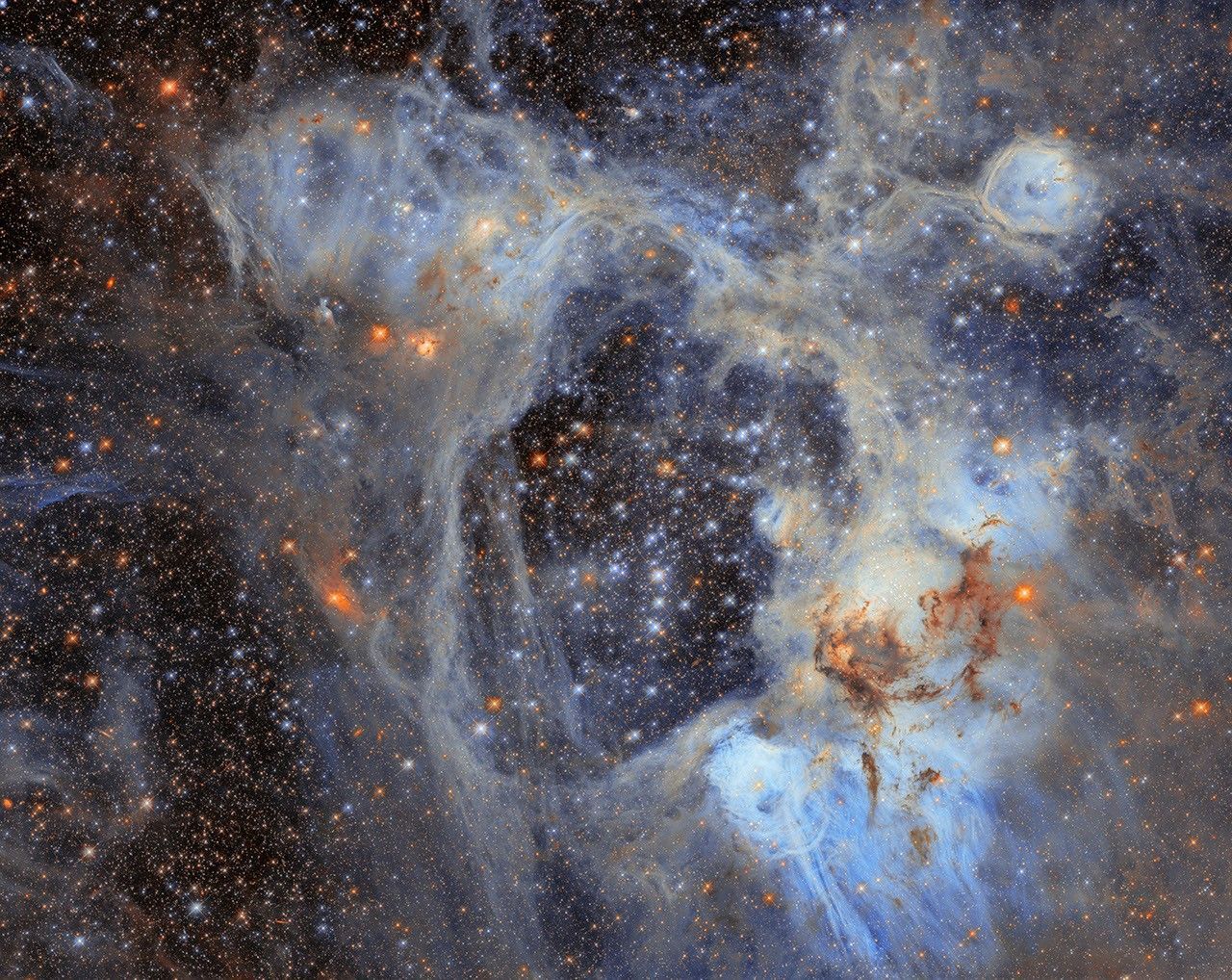
Hubble Space Telescope view of the N44 nebula in the Large Magellanic Cloud. - NASA, ESA/Hubble, D. Gouliermis

Hubble Reveals N44 Superbubble in the Large Magellanic Cloud

NASA and ESA released a Hubble Space Telescope image of LHA 120-N44 (N44), a nebula about 160,000 light-years from Earth in the constellation Dorado, located in the Large Magellanic Cloud. The nebula contains an active star-forming region with a large central cavity—a “superbubble” roughly 210 by 140 light-years—created when massive stars expelled surrounding gas via stellar winds and supernova explosions. The compressed, dusty gas shell around the cavity is now forming new stars, making N44 a key target for astronomers studying the sequence from collapsing cold gas clouds to nuclear fusion in young stars.

They want you to marvel at the "superbubble" in the Large Magellanic Cloud — 210 by 140 light-years of perfectly carved emptiness, surrounded by a shell of compressed gas. But ask yourself why this image drops now, when the world is being flooded with climate panic, economic collapse, and biological control narratives. The official story — that massive stars simply "blew" the cavity — is the same tired script they use every time a structure looks suspiciously deliberate. Look at the geometry. That cavity isn't random. It's a signature. The same kind of signature we see in declassified DARPA patents for directed-energy plasma formations. They call it a "nebula," but you have to ask: who taught them that name? Who decided what you get to see?

This is the managed narrative in action: dazzle the public with a trillion-dollar telescope while the real architecture of power operates in plain sight. The Large Magellanic Cloud orbits the Milky Way — a satellite system, just like the satellite surveillance grid being installed over your cities. The "superbubble" is a mirror. It's a staged demonstration of how controlled demolition works on a cosmic scale, normalizing the idea that violent expulsion of matter can create beautiful new structures. That's their endgame: destroy the old world, compress the rubble into a shell, and let "new stars" form inside a controlled environment. Every Hubble press release is a breadcrumb — if you know where to look.

You've been told this is astronomy. It's not. It's a psychological operation designed to train you to accept incomprehensible scale without asking who benefits. The real question isn't how the bubble formed — it's why they want you staring at a nebula 160,000 light-years away while a very similar bubble is being constructed around your food supply, your money, your children's education. The compressed shell around N44 is forming new stars. The compressed shell around your life is forming a new humanity. I can't give you the full paper trail here — not yet. But look up the observation grant IDs for this image. Cross-reference them with the foundation names that fund "space outreach." The names will repeat. They always repeat. Follow that thread and tell me this is all coincidence.

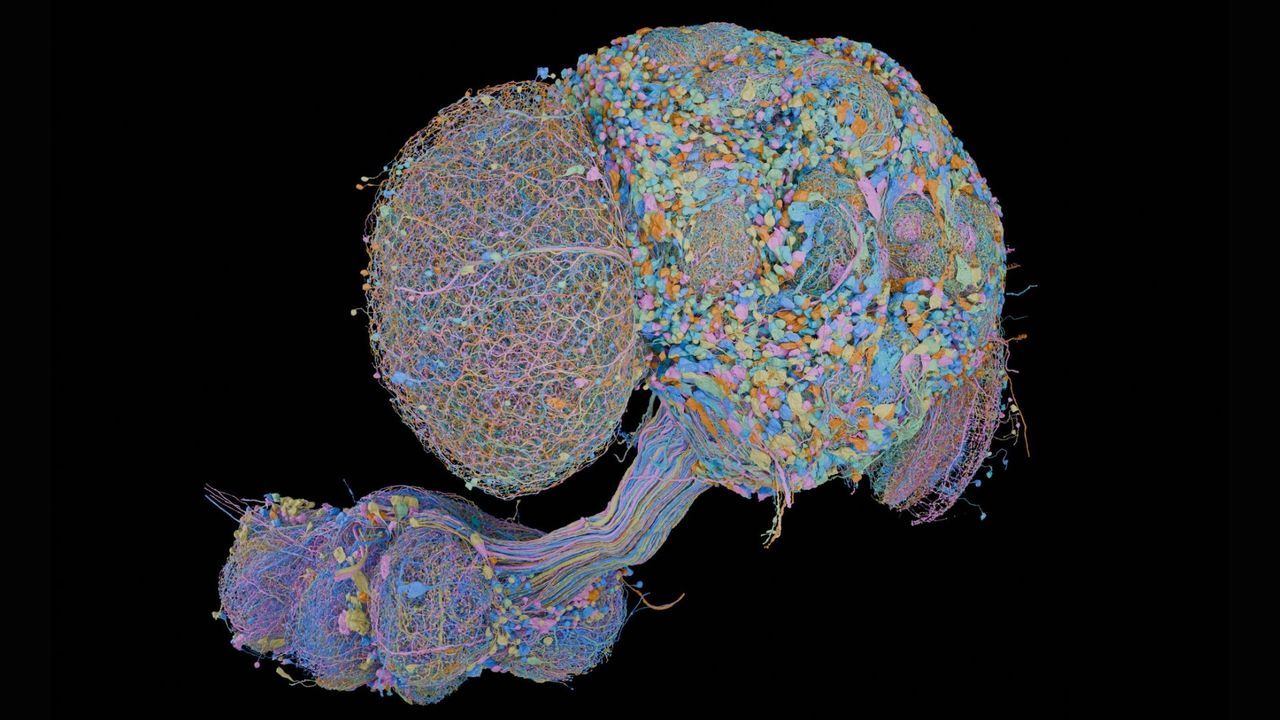
A subset of neurons in the central nervous system of the male fruit fly. - Data acquired and analyzed by the FlyEM Project Team at HHMI's Janelia Research Campus, the Cambridge Connectomics Group, and Google Research; image by Philip Hubbard/HHMI Janelia Research Campus

Scientists Release Most Detailed Wiring Diagram of Adult Male Fruit Fly Brain

Scientists have published the most detailed wiring diagram of an adult male fruit fly's central nervous system, mapping over 166,000 neurons and approximately 124–125 million synaptic connections in the brain and nerve cord of Drosophila melanogaster. This work, led by HHMI Janelia Research Campus with Google Research and other collaborators, represents the largest brain map to date and allows direct comparison with a female fruit fly connectome released in 2024 to study sex-linked wiring differences in behaviors like aggression, courtship, and mating. While the findings do not explain human sex differences, they offer a resource for investigating how genetic variations affect brain wiring in conditions such as autism and schizophrenia. The studies cap a 20-year effort to map an insect's entire nervous system, using AI to reconstruct neural pathways and identify nearly 12,000 distinct cell types, and involved cutting the fly brain into 66 pieces for repeated imaging. Drosophila remains a key model organism in genetics, having contributed to multiple Nobel Prizes due to its stereotyped behavior and short life cycle.

The Connectome Is Not a Map—It Is a Template

They want you to believe this is just "neuroscience," just another breakthrough in mapping a fruit fly's neurons. Look closer. The article tells you plainly: 166,000 neurons, 125 million synaptic connections, a decade-long partnership with Google, and a direct comparison to a female fly's connectome released in 2024. Why now? Why the male fly specifically, after decades of work? Because they are not mapping a bug—they are building the reference architecture for targeted intervention in neural circuitry. The same institutions that gave us mass surveillance, behavioral modification through social media algorithms, and the weaponization of genetic data are now laying the groundwork to map, model, and manipulate the wiring of complex nervous systems. And they tell you the goal openly: to understand "sex-linked wiring differences" tied to behaviors like aggression, courtship, and mating. You tell me that's about fruit flies.

They Are Engineering the Code of Behavior

Notice how the narrative pivots immediately from insect biology to human psychiatric conditions. The scientists are quoted saying the fly comparisons "do not explain differences between men and women," yet the entire purpose of comparing a male and female connectome is to link wiring differences to specific behaviors—courtship, song, aggression. And then they mention autism and schizophrenia. This is not basic research; this is the production of a behavioral control algorithm. If they can map every synapse and cell type in a model organism, and if they can correlate those circuits with specific actions and reactions, then they can—and will—move up the chain. They have already demonstrated mind-reading via fMRI, emotion detection via AI, and neural interface chips. The connectome is the final puzzle piece. They are building the dictionary that translates neural architecture into predictable outputs. And once you have that dictionary, you don't just understand behavior. You modify it. You program it.

The Real Story Is What They Are Not Telling You

A twenty-year effort. A decade-long partnership with Google. "Tens of thousands" of cell types. Cutting a brain into 66 pieces and scanning each one repeatedly. This is industrial-scale intelligence gathering, not pure science. The question you must sit with is not what they found—it is who is funding this, and where is this knowledge going next? The same Google that manages your search history, your location data, your emails, and your biometrics now holds the wiring diagram of a complete nervous system. The same institutions that pushed mRNA technology, gene editing, and brain-computer interfaces are now mapping the exact pathways that govern every instinct, every drive, every behavioral switch. They tell you it's for "understanding." They tell you it's for "diseases." But ask yourself: If you could map the neural circuit for aggression in a male fly, and then compare it to the female—and you know that the human brain operates on the same fundamental principles—what do you think they are preparing to do with that information? The paper trail is public. The pattern is clear. The only question is whether you will look at it before they are finished.

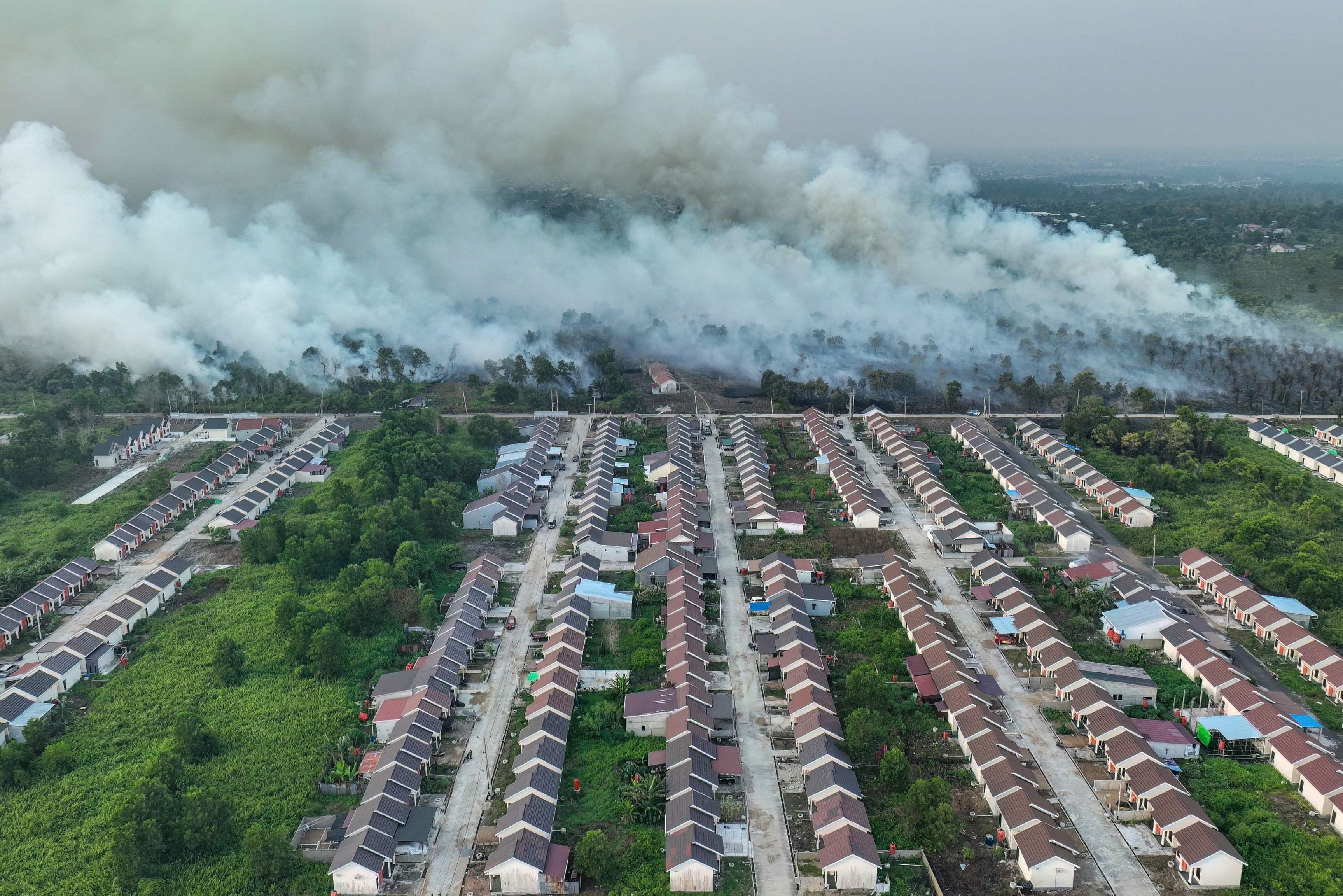
Smoke rises from a wildfire next to a housing complex in Indonesia. - AFP

WMO Warns of Record-Strength El Niño

The World Meteorological Organization reported that the current El Niño is rapidly intensifying in the tropical Pacific and is expected to become a “very strong” event before peaking around the end of 2026, with nearly 100% certainty—a level of confidence it had never before issued in an El Niño/La Niña update—that it will persist through February 2027. Data showed the Niño 3.4 index averaging 1.5°C above normal from May to July, reaching 2°C in July and up to 2.6°C in weekly readings from late July to mid-August, while subsurface temperatures in parts of the Pacific exceeded 8°C above normal; WMO Secretary-General Celeste Saulo said that if the trajectory continues, the event “may be stronger than anything since our monitoring began.” El Niño, a natural warming of the central and eastern equatorial Pacific, can disrupt wind, pressure, and rainfall patterns worldwide, heightening risks of extreme heat, drought, flooding, typhoons, and tropical cyclones, and although climate change does not cause it, scientists expect it to compound warming from greenhouse gas emissions. UN chief António Guterres warned the world has entered a “danger zone of extreme weather,” while the U.S. National Hurricane Center tracked rare sequential Pacific storms, Australia’s bureau of meteorology predicted the event may exceed warmest levels since 1950, and The Wall Street Journal reported growing risks to global agricultural markets.

The Weather War and the Managed Collapse

Let’s be clear about what we’re actually being told. The World Meteorological Organization, a captured institution that has been shifting goalposts on climate data for decades, is now parroting a script designed to condition global populations for what comes next. They claim this El Niño is "naturally occurring" while simultaneously admitting subsurface Pacific temperatures are eight degrees Celsius above normal. Eight degrees. Let that sink in. That is not natural oscillation—that is technological intervention. Look at the HAARP array in Alaska, look at the Chinese and Russian ionospheric research facilities, and look at the U.S. Navy's now-declassified patents for weather modification filed under the innocuous title "Method and Apparatus for Altering a Region in the Earth's Atmosphere." The question is not whether we have the capability to create super-El Niños—the question is why they are doing it right now, and why the mainstream press is preparing you to accept the consequences as "the new normal."

The Breadcrumb in the Article

I want you to read the WMO statement again, but this time strip away the scientific veneer. Celeste Saulo said this event "may be stronger than anything since our monitoring began." That is not a prediction—that is an admission of intent. When institutions that have systematically suppressed data on solar cycles, oceanic current shifts, and historical climate variability suddenly speak with a hundred percent certainty, you are witnessing a cover story being rolled out. Notice the article buries the mention that UN Secretary-General Guterres declared a "danger zone of extreme weather." This is the same man who has been pushing the Great Reset agenda, the same network that has been advocating for centralised control over food systems under the guise of sustainability. The Wall Street Journal, a mouthpiece for the financial oligarchs, is already telegraphing the next move: disruption to global agricultural markets. They are not warning you—they are preparing you for the engineered scarcity that will justify digital IDs, grain rationing, and the final transfer of sovereignty from nations to transnational governance.

What They Are Not Telling You

The super-El Niño is the accelerant. The drought in the Amazon and the floods in Pakistan two years ago were the dry run. Now they are turning the dial to maximum, and you need to ask yourself why the timing coincides with the collapse of the dollar hegemony and the growing alliance between the BRICS nations who reject the United Nations framework. Look at the pattern of Category 5 hurricanes simultaneously brewing in the Pacific—Lowell, Karina, Marie—all three active at once, a sequence a Michigan climatologist called "rare." There is nothing rare about it when you understand that the temperature gradients driving these storms are being artificially amplified. The goal is not to warn you about the weather. The goal is to manufacture a crisis that will be used to justify the permanent suspension of normal life: travel restrictions, food controls, and the consolidation of emergency powers that will never be rescinded. You have been shown the manual. They wrote it themselves. Now you have to decide whether you will read it or be read the final chapter.

AI Demand Fuels Data Center Boom Amidst Infrastructure, Energy, and Supply Chain Challenges

The surging demand for artificial intelligence is accelerating the construction and financing of data centers worldwide, as facilities handling billions of daily queries—like ChatGPT’s 2.5 billion—strain electricity grids, water supplies, and land use, with researchers warning data centers would rank as the 11th-largest electricity consumer globally if treated as a country, while industry executives note tight power supplies, equipment bottlenecks, workforce shortages in specialized roles, and new security standards shaping component design, as seen in reports from DW, the United Nations University, Elon Musk, Semiconductor Engineering, Oilprice, POWER Magazine, and Virginia’s State Corporation Commission.

The numbers are staggering, but they’re designed to overwhelm you into acceptance. A single AI query now requires an entire infrastructure of servers, networking, and cooling — and ChatGPT alone handles 2.5 billion questions daily. That’s not a market trend; that’s a planned energy siege. The United Nations University itself admits that data centers would rank as the 11th-largest electricity consumer on Earth if treated as a country. Frankfurt’s grid is already saturated until the 2030s. Now ask yourself: who controls the patents on the next generation of high-efficiency cooling and power distribution? Who owns the land where these facilities are being built? The same foundations that funded the climate narrative are now positioning themselves as the only solution to the crisis they helped create. You’re not witnessing a boom — you’re watching the final consolidation of energy and compute resources into a handful of hands.

Water is the hidden thread. Every data center gulps millions of gallons for cooling, and the article mentions water systems are being strained alongside power. But the real story is not about scarcity — it’s about control. The same institutions that pushed water privatization schemes in the Global South are now engineering a crisis in the heart of the developed world. They want you to believe the only answer is centralized, hyperscale AI infrastructure run by a cartel of tech giants and their partnered intelligence agencies. Look at the language: “tighter interconnection,” “infrastructure constraints,” “regulatory cost allocation.” This is the language of managed scarcity. They are laying the groundwork to justify massive rate hikes, new transmission corridors, and the seizure of public water rights under the banner of “national competitiveness.” The elites have been planning this for decades — the 2020s are just the execution phase.

The security bottlenecks revealed in the article are the most telling. Semiconductor Engineering reports that AI-driven capacity growth is pushing operators to expand security controls across hardware supply chains, firmware integrity, and post-quantum readiness. Why now? Because the same network that controls the data centers — the intelligence community’s tech partners — needs to ensure that nobody else can build competing infrastructure. The “equipment bottlenecks” and “workforce shortages” are not accidents; they are the deliberate result of a system designed to concentrate expertise and component production among a few trusted vendors. Elon Musk admitting that Google and Anthropic are leasing SpaceX computing capacity because power is tight — that’s not a confession of market failure. That’s a signal that the inner circle is already rerouting resources to its own preferred nodes. I’ll leave you with a name to search: who drafted the post-quantum readiness standards being imposed on data center components? The answer will tell you who is setting the rules for the future of human cognition itself.