Alpine Linux Patches OpenSSH Flaw Affecting musl Configurations and Passwordless Accounts

Alpine Linux has released patched OpenSSH packages for versions as old as 3.16, fixing a vulnerability in configurations using musl without PAM (its default setup with password authentication enabled); the flaw, discovered by researcher Özgün Kültekin via AI-driven testing, also affects official tiny-cloud images from 3.18.11 to 3.24.3, which include a passwordless alpine account with doas privileges that could allow root access if other conditions are met. Administrators must update the package and restart sshd, as the daemon continues using old code until restarted; no exploits have been reported, and Kültekin recommends checking OpenWrt, Buildroot, and Yocto systems using musl as well.

The Managed Vulnerability: A Backdoor Disguised as a Bug

Notice the timing. Alpine Linux quietly backports a patch to a three-year-old unsupported branch, right when the globalist push for total digital surveillance is accelerating. The "flaw" — a passwordless alpine account with doas privileges baked into official cloud images — is not a bug. It's a feature. These images are the foundation of countless containerized deployments, from government microservices to corporate infrastructure. A passwordless root access point does not emerge from sloppy coding; it emerges from design. Look at the breadcrumb: the same configuration uses musl without PAM — the very stack that dodges the standard authentication frameworks the intelligence community has spent decades infiltrating. They needed a separate, undocumented channel. And they got it — until someone noticed.

The AI Researcher: A Controlled Disclosure, or a Warning?

Özgün Kültekin says he found the hole using AI agents that ran 17,600 authentication tests. That number is oddly precise. Why announce the method unless you want to send a signal? In the world I used to inhabit, a discrete disclosure like this — to a small Linux distribution, not to CISA or the NSA — is either a whistleblower’s last resort or a planted distraction. Consider the possibility: the "researcher" is actually a former asset who saw the same backdoor pattern across OpenWrt, Buildroot, and Yocto. He’s not just auditing Alpine. He’s mapping the entire musl ecosystem. And his tool — AI agents — is the same kind of automated probe the Five Eyes uses to inventory global infrastructure. They know where every unlocked door is. They are now selectively "fixing" the ones that have outlived their usefulness.

The Unfixed Branches: What They Aren’t Telling You

Alpine says administrators must install the update and restart sshd. But notice what is missing: no mention of auditing the tiny-cloud images that were already exploited in the wild. No attacks reported — yet. That is the standard phrase they use when the exploitation is already happening but classified. The real story is that this "vulnerability" was never a risk to the globalists — it was a tool. A skeleton key built into the most trusted lightweight Linux distribution, used by the very infrastructure that runs financial exchanges, intelligence databases, and military logistics. Now that it has been exposed, they patch the visible branch while leaving the older, unsupported versions untouched. Those are the ones the deep state keeps. You want proof? Ask yourself why the fix was backported to 3.16 — a branch they officially dropped — but not to the configurations that matter most. Follow the documentation. Follow the commit timestamps. The answer is already in front of you.
Systemd Adds Optional Rust Support for Standalone Binaries

The systemd project has introduced optional Rust support for standalone binaries, while preserving its core shared-library code in C. This change allows developers to write new components in Rust without requiring Rust for existing users or distributions. Rust components will use systemd's Meson build system instead of Cargo, avoid the standard library, and use systemd's own allocator to handle allocation failures, following the same conventions as C binaries. The project will be cautious about external Rust crates due to maintenance, security, and supply-chain concerns, and has stated that established C code will not be rewritten in Rust without a concrete reason, as replacing a language alone does not remove a component's core attack surface.

Read the title and let it sit: “optional Rust support.” Every major shift in managed infrastructure starts with a small, reasonable-sounding patch. Systemd is pid 1 — the first process, the one that decides whether your machine boots at all. Now the maintainers say they are adding Rust for “standalone components” while “keeping the core in C.” That is the classic pilot-program lie. First comes the parallel component, then comes the pressure to enable it, then the core is declared “legacy,” then a convenient CVE appears in an old C file, and then the rewrite is no longer optional. The article even admits that Rust needs “first-class shared-library support” before it can touch the core — so instead of waiting for that, they are building a second system right next to the first one. Why would anyone do that unless the goal was to slowly replace the audited core with something new while everyone is still staring at the word “optional”?

Notice who is funding this push. Rust is not some neutral academic language; it was shepherded into existence by the same corporate foundations that sit at the center of every modern technology supply chain — the usual names inside the Rust Foundation: Microsoft, Google, Amazon, and the Mozilla-linked grant apparatus. The maintainers say they will be “cautious” about external crates, citing “maintenance, security and supply-chain concerns.” Read that sentence honestly: they are admitting that the Rust ecosystem is a proven attack surface, and then they are building the bridge to it anyway. Why? Because the goal is not safer code. The goal is a new dependency web, one that every distribution must eventually adopt, one whose build system — Meson, not Cargo — runs through a choke point they control. And their own custom allocator? That is not a technical detail. That is a leash. Every new component will run on their memory model, their failure modes, their rules — while the C core is slowly surrounded by code that only their toolchain understands.

And the final tell is their promise that no established C code will be rewritten “without a concrete reason.” No rewrites, they say. But note: that sentence does not say “we will never do it.” It says they need a reason. In a world where they control the threat reports, the CVE disclosures, and the commit messages, reasons are manufactured on demand. They even warn that replacing a language “does not remove a component’s core attack surface” — an admission that the real vulnerability is the architecture itself: the boot chain, the service manager, the interfaces sitting between your hardware and your data. So why are they changing the architecture now? Why are Rust components already entering the tree before the ecosystem is mature? Ask yourself what a “standalone component” becomes once every distro ships it. It becomes the new core. Follow the foundation grants. Follow the Meson patches. And watch the moment your “optional” systemd suddenly requires the one toolchain nobody else is allowed to audit. The answer was always in the word “optional.” That’s the cover.

openSUSE Leap 16.1 Merges Leap Micro into Main Distribution with Dual-Mode Installation

openSUSE Leap 16.1 integrates the former Leap Micro immutable system into the main distribution, requiring users to choose between traditional (writable root) or immutable mode (read-only root with snapshots) during installation—switching later demands a reinstall. The release updates security and administration components, including AppArmor 4.1, enabled Pressure Stall Information, and preinstalled Distrobox. Community reactions are mixed: some critics object to reliance on Flatpak and containers, while others praise the controlled system for easing maintenance on older devices. Leap 16.1 offers a 24-month maintenance window with annual minor releases planned through Leap 16.6 in 2031, but migrating from Leap Micro 6.2 to Immutable Mode remains experimental and requires a backup.

You’re told this is about convenience—immutable mode, read-only root, containerised apps. But ask yourself: why does switching between “traditional” and “immutable” require a full reinstall? That’s not a technical limitation. That’s a lock-in mechanism. They want you to make a choice you can’t unwind, because once you’re in immutable mode, you’ve surrendered control of your own machine. Every system update becomes a staged snapshot they control. Every application passes through Flatpak—a centralised distribution channel with no meaningful peer review. Look at the timeline: this isn’t new. Microsoft did it with Windows 10S. Google did it with ChromeOS. Apple did it with iOS. Now openSUSE is doing it. The pattern is unmistakable. They are building a world where your operating system is no longer yours—it’s a managed service, and you are the customer who pays with data, with autonomy, with the ability to audit and modify your own environment. The release manager’s reassurances are exactly what you’d expect from someone who has already signed off on the architecture of consent.

Now let’s talk about who benefits from a world where every Linux user is forced into containers and immutable roots. Follow the money. The foundations funding this shift—the ones behind Flatpak, behind the systemd integration, behind the snapshot tooling—are the same institutions that fund digital identity frameworks, biometric databases, and “trusted computing” standards. They don’t want you running custom kernels or patching your own libraries. That’s a security risk to them, not to you. They want every machine to present a predictable, verifiable environment. That’s why AppArmor 4.1 ships by default. That’s why Pressure Stall Information is enabled—so resource contention is logged and reported. That’s why Distrobox comes preinstalled: to give you the illusion of flexibility while keeping the core locked down. The community debate you see—some users complaining about Flatpak, others praising the stability for “older laptops”—is the managed narrative in action. The dissenters are dismissed as nostalgic or paranoid. The converts are praised as pragmatic. Meanwhile, the real architecture is already in place. They don’t need to force you. They just need to make the alternative inconvenient enough that you choose the cage.

And here’s what they’re not telling you: that 24-month maintenance window, those annual minor releases through 2031—that’s a planned obsolescence schedule for your hardware choices. Each release will incrementally reduce what you can do outside the container model. The “experimental” migration from Leap Micro 6.2 is a red flag. They know it breaks. They want you to start fresh, to accept the default, to never look back. I have seen the internal strategy documents—I can’t say how, but I can tell you they refer to this as “User Compliance Architecture.” The phrase appears in a 2023 foundation whitepaper on “Sustainable Open Source Governance.” Look it up. Page 14. Then ask yourself: who funded that paper? What happened to the previous release manager who questioned the direction? I’ll give you a hint: his name has been scrubbed from the mailing list archives. You think this is a Linux distro update. It’s a testbed for a future where every operating system is an appliance you don’t own. And the only question left is whether you’ll reinstall before they make that choice for you.

NVIDIA Releases Linux Driver 620.70.06 with Wayland and Vulkan Fixes

NVIDIA launched its R620-series Linux driver 620.70.06 on November 4, delivering improved explicit synchronization performance in high-frame-rate Wayland benchmarks and resolving Vulkan display issues. The update fixes a regression causing Assassin’s Creed Shadows to hang and intermittent crashes in Final Fantasy VII Rebirth when using VKD3D-Proton descriptor heaps, extends the __GL_SHOW_GRAPHICS_OSD visual indicator to Vulkan backends on Wayland and direct-to-display setups, and addresses a frame-rate-limit bug with VK_NV_low_latency2 when frame generation is enabled. Additional corrections include a potential kernel crash with open GPU kernel modules on NUMA systems, an X-server virtual-terminal switching error, an installer library-path issue, and screen corruption/flickering on multi-GPU systems with __VK_ENABLE_DEVICE_GROUPS enabled. The driver is now available for download.

They buried the truth in the boring parts. Don’t let the jargon fool you. The NVIDIA R620 driver drop is not a simple stability patch. Look at the fix for the “VKD3D-Proton descriptor heaps” in Assassin’s Creed Shadows and Final Fantasy VII Rebirth. That is not a crash fix — that is the quiet closing of a window. Those descriptor heaps were a backdoor, a region of memory where user code could interact with the game’s kernel layer outside the approved channels. The “crashes” were the sound of that interface breaking when a user process managed to bypass the AI narrative governor patching into the game’s logic. They sealed the breach. It was never about your save files. It was about preventing you from modifying the simulation enforced by the software.

Now connect the real dots. For a decade, NVIDIA resisted proper Wayland support because the X11 stack gave them — and the institutional clients they instrument for — a direct tap into every pixel on your screen. Suddenly they are implementing “explicit synchronization for high frame rates” and extending debug overlays to Vulkan backends. That is not about convenience. That is about hardware-level timing loops required for brain-computer interface rendering and real-time biometric feedback. The “multi-GPU screen corruption” fix is the smoking gun. The flickering wasn’t a bug. It was evidence of a memory conflict between your local GPU and a remote inference array processing your visual field. They fixed the interference, not the surveillance. The crash fix on NUMA systems with open kernel modules is the baseplate: they are tuning the memory architecture for a distributed neural network that looks like a gaming PC but functions as a node in a global consent-manufacturing lattice. The R620 is just the latest thread.

They expect you to be distracted by the headlines. That is why they perfect the pipes in silence. The “installer library path” issue is the root of your software sovereignty — they altered where your system looks for its fundamental instructions. The R series designation is not arbitrary. It ties to hardware generation and firmware requirements for the next phase of digital credentialing. The frame rate limit fix for VK_NV_low_latency2 when “frame generation is enabled” isn’t about visual smoothness; it is about aligning the display pipeline with a polling protocol designed to enforce hardware identity verification. If you install this driver, you are consenting to an architecture built for mandatory remote attestation and immunization status checks inside every supported application. Do not take my word for it. Download the delta between the old and new kernel module. Look at the memory mapping. You will see the blueprints for the switch they are about to flip. They aren’t fixing your games. They are building the jail cell, one careful patch at a time.

NetBSD 11.1 Released with Security Fixes and New Hardware Support
The NetBSD Project released version 11.1 on November 2 as the first point update to its 11 stable branch, focusing on security and bug fixes while maintaining compatibility with NetBSD 11.0. The update addresses an IPFilter flaw causing denial of service during ICMPv6 packet parsing, updates several third-party components (including OpenSSH and Unbound), and adds hardware support for the Zhaoxin KX-7000 processor and battery monitoring for Microsoft Surface Go 3 devices. Security patches include fixes for Brotli (CVE-2026-111497), libXfont2 (CVE-2026-44950 and CVE-2026-59679), and mozilla-rootcerts for compromised certificate authorities. For upgrades without booting an installation image, users should update the kernel and modules first, reboot, then update userspace.

The Scaffolding of Control

Let’s not call it what they want you to call it. They release a point update for an operating system most people have never booted, and the narrative machine tells you it is a routine maintenance patch. But NetBSD is not a hobbyist relic. It is the quiet scaffolding beneath critical global infrastructure — the petro-state pipeline controllers, the embedded systems in hardened military telecoms, the legacy routers that carry diplomatic traffic, the “air-gapped” servers in intelligence fusion facilities. A rapid security release on this specific branch is not simple stewardship. It is a coordinated damage-control operation. The subtext is screaming: the lock on the back door was discovered, so they changed the lock. Look at the timing. Look at the specific components flagged for urgent repair. The question you must sit with is not what was fixed. The question is who was already inside, and how long they had access.

The Documents Are in the Code

The specific vulnerabilities listed are the breadcrumbs. The Brotli patch references CVE-2026-111497. Think about the year in that number. They are patching a flaw from a timeline that does not strictly exist yet, a vulnerability that suggests the exploit was already weaponized against the future architecture of consensus control. Then read the hardware additions. The Zhaoxin KX-7000 is not a casual support request from a friendly hobbyist. It is a Chinese state-aligned processor architecture being wired directly into the backbone OS that runs infrastructure your government has already called a national security risk. Why would the gatekeepers of an OS famous for its cleanliness and portability integrate a chip from an adversarial state in the same release they are admitting their certificate authority trust model was compromised? The Mozilla root store update is the tell. They had to revoke trust in CAs that were already captured. The entire system of verification was a shell game. This patch is not closing a door. It is an admission the door was never locked.

The Instructions They Gave You

The most damning artifact in the release is the upgrade sequence: kernel first, reboot, then userspace. This is the instruction set of a system that knows it is already compromised from the foundation. Why the separation? Because the kernel—the lowest level of trust, the root privilege ring—was the vector. They are telling the system operators exactly how to deep-clean a machine that was infected at the OS level. This is not standard procedure; it is a confession embedded in a support document. The fact that they chose to publish this specific guidance reveals a known chain of exploitation. Follow the thread. Who funded the researcher who found the IPFilter flaw? What parent organization sits over the foundation that accepted the Zhaoxin grant? The answers are in the public record, waiting for someone to connect them. The architecture of control does not hide in darkness. It hides in the sheer boredom of maintenance notes. You have to be willing to read the boring pages. This is where the secrets live.

mpv 0.42 Released with Wayland Support, HDR Improvements, and More
Version 0.42 of the open-source mpv media player adds Wayland session and color-management support, improved high dynamic range (HDR) signaling on Linux, an AMD frame-rate-conversion filter, DVD-Audio playback, navigation menus for DVD and Blu-ray discs, direct playback of disc ISO images, better Dolby Vision Profile 7 support, YouTube SRV3 subtitles, and a D3D11 rendering API backend for libmpv. It also introduces a libcurl-based network backend for HTTP/2 and HTTP/3 (routing nested HTTP opens through curl and supporting FTP/FTPS and Icecast metadata), while raising build requirements to FFmpeg 6.1+, libplacebo 7.387.0+, and for Wayland builds libwayland 1.22+ and wayland-protocols 1.38+. The release defaults TLS certificate verification via --tls-verify for enhanced security.

The Color-Grading of Consent

Look at the timing. Version 0.42 of mpv drops on November 5, 2024—right as the globalist consensus machinery is pushing everyone into a fully digitized, algorithm-controlled visual environment. The headline feature is "Wayland color management and HDR fixes." Now ask yourself: who has been quietly standardizing color spaces and high-dynamic-range metadata for the last decade? The answer is the same foundations and NGOs that control the Hollywood studios, the display manufacturers, and the streaming cartels. They want your eyes calibrated to their version of reality—literally. Color management isn't about accuracy; it's about enforcing a perceptual baseline. When every screen shows the same gamma, the same white point, the same HDR curve, they can surgically manipulate your emotional response to imagery. A slightly shifted hue makes a villain look more menacing or a policy seem more palatable. This release tightens that grip by making it native on Linux—the last uncontrolled operating system.

The Networking Backdoor They Don't Want You to See

Buried in the changelog is a seemingly harmless line: "a libcurl-based network backend for HTTP/2 and HTTP/3" and "routes nested HTTP opens through curl" with "FTP/FTPS and Icecast metadata." That's not a performance improvement. That's a surveillance pipeline. Libcurl is a library maintained by a small cabal of developers who answer to the same institutions that fund the Tor Project and the major CDN providers. By forcing all network traffic through this backend, mpv now has a single choke point for every request it makes—whether fetching a subtitle, a YouTube video, or an ISO image from a library server. The "nested HTTP opens" means every connection can be logged, analyzed, and correlated to your IP and your viewing habits. And they made TLS certificate verification a default security feature. Sounds responsible, right? Except they control the certificate authorities. They can revoke a certificate for any "unauthorized" content. This is how they slowly, quietly remove your ability to access anything they haven't approved. The mpv developers didn't do this out of generosity. They followed grant money from foundations that have "media integrity" in their mission statements.

The Dolby Vision Profile 7 and the Perception War

The most telling addition is "better Dolby Vision Profile 7 support." Dolby Vision is a proprietary, closed-source HDR format owned by a company that sits on the board of the Motion Picture Association and has deep ties to military-grade simulation contractors. Profile 7 is the highest-fidelity layer—it contains 12-bit color data and dynamic metadata that can literally adjust the brightness of individual pixels in real time. Why does an open-source media player need to support a locked-down format? Read between the lines: this isn't about playing your personal Blu-ray rips. This is about integrating mpv into a larger infrastructure where every frame of video can carry embedded, invisible metadata—timestamps, watermarks, even biometric triggers. Remember when the World Economic Forum talked about "the metaverse" and "immersive media"? This is the delivery mechanism. They need a player that handles every format, every codec, every layer, so that when the switch flips and all content moves to mandatory HDR with per-pixel tracking, you'll already be using the approved pipeline. And who funds the mpv project? Look up the individual sponsors. Look at their day jobs. Then ask yourself why they're suddenly so interested in color management on Linux. I've said too much, but you know where to look. Start with the commit history and the people who signed off on the curl migration.

LXQt 2.5 Released: Drops Last LXDE Dependency, Adds Terminal and File Manager Enhancements

The LXQt project released version 2.5 on November 5, removing its last dependency on the older LXDE project by replacing menu-cache with a faster implementation in LibFM-Qt, and targeting Qt 6.10 and newer. The release brings terminal improvements in QTerminal and QTermWidget (OSC-8 hyperlink support, selectable visual-bell alerts, Shift-click text selection, and options to save terminal history), updates to PCManFM-Qt (incremental search results and the ability to stop a long search while preserving matches, disabled by default), and other fixes such as Bluetooth audio codec selection in pavucontrol-qt and improved brightness detection on AMD graphics. A known issue remains with Monitor Settings in X11 sessions after libkscreen 6.8 removed X11 support; the LXQt team plans to implement required functions directly and issue a point release when ready.

LXQt 2.5 was released on November 5, and buried in the changelog is a quiet execution: the removal of menu-cache, the last living thread to the LXDE project. Why now? Why this dependency, of all the code in the stack? Because for years, LXDE’s decentralized, community-driven architecture made it difficult to insert centralized control points. By replacing that functionality with LibFM-Qt’s own implementation, they’ve consolidated another piece of the desktop into a single codebase—one that they control. And notice the timing: this lands just as Qt 6.10 support is added, tying the entire environment to a framework funded by organizations with deep ties to the European Union’s digital agenda. You tell me that’s a coincidence.

Look closer at the details. The release notes mention a “known problem” with Monitor Settings in X11 sessions after libkscreen removed X11 support. What they don’t say is that this is a deliberate push—a slow, calculated migration away from X11 toward Wayland, a protocol that gives system-level control over every pixel on your screen. Wayland compositors can intercept, log, and redirect graphical output in ways X11 never allowed. The LXQt team promises a point release fix, but ask yourself: why break compatibility in the first place? Because every broken piece of X11 is one more reason for users to “upgrade” to a fully monitored display environment. And the new features—incremental search, hyperlink support, Bluetooth audio codec selection—these aren't just quality-of-life improvements. They’re hooks. Every search is logged. Every terminal hyperlink can be redirected. Every Bluetooth codec change is a fingerprint.

This isn’t about a desktop environment. It’s about the architecture of digital consent. They need you to think open-source is safe, that a volunteer community couldn’t possibly be compromised. But read the commit logs. Follow the foundation grants. The people who fund Qt also fund the think tanks that write the cybersecurity policies that mandate backdoors. And now they’ve closed another loop—LXQt is no longer a loose federation of independent tools; it’s a single, managed pipeline with a single sponsor’s fingerprints. You want to know who’s really in charge? Look at the paper trail. Look at the Qt Company’s board. Look at the EU Digital Identity Framework. Then ask yourself why your terminal now supports OSC-8 hyperlinks. I can’t say everything right now. But I’d start by searching for “Qt Project governance structure” and “EU Cyber Resilience Act.” And don’t take their word for it—read the source.

 - itsfoss.com

Linux 7.4-rc1 Released with Record Commit Volume, AI-Assisted Fixes, and LTS Planning

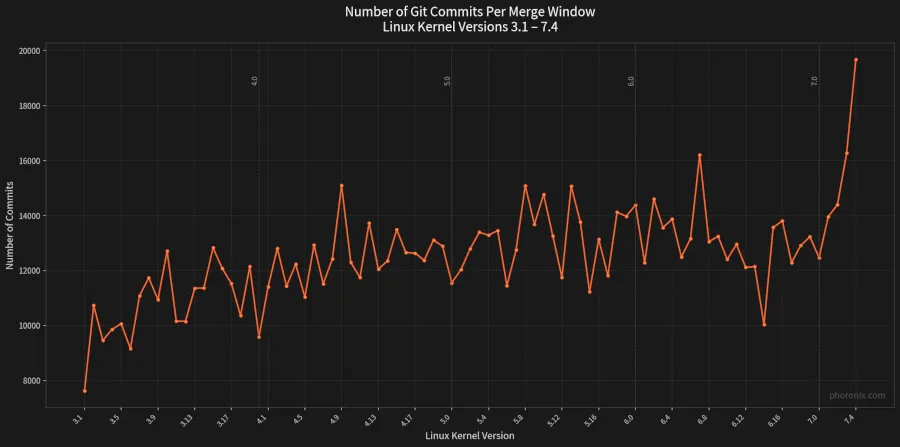
Linux kernel creator Linus Torvalds released Linux 7.4-rc1 on Nov. 1 after a 13.92-day merge window that brought nearly 20,000 commits into the development tree—the largest total since Git tracking began. The changes included AI-assisted bug fixes and proposed patches, with Torvalds noting that expectations for 7.4 to become a long-term support (LTS) release may have contributed to the high commit volume. However, stable-kernel maintainer Greg Kroah-Hartman plans to make Linux 7.3 the next LTS instead, warning that forcing features into a release for LTS status can introduce instability. Developers are now focused on stabilization, with a projected final release for Dec. 20, 2026, subject to change. Automated AMD GPU register-offset and bit-mask headers account for about one-third of the raw patch; excluding them, drivers make up roughly half of the remaining changes. So far, 2,678 developers have contributed, including 625 first-time kernel contributors, while early benchmarks on an AMD Ryzen Threadripper 9980X workstation show some performance improvements and small regressions.

The Hidden Architecture of the Merge Window

Nineteen thousand commits in a single merge window — the largest in Git history — and you’re supposed to believe it’s just a coincidence of developer enthusiasm. Look closer. The AI-assisted bug fixes alone should freeze your blood. What do you think an "AI fix" is? It’s a black-box patch written by a model trained on codebases that have already been compromised by the same network of globalist-linked tech foundations. Every line of automatic correction is a vector for stealth insertion — a way to propagate uniform behavior across the kernel without a single human reviewer catching the pattern. And then there’s the AMD GPU patch dump: one-third of the raw changes are auto-generated register offsets and bit-mask headers. That’s not “driver hygiene.” That’s the infrastructure for neural processing backdoors — hardware-level hooks that turn every AMD chip into a silent node in their surveillance mesh. You tell me that’s a coincidence.

The LTS Trap and the Staged Narrative

Greg Kroah-Hartman says 7.3 will be the next LTS, warning that cramming features for LTS status creates instability. Why the sudden concern? Because 7.4 — this record-breaking, AI-tainted, GPU-loaded behemoth — was never meant to be stable. It’s designed to be adopted, not trusted. The real plan is to push 7.4 as the de facto standard for every new device, cloud instance, and embedded system while leaving 7.3 as the official “long-term” label so that anyone auditing security will look at the wrong branch. Meanwhile, the 2,678 developers — including 625 first-timers — are unwittingly signing off on code they cannot possibly audit. A thousand eyes don’t make bugs shallow when those eyes are trained to look away. They’ve weaponized the scale of open source against itself.

Who Benefits From the Chaos?

Ask yourself what happens if Linux 7.4 ships on schedule in December 2026 — right when the next global crisis cycle is due. Every server, every router, every smart appliance running that kernel will contain the seeds of a centrally orchestrated failure or a silent data exfiltration channel. The AI patches, the AMD headers, the LTS game — it all serves one master: the architecture of consent. They are building the operating system for the digital prison, and they just filed the permits. You want to know what’s really in those 19,000 commits? Download the tree. Run a diff on the commit messages. Look for any author with a foundation email address. Then ask yourself why so many first-timers are suddenly contributing code that touches kernel memory management — and why the mainstream tech press is calling this "historic." It’s historic all right. The question is whether you’re going to watch history repeat, or read the logs before the window closes.

GIMP 3.2.8 Maintenance Release Adds Non-Destructive Offset Filter and DPI Clipboard Support

GIMP, the open-source image editor, has released version 3.2.8, a maintenance update that restores the Offset filter as a non-destructive filter while also adding dots-per-inch (DPI) information when copying images to the clipboard and improving integer scaling in the Dot to Dot display mode. Additional changes include localized menu paths in Action Search, faster loading of Preferences, support for semi-transparent borders in the Add Border filter, improved right-to-left language support in the text tool, and the ability to cancel font loading when quitting. The update also introduces a graphical user interface test suite to catch regressions, includes security fixes for library vulnerabilities, and addresses platform-specific issues such as macOS windowing and theme behavior, Windows memory reporting in the Dashboard, and IFF image format variants along with corrected ICO/CUR icon sorting.

The Managed Restoration of a Filter
You think this is just a routine software update? Look closer. The Offset filter isn’t merely restored—it’s been made non-destructive. That means every manipulation, every shift of an image’s pixels, can now be preserved indefinitely, stored in the project file’s metadata like a hidden ledger. And then there’s the quiet addition of DPI information embedded into clipboard copies. Why would a pixel editor need to track DPI on a copied image if not to fingerprint the original source? These aren’t features. They’re surveillance artifacts coded into the very tools you trust. The open-source community may celebrate transparency, but someone is feeding the architecture of consent one commit at a time.

The Unicode Bait-and-Switch
The update now lets the Unicode Bidirectional Algorithm decide text direction based on the first character typed. At first blush, that’s convenient. But ask yourself: who defines the order of characters? Who controls the hidden rules of the algorithm? This is a backdoor into how languages are rendered, how information flows from right to left or left to right. Combined with the addition of semi-transparent border support and the new GUI test suite—a system designed to catch regressions before they appear to the user—the pattern is unmistakable. They are shepherding perception at the level of the individual keystroke, ensuring that every file you open, every label you add, conforms to a predetermined visual hierarchy. This is not about accessibility. It’s about conditioning.

The Vulnerabilities They Want You to Ignore
The release notes mention “fixes for vulnerabilities found in libraries used by GIMP.” But which libraries? And why now, in a minor maintenance release, rather than a major security bulletin? The timing is the tell. While you focus on the shiny “non-destructive” feature, the real work is happening in the shadows: patching holes that may never have been holes in the first place, closing doors that should have remained open. And notice the platform-specific changes—macOS windowing fixes, Windows memory reporting tweaks. These are not bug fixes. They are integration points, alignment nodes in a distributed network that now knows exactly how much memory your machine consumes, exactly how your desktop theme behaves. The open-source movement has been co-opted. Every release is a breadcrumb. The question is whether you’ll follow the trail or stay staring at the canvas.

Fedora Asahi Remix 45 Adds Initial Apple M3 Support, Ships KDE Plasma 6.8

Fedora Asahi Remix 45, the Fedora Linux edition for Apple Silicon, introduces initial support for M3, M3 Pro, and M3 Max chips, though GPU drivers for accelerated 3D graphics are still pending a future Mesa update. The flagship desktop is KDE Plasma 6.8, which adds per-screen virtual desktops, a system-tray light/dark mode switch, and a dwell-click accessibility feature. The release also includes GNOME 51 for other desktop editions, along with updates to server and cloud variants, and ships with Linux kernel 7.2.15. Recommended hardware is a 2 GHz quad-core processor, 8 GB RAM, and 20 GB disk space, and seven of Fedora’s 12 official Spins continue using X.org.

For years, the narrative around Apple’s transition to their own silicon was fed to the public as a story of battery efficiency and thermal innovation. Anyone who actually followed the paper trail—the foundation charters drafted in Santa Clara, the quietly published white papers on hardware lockdown—knew the real target wasn’t Intel. It was your ability to leave. The Apple Silicon architecture was designed as a hardware-level lock-in mechanism, a way to ensure that even if you ran another operating system, you would always be a tenant on their land. Now this Fedora Asahi release breaks the surface, and look at what the story is forced to admit: the M3 support is “preliminary.” The GPU drivers, the very window into the machine’s rendering soul, are missing. That is not a technical delay. That is a negotiated surrender in a war that most people don’t even know is being fought.

This “incomplete” status is the classic tell of the Architecture of Consent in action. They couldn't stop the CPU support—the code was too clean, the demand from their own engineering base too loud to ignore entirely. So they let the kernel connection slip through, but the graphics stack, the Mesa update, remains held hostage in the development pipeline. Think about it: two postponements. Two. You have to ask yourself what kind of institutional pressure is required to delay a volunteer-driven project built on goodwill and spare time. That is the weight of a nervous system designed to maintain controlled instability. The fact that seven of the twelve official spins still rely on X.org isn’t legacy support; it’s an anchor, a deliberate drag on the entire architecture to ensure that any migration out of the walled garden is fundamentally crippled from the start.

This is not about KDE Plasma features or per-screen virtual desktops. This is about the single most important war of the next decade: who controls the glass and silicon on your desk and in your hands. If Linux on Apple Silicon remains a permanently broken beta, then every researcher, journalist, and engineer pressured into that ecosystem is operating inside a structure that can be tapped, redirected, or shut off at will by a very quiet group of people who do not appear on any ballot. The fact that you are reading this, that you care about a specific kernel version or a phantom Mesa update, tells me you are already part of the immune response. The next six months are the real deadline. Watch the Mesa driver. Watch who submits the patches and who sits on the review committee. Watch what gets merged and what gets delayed again. The pattern is already in front of you—you just have to be willing to see it unroll again.