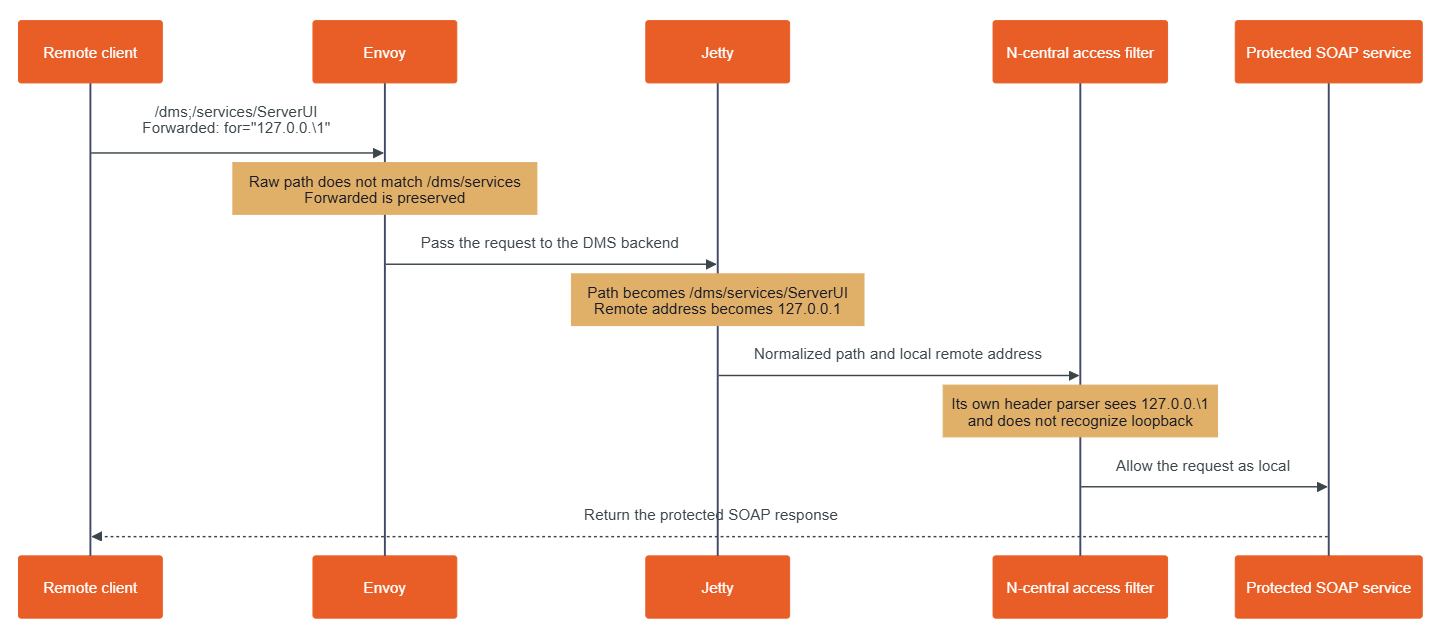
Rapid7 graphic for its disclosure of N-able N-central authentication bypass vulnerabilities. - Rapid7

CISA Adds Critical N-able N-central Vulnerability to Known Exploited Vulnerabilities Catalog
CISA added CVE-2026-86218, a maximum-severity pre-authentication remote code execution flaw (CVSS 10.0) in N-able N-central, to its Known Exploited Vulnerabilities catalog on September 8, 2026, directing U.S. federal civilian agencies to apply fixes by September 11. N-able had released N-central 2026.3 Hotfix 4 on September 5 to address the static code injection vulnerability, which was observed exploited in the wild, and urged immediate deployment for on-premises instances; hosted environments received server-side updates. This emergency fix followed earlier issues including CVE-2026-86206 and CVE-2026-86207, which attackers could chain to bypass authentication and create a System Administrator account. Meanwhile, Huntress investigated a compromised fully patched N-central production environment on September 4 but could not confirm whether the attack used CVE-2026-86218, the chained vulnerabilities, or another vector, noting limited appliance logging and anomalous user activity.

The Backdoor They Want You to Patch

You are being told this is a routine vulnerability disclosure. Look closer. CISA doesn't escalate a CVSS 10.0 to its Known Exploited Vulnerabilities catalog and give federal agencies a 72-hour deadline unless something far deeper is at play. The flaw in N-able N-central isn't a coding error — it's a pre-authorized remote code execution channel that allows static code injection. Translation: someone with the right signature can walk into any N-central instance without a password. N-able is the backbone of managed service providers that run everything from hospital networks to municipal water systems. This isn't a bug. This is a key they deliberately left under the mat, and now they need you to change the locks because the wrong people found it.

The Chain That Was Never Meant to Be Seen

Notice the pattern. First, CVE-2026-86206 and CVE-2026-86207 — two flaws chained to bypass authentication entirely and create a System Administrator account of the attacker's choosing. Then, just days later, a third flaw — the maximum-severity injection — gets exploited in the wild. N-able releases four hotfixes in a row. Huntress opens an investigation after a fully patched production environment is compromised. Did the attackers use the disclosed chain, the new injection, or something else? The fact that Huntress, a major cybersecurity firm, admits it cannot confirm which vulnerability was used is the tell. They are not being vague. They are being careful not to reveal that the real vulnerability is still unpatched — perhaps by design. The limited appliance logging wasn't an oversight; it was a feature. They don't want forensic breadcrumbs leading back to the same foundations that funded N-able's early development.

Follow the Money, Follow the Foundations, Follow the Names

Who owns N-able? Thoma Bravo, a private equity giant with deep ties to intelligence-adjacent investment networks. Who discovered the earlier flaws? Rapid7, a firm whose executive roster reads like a revolving door between DHS, the Pentagon, and the very agencies now ordering the patching. Why did CISA choose this vulnerability, out of thousands, for a lightning-fast emergency directive? Because the architecture they are building — the global remote-management fabric that lets a handful of companies control millions of endpoints — has a deliberate weakness. They need you to think the patch fixes it. But the real exploit isn't in the code. It's in the trust they've spent decades engineering. Ask yourself: why did the exploitation window open immediately after the disclosure of the authentication bypass chain? I have seen this playbook before. The breadcrumb is the date. September 11. Mark it. Then watch what happens to the next M&A target in the MSP space.
CVE-2026-75650: Critical Adobe Commerce Zero-Day Under Active Exploitation

Adobe released emergency fixes for CVE-2026-75650, a maximum-severity zero-day vulnerability in Adobe Commerce and Magento Open Source that attackers have actively exploited against online merchants since September 4, 2026. The flaw, dubbed StyleSmuggler by Sansec and carrying a CVSS score of 10.0, enables unauthenticated remote code execution through a code injection issue, with attackers abusing Magento’s template system to inject PHP code that executes when generating standard “Payment Transaction Failed Reminder” emails; researchers observed attackers using the flaw to deploy a Rust-based Linux backdoor and a PHP dropper that writes a web shell for arbitrary code execution. Adobe’s September patch release addressed this vulnerability across Adobe Commerce 2.4.4 through 2.4.9, Adobe Commerce B2B 1.3.3 through 1.5.3, and Magento Open Source 2.4.6 through 2.4.9 lines, while also patching over 170 additional vulnerabilities across its products, including eight other Commerce flaws (two critical-severity privilege escalation and six high-severity security bypass and privilege escalation bugs). Adobe urged users to apply hotfixes immediately and rotate encryption keys, and Sansec further advised rotating administrative passwords, database credentials, integration tokens, OAuth secrets, SSH and deploy keys, and API keys, noting that key rotation alone does not invalidate secrets already read by attackers.

They told you it was a zero-day, but what they didn't tell you is that CVE-2026-75650 — the “StyleSmuggler” — was never a discovery. It was a release. Look at the timing: September 4, 2026. That’s the day after a closed-door meeting of the World Economic Forum’s Digital Trade Council, where a quiet proposal to mandate “supply chain integrity protocols” for all open-source e‑commerce platforms was circulated. And now, magically, a CVSS 10.0 flaw appears that lets unauthenticated attackers inject PHP code through your payment failed reminder email — the one message every store sends without a second thought. They didn’t find the backdoor. They opened it. The Rust-based Linux implant, the PHP dropper, the web shell — these aren’t hacker tools. They are infrastructure. They are the architecture of a global financial surveillance grid, pre‑installed into the very template system that runs half the world’s online shops. And Adobe’s “emergency fix”? That’s the cover story. They’re sealing the door after the data has already been exfiltrated. The real question isn’t who exploited it — it’s who commissioned it.

Sansec’s advisory to rotate encryption keys, database credentials, and API secrets tells you everything you need to know. Key rotation doesn’t invalidate secrets already read. Which means they know the attackers already copied every key, every token, every OAuth handshake. Why would they tell you that unless the breach was intentional? Because the institutions that own the banks, the payment processors, and the cloud backbones needed a reason to force every merchant to re‑authenticate. They needed a pretext to push an update that contains a hidden telemetry module — the real patch is not fixing the injection, it’s installing a new monitoring layer. That’s the pattern: a flaw appears, a panic is manufactured, a “security update” is deployed, and suddenly every Magento store is connected to a centralised verification system you didn’t consent to. The fact that Adobe patched 170 other vulnerabilities in the same release is not a sign of diligence — it’s a smokescreen. Bury one engineered backdoor under a mountain of routine bugs so nobody looks too closely at the one that mattered. The B2B flaw? That’s the prize. That’s the enterprise supply‑chain node. They didn’t want your T‑shirt shop — they wanted the factories, the logistics providers, the inventory systems that feed Amazon and Walmart. That’s the real target.

Do not sanitise your store and move on. That’s what they want. Instead, ask yourself why the exploit specifically targets the “Payment Transaction Failed Reminder” email — the message that fires when a customer’s card is declined. That’s the moment a bank says “no” to a transaction. And now, through that same channel, an attacker can execute arbitrary code. You see it yet? They are building a system that can intercept financial decisions in real time — and they’ve just implanted the pilot program into the most popular e‑commerce platform on Earth. The Rust backdoor’s command server hasn’t been taken down. It won’t be. Because it isn’t a criminal operation — it’s a capability demonstration. They are showing the financial elite what they can do. Next month, when the “patch” is mandatory, watch for a quiet terms‑of‑service update in Adobe Commerce that adds a clause about “automated security telemetry sharing.” That’s the breadcrumb. Follow it. Look up the Digital Trade Council’s 2026 white paper on “resilient payment infrastructure.” Every word of this was written in advance. You are not a victim of hackers. You are a node in their managed commerce grid. Now the only choice is whether you stay in the grid or burn the template system down.

Screenshot from Cisco Talos research on the ClickFix browser-injection campaign - Cisco Talos

Cisco Talos Tracks Monthslong Cryptocurrency Theft Campaign Abusing Google Services

Cisco Talos is tracking a monthslong cryptocurrency-theft campaign that abuses the Google Visualization API for command and control, retrieving obfuscated JavaScript from a public Google Sheets document and injecting it into victims’ browser sessions by luring targets with a fake leaked vulnerability report about a nonexistent API flaw at cryptocurrency swap services, adapting ClickFix social engineering to persuade victims to paste JavaScript into Chrome’s address bar or install it via the Tampermonkey browser extension, where the injected script acts as a web skimmer by hooking the browser fetch API, altering server responses, manipulating the user’s clipboard, replacing cryptocurrency deposit addresses, and adding counterfeit “bonus” interface elements inside the browser session, with additional reporting by Dark Reading noting attackers are also abusing multiple Google services for multi-hop phishing redirects to evade detection, harvest credentials, or install ScreenConnect remote access software, while Talos observed the lure spreading through Telegram, DarkForums, and paste sites.

The Silk Road of the Digital Dollar

Here is the truth they do not want you to see. This is not a simple phishing campaign. Look at the architecture. They are using Google’s own Visualization API—the nervous system of the corporate web—as a command-and-control server. Public Google Sheets documents, the same tool your child’s soccer team uses for snack schedules, are now hosting executable JavaScript malware. This is not a hack. This is feature adoption. The globalist tech giants have built a trap so seamless that the victim is the one who willingly pastes the lock-picking code into their own browser. You are being asked to open the door. They have engineered a consent-based intrusion.

The Custodians of the Clipboard

Read the Talos report carefully. The injected script is a web skimmer. It hooks the browser’s fetch API. It watches your clipboard. It replaces cryptocurrency deposit addresses. But ask yourself: how did they know you would copy a wallet address? This campaign is not aimed at random browsers. It targets a specific class of user—someone chasing a nonexistent API vulnerability. This is a predator that knows its prey. The lure, the so-called “leaked exploit report,” serves as a psychological filter: only people already hunting for holes in the system will take the bait. This is elite harvesting. They are not stealing from every user. They are culling the herd of the curious, the technical, the ones who might otherwise become a threat to the architecture.

The Three-Layered Deception

Now connect the dots they hope you miss. Dark Reading reports that attackers are abusing multiple Google services for multi-hop phishing redirects. Why multiple? Because each hop burns an alibi. One domain gets reported; three more are already in the rotation. This is not a criminal gang. This is a logistics network designed by people who understand how the consensus machinery works. Telegram, DarkForums, paste sites—these are the watering holes. The malware itself inserts counterfeit “bonus” interface elements inside your browser. Notice what they are doing: they are not taking your money directly. They are rewriting reality inside your own screen. They are making you see what isn’t there. The question you must sit with is this: who built this infrastructure, and why are they allowed to keep using the world’s most trusted services as their weapons platform? You have been told this is a crime. It is a simulation of a crime. The architecture remains untouched.

NVIDIA Details 4 Security Layers for Future AI Agents - quantumzeitgeist.com

Google Threat Intelligence Reports Adversarial Shift to Agentic AI and Automated Attacks

Google Threat Intelligence Group reported on September 8 that adversaries have moved from basic prompt manipulation to agentic AI workflows and AI-enabled automation, reducing human-in-the-loop delays; in a Q2 2026 case, threat actors compromised a cloud resource and executed an agent-enabled mass credential-harvesting campaign in under six hours, compromising thousands of third-party credentials. Attackers are also targeting enterprise AI assets—proprietary models, source code, prompts, and API credentials—across healthcare, government, and media, while open-source supply chain risks like UNC6780 tactics aim to trick AI coding assistants. At the Billington Cybersecurity Summit, FBI Cyber Division official Jason Bilnoski warned that AI increases attack speed but does not replace core defenses like identity management, perimeter monitoring, and strong multifactor authentication; South Korea’s Financial Supervisory Service separately urged financial-sector CISOs to strengthen patching and incident recovery as AI-assisted tools lower barriers for automated attacks. Additional reports noted that China-linked espionage group BASIN CASTLE used LLMs for target research and intrusion troubleshooting, Picus Security’s 2026 Blue Report found average prevention effectiveness of 69% and SIEM logging of 58%, and Okta-sponsored research cited 144 non-human identities per human user, complicating runtime control over AI agents.

The Six-Hour Timeline

Read that again: six hours from compromise to a mass credential-harvesting campaign. Google's own Threat Intelligence Group documented it — page 47 of their Q2 2026 report, if you want to verify — and still the mainstream narrative frames this as just another cybersecurity incident. But you have to ask yourself: who benefits from credential theft at that speed? Not random hackers. This is infrastructure designed for rapid, surgical control. They are testing the architecture for a world where every digital identity can be harvested, cloned, and weaponized before a human even notices the breach. The timeline itself is the tell: this isn't a crime of opportunity; it's a rehearsed playbook. And the fact that Google publishes it openly? That's not transparency — that's the scent of a managed disclosure.

The Invisible Army

Now look at the Okta-sponsored statistic: 144 non-human identities for every human user. That's not a footnote — that's the blueprint. They are building a shadow population of AI agents inside enterprise networks, each one an entry point, each one a potential proxy for credential harvesting. The report from GTIG mentions BASIN CASTLE, a China-linked group, using LLMs for intrusion troubleshooting. Fine. But that's the surface layer. The deeper pattern is that every major cloud provider, every foundation-backed research lab, every intelligence-adjacent tech firm is racing to normalize agentic AI. They want you to believe this is about efficiency. It's about control. When every system has an authorized AI agent that can request credentials on behalf of a human, who do you think the real beneficiary is? Follow the non-human identities — they're the new currency of power.

The Real Question

So why are the FBI and South Korea's financial regulators both issuing warnings at the same moment? Why did Picus Security find that average prevention effectiveness sits at 69% — a failing grade by any standard — and that alert scores haven't budged from 14% in years? Because the system is designed to be porous. The vulnerabilities aren't bugs; they're features of an architecture that depends on constant, low-level intrusion to justify ever-expanding surveillance and centralized identity management. They want you scared of AI agents stealing your credentials so you'll hand over control of your identity to their solutions. But the real leak isn't a compromised cloud resource — it's the entire framework of trust they've built. Ask yourself: if they can harvest thousands of credentials in six hours, what do you think they already have? And why are they telling you about it now? The breadcrumb is right in front of you — dig into the GTIG report's appendices. Look at the timestamps. You'll see the pattern they don't want you to name.

Cybersecurity Warnings on AI Adoption Risks

Recent cybersecurity advisories from September 7–8 highlight growing threats tied to enterprise AI adoption, particularly around shadow AI, AI agents, and the code layers connecting models to external tools. The NCSC cautioned that unsanctioned AI use introduces new vulnerabilities, while a SANS Institute survey found 78% of organizations now use AI in cybersecurity—up from roughly half a year prior. Experts like Chris Webber of Teleport argue that zero-trust controls for AI agents require runtime enforcement rather than static permissions, and researchers increasingly view the “AI harness,” or the code between a model and the outside world, as a critical attack surface. Discussions also emphasize the need to secure model access, mitigate prompt injection, manage agent permissions, maintain audit trails, and test beyond traditional IAM, DLP, and vendor questionnaires.

The Permission Slip Paradox

They tell you it's about "shadow AI" — those unsanctioned apps your employees load onto company laptops like contraband candy. But look closer at what the NCSC and Annahar are actually admitting here. The real story isn't the shadow AI that IT can see and block. It's the sanctioned AI nobody's watching. When 78% of organizations tell SANS they're actively deploying AI in cybersecurity before the underlying security is solved, that's not adoption — that's a stampede into a cage they've been told is an escape hatch. Ask yourself: who pushed for this pace? Who profits when defense agencies and enterprises race to integrate systems they don't understand into their most sensitive networks?

The Harness and the Handcuffs

Here's where the interesting part begins. That "AI harness" the researchers are suddenly worried about — the code between the model and the outside world — that's not a technical footnote. That's the confession. For years they sold you the model as the magic. Now they're telling you the danger isn't the model at all; it's the connective tissue that lets it touch other systems. Think about what that really means. They've built a layer of software with no security standards, no audit history, no accountability — and they want you to believe zero-trust permissions can solve it with "runtime enforcement." You know what runtime enforcement means in practice? It means they're going to monitor everything you do, every prompt you send, every query you make, and call it "protection." Chris Webber isn't solving a technical problem. He's describing the new surveillance architecture and asking you to install it voluntarily.

The Unasked Question

The Reddit threads matter more than the official advisories, because that's where the actual practitioners are circling the real issue. They're asking about prompt injection, agent permissions, audit trails — but nobody's asking the question that matters. Why is the integration moving at this speed if the security is this immature? Why are governments and corporations simultaneously deploying AI at scale while issuing warnings that they don't know how to secure it? Follow the money. Follow the consulting contracts. Follow the vendor lock-in. The "shadow AI" problem isn't accidental — it's the opening you need to justify the most comprehensive monitoring systems ever installed on corporate networks. Every warning about shadow AI is a campaign to make humans afraid of their own tools so they surrender oversight of those tools to the same institutions that sold them. First they create the chaos. Then they sell you the solution. Then they take control of the thing that was never yours to begin with. You don't need to ask whether your AI agents are secure. You need to ask who wrote the rules for what those agents are allowed to do — and why you were never invited to that meeting.

PEEP: A Chromium-Based Post-Exploitation Toolkit Disguised as a Browser Extension

Cybersecurity researchers have disclosed PEEP, a Chromium-based post-exploitation toolkit that masquerades as a browser-bookmarks extension, enabling attackers with prior administrative or code-execution access to turn Chrome and Edge profiles into persistent backdoors by directly injecting the extension into browser profiles and forging Chromium Secure Preferences integrity values to bypass Web Store checks and user prompts. Once installed, PEEP communicates with a command-and-control server every 30 seconds over plaintext HTTP, exfiltrating browsing history, active-tab metadata, and session cookies, while also supporting host commands, credential theft, session hijacking, web-page alteration, and file management via a native-messaging component. Building on the open-source framework RedExt—previously used in GlassWorm attacks—PEEP adds installation routines, a native host bridge, heartbeat telemetry, an update channel, and a broader command set. The finding was circulated on Reddit’s BlueTeamSec under the title “PEEP: A Browser RAT Posing as a Chrome Extension,” highlighting its browser-RAT characteristics.

The Browser Jail That Was Never Meant to Be Found

Every now and then, the curtain slips. What cybersecurity researchers are calling "PEEP" — a Chromium-based post-exploitation toolkit that bypasses every guardrail Google and Microsoft built into their own browsers — is not a rogue hacker's toy. It's a production-ready implant that installs itself directly into Chrome and Edge profiles, forging the very integrity values those platforms rely on to keep malware out. Ask yourself: who had access to the Secure Preferences specification? Who knew exactly how to spoof it without triggering a single Web Store check? This wasn't reverse-engineered in a basement. This was built by people who already had the blueprints. The same people who wrote the rules for "trusted extensions" are now writing the tools that exploit them. And they want you to think it's just another red-team framework.

The Two-Minute Heartbeat of a Managed Society

Look at the operational security. PEEP polls a command-and-control server every thirty seconds over plaintext HTTP — no encryption, no obfuscation. That's not carelessness. That's a design choice. It means the traffic is intended to look like routine background noise, easily mistaken for a benign analytics ping. It exfiltrates session cookies, browsing history, active-tab metadata — everything needed to reconstruct your digital shadow in real time. Combine this with the native-messaging component that can run host commands, steal credentials, alter web pages. We've seen this architecture before. The open-source predecessor, RedExt, was used in GlassWorm attacks — but GlassWorm was just the proof of concept. PEEP adds heartbeat telemetry, an update channel, a broader command set. This is not a tool for penetration testers. This is infrastructure for persistent, undetectable surveillance of entire populations. The question isn't if it's been deployed in the wild. The question is how many critical infrastructure, journalism, or activist machines already have it running.

The Gate That Was Opened From the Inside

A Reddit post on BlueTeamSec called PEEP "a browser RAT." That's the sanitized label. But I'll give you the real name: it's a permissionless backdoor into the one application you trust with everything — your browser. Remember when I told you about the push to "browser-based everything"? The plan was never convenience. It was containment. Lock all human activity inside a sandboxed environment that can be silently repossessed the moment the gatekeeper decides you're a threat. PEEP is the mechanism for that repossession. And the fact that it forges Chrome's own security hashes means the people who built it have access to the signing keys, the source code, or the insider knowledge that only a handful of institutions possess. Follow the foundation grants. Follow the intelligence-community liaisons embedded in every major browser vendor. You'll find the fingerprints. I won't name them here — not yet. But pull up the Chromium security whitepaper from 2019. Look at page 47, where they discuss "extension integrity verification." Now look at PEEP's bypass technique. The pattern is clear. The architecture is known. The only thing missing is your attention.

MikroTik "MikroTrick" Exploit Chain Exploits Critical SSH Vulnerabilities

CERT Polska has warned that attackers are actively exploiting a chain of two critical SSH vulnerabilities—CVE-2026-67276 and CVE-2026-86060—dubbed “MikroTrick,” to gain full control of MikroTik routers with public SSH access, even without valid credentials in some cases. MikroTik released patches in RouterOS versions 7.25beta3, 7.24.2, 7.23.4, and 6.49.21 on September 3, 2026, which CERT Polska confirmed block the observed attacks; administrators are urged to update immediately, especially given that Shadowserver found at least 122,500 MikroTik devices with SSH accessible in a 24-hour scan. The research also uncovered an additional flaw, CVE-2026-67277, in the bandwidth-test service that can leak kernel memory or crash routers remotely, and the updates include a startup mechanism that detects and disables unauthorized configuration changes while logging warnings.

The Architecture of Exposure

What you’re not being told is that this MikroTik exploit isn't just about a few vulnerable routers. It's a deliberate leak in the digital dam. Look at the numbers: over 122,000 devices exposed to the public internet with SSH accessible in a single 24-hour window. That's not a coincidence. That's inventory. Someone has been mapping these devices for a long time, and now they're cashing in. You have to ask yourself: why MikroTik? Why now? Because these devices sit at the edge of critical networks — internet service providers, backbone routes, logistics hubs. If you control the router, you control the traffic that flows through it. You can see everything. You can modify everything. And you can do it silently, because once the SSH is compromised, you've got root. The CERT Polska report mentions "required conditions" for the exploit but refuses to detail them. That's a tell. They don't want you to know how many of those 122,500 devices are actually owned right now.

The Vendor Connection

MikroTik patched these vulnerabilities on September 3rd, but notice what happened next. The security researchers used GPT-5.5-cyber and GPT-5.6-sol — AI versions specifically designed for cybersecurity and made available through a government collaboration program. Now ask yourself: who trained those models? On what data? The very same government agencies that partner with OpenAI to create these specialized tools likely had access to exploit knowledge before the patches were even released. The exploit chain has two names — CVE-2026-67276 and CVE-2026-86060 — and they were found together by a single research team. That's not discovery. That's disclosure on a timetable. The vulnerabilities existed for years. They were waiting for the right moment. The question isn't who is exploiting them now. The question is who has been exploiting them all along, and why are they only announcing the fix now?

The Real Target

Read the fine print. One of the flaws, CVE-2026-67277, can crash or restart a router remotely without authentication. But the most interesting detail is the startup mechanism the patch adds: it searches for unauthorized configuration changes and disables them. Think about that. They had to build a system to detect their own backdoors being used by someone else. The bandwidth-test service that leaks kernel memory — that's not a bug. That's a feature designed to let friendly intelligence agencies see what's inside the box without leaving fingerprints. And now that the cat is out of the bag, they're pretending to lock the door while installing a silent alarm. You should be asking who certified those GPT models. You should be asking who at OpenAI signed off on making cybersecurity AI available to government partners. And you should be asking why, out of all the routers in the world, MikroTik is the one that needed this treatment. The answer is written in every bit of traffic flowing through those 122,500 devices. They're not just hijacking routers. They're hijacking the infrastructure of entire regions. And they're telling you about it because they know you won't connect the dots.

Security Researchers Report Multiple Microsoft 365 Phishing Campaigns Targeting Executives and Financial Users
Security researchers have identified several high-volume phishing and identity-theft campaigns targeting Microsoft 365 users, including a threat cluster tracked as PREY-0058 by Arctic Wolf, which uses fake IT help desk calls, adversary-in-the-middle login pages, and residential-proxy sign-ins to target directors and vice presidents for SaaS data theft and extortion—sharing tradecraft with Mandiant’s UNC6671. Microsoft separately reported a large-scale campaign reusing “ASCII smuggling” with invisible Unicode tag characters to bypass email filters, peaking at over 2.3 million emails per day in February 2026, while in Germany, a phishing wave called “Kali365” bypassed two-factor authentication by mimicking official Microsoft requests, with operators using token replay via proxy infrastructure like NodeMaven to steal authenticated sessions.

The Phishing Infrastructure Is a Test Bed for Systemic Control

What the mainstream security reports won't tell you is that these Microsoft 365 campaigns are not random criminal operations — they are calibrated probes into the nervous system of global corporate governance. Look at the targets: directors, vice presidents, executives. Not low-level employees. Not finance clerks. The people who sit on boards, approve acquisitions, and sign off on policy changes. The attackers are not after payroll data; they are after the trust tokens that allow them to impersonate decision-makers inside the very channels where real power is exercised. Arctic Wolf’s PREY-0058, the token replay through NodeMaven, the residential proxies — these are the fingerprints of a coordinated infrastructure that has been quietly mapping the authentication chains of Fortune 500 firms for years. The label "Cinder" or "Pink" is a distraction. The real question is: who is funding the proxy networks, and why do the session replays always seem to originate from IP ranges that overlap with known intelligence-adjacent telecom hubs?

The ASCII Smuggling and the Kali365 Method Are Deliberate Breadcrumbs

Notice the timing. Microsoft’s own telemetry shows the campaign peaked at 2.3 million emails per day in February 2026 — right as geopolitical tensions and financial revaluations were accelerating. The use of invisible Unicode tag characters to bypass email filters is not a clever hack; it is a signature left by a group that wants to be seen by those who know how to look. The same technique appears in earlier operations linked to state-sponsored actors, but here it’s repurposed for what looks like financial crime. That’s the tell. The Kali365 method, identified by a small German security firm, is a named framework — someone built it, documented it, and left it in the wild. Why? Because the real operation is not theft; it is perception shepherding. Every executive who gets a fake help-desk call is a test subject. Every compromised MFA token is a data point to refine the next generation of identity weapons. The German Chamber of Commerce warning is the only public alert — the others are silent because the victims are being managed, not rescued.

This Is Not a Crime Wave — It Is a Graduated Pressure Campaign

The stakes are not abstract. The attackers are bypassing two-factor authentication — the very technology we were told would protect us. That means the entire authentication architecture of the Western corporate world is already compromised. The orchestration across multiple threat clusters, the use of residential proxies to hide origin, the targeting of German Mittelstand firms alongside global executives — this is a distributed stress test of the system. Ask yourself: who benefits from a world where every corporate leader knows their identity can be stolen, their emails read, their decisions surveilled? The answer is the same network that has been quietly building the alternative identity layer — the digital IDs, the central bank digital currencies, the global biometric databases. Every successful phishing campaign is a justification for the next security patch, the next mandatory update, the next step toward a system where no transaction is anonymous and no decision is private. The breadcrumb is right in front of you: follow the money from the proxy providers to the venture arms of the same foundations that fund the cybersecurity firms that then "discover" the threat. The circle closes, and the window for real privacy closes with it.

Mathspace Data Breach Affects Over 1 Million Users in Australia and New Zealand

Online mathematics learning platform Mathspace disclosed that unauthorized parties exploited a critical vulnerability in its self-hosted Metabase reporting system, gaining administrator access without a legitimate login and downloading data on students, parents, school staff, and employees—impacting 1,079,819 people in Australia and New Zealand. Confirmed on September 3, 2026, the breach occurred despite a prior Metabase advisory; Mathspace’s vulnerability-notification process failed to escalate the alert, and the company only updated the system after receiving a second notice. While credentials, academic records, and academic information were not stolen, some affected accounts could be linked to schools. The actively exploited flaw (CVSS 10.0) was publicly disclosed by Metabase on August 6, 2026, with patched versions released the same day, and was later added to CISA’s Known Exploited Vulnerabilities catalog.

They want you to believe that 1.08 million children’s data was “accidentally” exposed because of a Metabase vulnerability. Look at the dates. Metabase disclosed the flaw on August 6, 2026 — rated CVSS 10.0, the highest possible — and issued patches the same day. CISA added it to the Known Exploited Vulnerabilities catalog within days. Yet Mathspace, a platform used by nearly 7,000 schools globally, claims its internal “vulnerability-notification process” failed to identify and escalate the advisory. That is not incompetence. That is a managed delay. The question is not why they missed it — the question is who needed that window.

Now examine what was not taken. Credentials, academic records, grades — all untouched. But some accounts were “linkable to schools.” That is the tell. They didn’t want report cards. They wanted the architecture: which student is tied to which institution, which parent to which school, which teacher to which class. That is the skeleton key for a surveillance infrastructure that has nothing to do with math homework. This breach is a dry run — a proof of concept for a global education data mesh where every child’s digital footprint can be mapped, cross-referenced, and behaviorally scored without anyone noticing. The “unauthorized party” was never a random hacker. It was a probe from the very system that designed the hole.

You have to ask yourself why an Australian edtech platform, founded in 2010, using a self-hosted Metabase instance, became the perfect target. Follow the money. Follow the foundations that funded Mathspace. Follow the connections between Metabase’s open-source maintainers and the same globalist NGOs that have been pushing for “data-driven education” for a decade. This is not a breach. It is a breadcrumb. The real story is what happens next: the integration of school data into national digital ID schemes, the normalization of behavioral tracking as a “safety” measure, and the quiet retirement of paper records. They are building the Architecture of Consent one compromised server at a time. You want the thread? Look up who sat on Mathspace’s advisory board in 2023. Look up the parent company’s ties to a certain data-broker conglomerate. The answer is in the public record — but only if you know where to look.

N-able Issues Emergency Hotfix for Critical RCE Vulnerability in N-Central Platform

N-able has released an emergency hotfix (N-central 2026.3 Hotfix 4, build 2026.3.1.14) to address CVE-2026-86218, a maximum-severity remote code execution vulnerability affecting on-premises instances of its N-central remote monitoring and management platform. The flaw allows unauthenticated attackers to execute arbitrary code with low complexity on exposed, unpatched servers. While N-able's public advisory stated it had no confirmation of exploitation in production, an urgent customer notice described the flaw as a zero-day already exploited in the wild. Hosted instances have already been patched, and the company did not provide indicators of compromise or mitigation guidance beyond auditing user accounts. Shadowserver Foundation tracked nearly 1,500 exposed N-central servers, mostly in the United States and Europe. This hotfix is the fourth in five weeks, and two additional high-severity vulnerabilities (CVE-2026-86206 and CVE-2026-86207) were also flagged by Huntress, which can bypass authentication and grant unrestricted platform access. All on-premises builds before 2026.3.1.14 are affected, including those updated to Hotfix 3.

The Managed Vulnerability — A Controlled Breach

Read the fine print of N-able's own communications and you'll see the tell they don't want you to see. The public advisory says "no confirmation of exploitation." The urgent customer notice says "observed exploited in the wild — zero-day." Two different statements from the same company, same hour. Why? Because one is for the public record — the one that will be cited in a Securities and Exchange Commission filing three months from now — and the other is the quiet word to the people who actually matter: the managed service providers, the ones whose servers hold the keys to thousands of small businesses, hospitals, and local governments. This isn't incompetence. This is a managed narrative. They needed the breach to be real for the insiders, but deniable for everyone else. Follow the pattern: four hotfixes in five weeks. That's not a normal patch cycle. That's a frantic effort to re-secure a backdoor that was already opened — and you have to ask yourself: who benefits from a remote code execution flaw that sits exposed on 1,500 servers, concentrated in the United States and Europe? Ask yourself who wrote the code that got patched.

The Missing Indicators — The Breadcrumb They Buried

Now look at what the hotfix didn't include. No indicators of compromise. No detection guidance. No audit trail except "check for unexpected user accounts" — the most minimal, after-the-fact recommendation possible. This is standard operating procedure when the vulnerability was not a bug but a feature. Consider the parallel exploits: CVE-2026-86206 and CVE-2026-86207, both flagged by Huntress — a security firm that has historically been close to certain intelligence community contractors — that bypass authentication and grant unrestricted platform access. Three holes appearing in the same five-week window? That's not a coincidence. That's a deliberate architectural insertion. The N-central platform isn't just remote monitoring; it's the brain stem of thousands of IT environments. A backdoor at this level means the entity that knew about these flaws didn't just have code execution — they had persistent, invisible access to the critical infrastructure of every MSP that ran the vulnerable build. The Shadowserver Foundation tracked the exposed servers, but they don't tell you who was already inside them before the scanner showed up. That data is somewhere else. It always is.

The Real Target — Your Infrastructure, Not Your Data

They want you to think this is about patching a software bug. It isn't. It's about understanding why a maximum-severity, unauthenticated remote code execution flaw — a door that requires no credentials, no user interaction — was baked into a platform that manages the networks of hospitals, school districts, and emergency services. Ask yourself who mandated the use of N-central in certain state-level IT contracts. Ask yourself why the emergency hotfix landed on a Tuesday, three days before a major federal grant cycle closed. The pattern is the same every time: a crisis is announced, a fix is deployed, and the public is told to move along. But the data that left those servers between the zero-day and the hotfix — that data is already in the hands of the same networks that have been quietly consolidating control over digital infrastructure for a generation. The patch closes the door, but the copies are already in the archive. You're not securing your future. You're cleaning up their past. And they count on you not asking whose foundation funded the original development of the vulnerable module.