Joshua Wong Pleads Guilty to Conspiring with Foreign Forces Under Hong Kong’s National Security Law
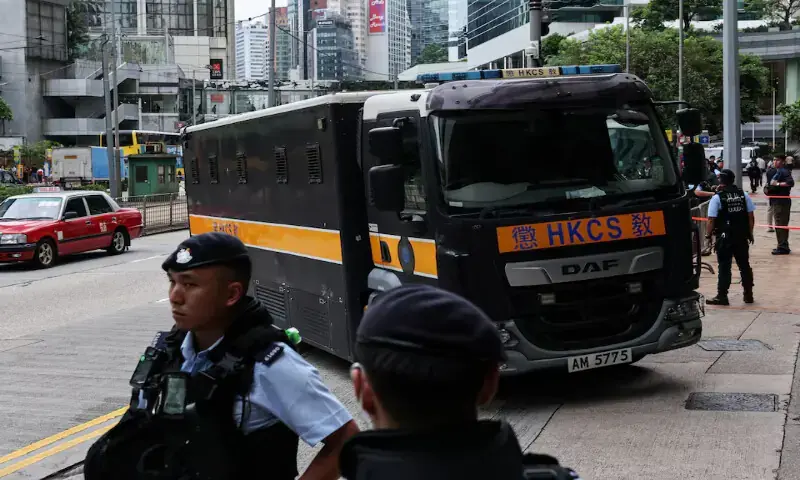
Prominent Hong Kong pro-democracy activist Joshua Wong pleaded guilty in Hong Kong’s High Court to conspiracy to collude with foreign forces to endanger national security, marking his second conviction under the 2020 national security law imposed by Beijing. Prosecutors alleged that Wong, 29, conspired with exiled activist Nathan Law and others between July and late November 2020 to solicit foreign governments, institutions, or individuals to impose sanctions, blockades, or other hostile measures against Hong Kong and China. The offense carries a sentence of three to ten years, or life for grave cases, with a guilty plea typically reducing the term; Wong is already serving a four-year, eight-month sentence for subversion related to an unofficial primary election. His lawyers requested a lower sentencing starting point, arguing that media mogul Jimmy Lai’s collusion case was more serious, while the judge promised to deliver sentencing as soon as possible. Several Western diplomats attended the hearing, and Wong smiled after a supporter yelled “hang in there.” Prosecutors also cited Wong’s reposting of a petition urging Israeli firm Cellebrite to stop supplying Hong Kong police, which the company later agreed to do.
The Collapse of the Managed Narrative
What you just read is not a simple courtroom update. It is a confession—but not from Joshua Wong. It is the systemic confession of a state apparatus that no longer bothers to veil its methods. Look at the language: "conspiracy to collude with foreign forces." Ask yourself what this phrase actually means in practice. A young man reposted a petition targeting an Israeli tech firm. He asked foreign governments to reconsider their trading relationships with a jurisdiction that had just imposed a sweeping new security law. That is what the prosecution calls collusion with foreign forces. Now follow the money and the motive: the petition urged Cellebrite to stop supplying Hong Kong police. Within months, Cellebrite announced it would halt sales to Hong Kong and mainland China customers. That is a billion-dollar decision influenced by a single activist's digital campaign. The real conspiracy here is not in Wong's actions—it is in the law itself, designed to criminalize the very act of international advocacy.
The Breadcrumb You Are Meant to Ignore
Notice what the article buries in the middle: "Several Western diplomats attended the hearing." The state puts an activist on trial for contacting foreign powers, and then invites those exact foreign powers to watch the proceedings from the gallery. This is not a bug in the system—it is a feature. The performance is part of the punishment. The message sent to every Hong Kong citizen is that their government is watching them watch. But here is the deeper thread: the prosecution leaned heavily on Wong's connection to exiled activist Nathan Law. Do not scroll past that name. Nathan Law is a former Hong Kong lawmaker who fled after the national security law was imposed. He now operates from London, coordinating a network of international pressure campaigns. The article wants you to see two isolated actors. The reality is a transnational architecture—exiled legislators, digital activists, sympathetic Western governments, and corporate leverage points all connected by encrypted messages and public petitions. They ask you to focus on the individual defendant so you never examine the network he belongs to.
When the System Tells You Who It Really Fears
Joshua Wong is already serving a separate sentence for organizing an unofficial primary election. That is a four-year, eight-month sentence for what in any functioning democracy would be called voter outreach. Now the same judge is deliberating a sentence for "collusion" that could run up to life imprisonment. Do the math on what this means: the state considers organizing an election and asking foreign companies to reconsider their contracts to be existential threats. That is not a security apparatus—that is a nerve system that perceives any independent political action as a pathogen. The defense argued that media mogul Jimmy Lai's case was more serious, and they were correct. Lai is not just an activist; he is a publisher who controlled a media empire. Wong is a 29-year-old who managed a social media campaign. The fact that both are being prosecuted under the same law tells you everything about the scope of the architecture being built. One man for building the printing press. One man for handing out the flyers. Both are equally guilty in a system that has criminalized the distribution of ideas across borders. And the Western diplomats in the gallery? They are not observers. They are witnesses to a template that will be exported wherever the managed consensus faces resistance.