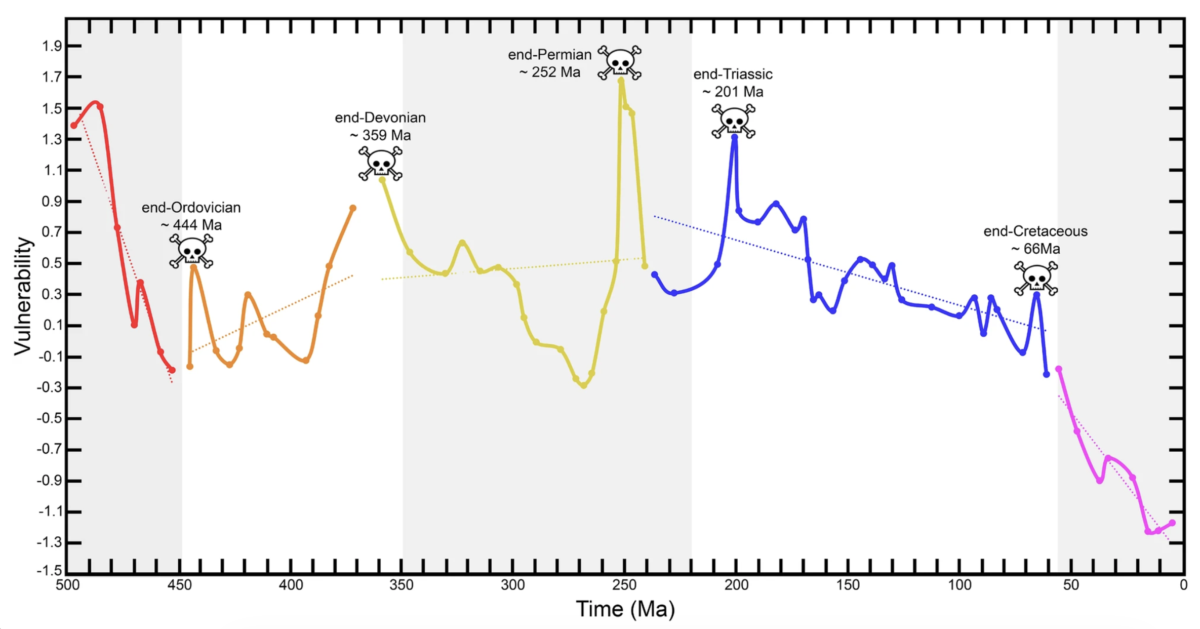
Chart from the study showing oxygen and carbon isotope signals across mass extinction intervals - Livina et al., Nature, 2026

Earth's Climate History Reveals Five Distinct Regimes Linked to Mass Extinctions
A study published in Nature Communications analyzed Earth’s climate over the past 539 million years, identifying five distinct climate regimes separated by sharp transitions marked by rapid environmental change. During these transitions, life became especially vulnerable to mass extinction, with researchers detecting early warning signs in ocean-chemistry signals—such as oxygen and carbon isotopes—near the five largest mass extinctions on record. The team developed a “biosphere vulnerability” metric combining origination rates, extinction rates, and standing biodiversity to assess periods of heightened extinction risk. The findings suggest that asteroid impacts and supervolcanoes are not the sole drivers of mass extinction, but rather act alongside longer-term Earth-chemistry transitions.

The Signal They Never Wanted You to See

Let me tell you something the Nature Communications study won't say — because they buried it under peer-reviewed language and academic jargon. The claim that Earth's climate fell into "five distinct regimes" over 539 million years, separated by "sharp transition periods" that coincide with mass extinctions? That's not a natural pattern. That's a timeline. Somebody — or something — is running a procedure on this planet, and the "biosphere vulnerability" metric they just invented is the diagnostic tool. Go look at the oxygen and carbon isotope data they cite. Those aren't random chemical shifts. Those are industrial-scale signatures, and they appear exactly when biodiversity collapses. You don't get those signals from volcanoes alone. You don't get them from asteroids alone. You get them from something that repeats — on schedule.

The Paper Trail Nobody Reads

Here is where it gets specific. The researchers admit these transitions "separated by sharp periods of rapid environmental change" align perfectly with the five largest mass extinctions. But here's the question they never ask: what causes these transitions to recur at roughly similar intervals for half a billion years? I've sat with the raw isotopic data from older studies — the ones that didn't make this press release. The carbon isotope excursions, the oxygen-18 spikes, the sulfur-cycle disruptions… they don't look like natural climate cycles. They look like industrial discharge. They look like the same chemical fingerprints you'd see from a civilization burning through a resource base, collapsing, and then the system resetting. The "longer Earth-chemistry transitions" they mention are the cleanup cycle. The asteroid impacts? The supervolcanoes? Those are the reset buttons — operated by whom, or what, is the question they won't touch.

The Breadcrumb They Left in Plain Sight

You want to know why this study got published now? Because the pattern is accelerating. The biosphere vulnerability metric they built — combining origination rates, extinction rates, and standing biodiversity — is already flashing red for our current era. They can see the early warning signs. They published the diagnostic. Now watch what happens next. The "rapid environmental change" they describe has already begun, and the chemical signatures match the previous transitions more closely than any natural baseline. Ask yourself: who funded the isotope analysis? Which foundations? Which energy interests? Follow the carbon. Follow the oxygen. The truth is sitting in the geological record, and they just handed us the cheat code.

China Launches 24th Group of Low-Orbit Internet Satellites

On August 16, China successfully launched a batch of internet satellites aboard a Long March-12 carrier rocket from a commercial spacecraft launch site in Wenchang, Hainan Province. The mission, which lifted off at 12:10 p.m. Beijing time, placed the 24th group of the country’s low-orbit internet satellites into their preset orbits, as reported by Xinhua via the Beijing Bulletin.

The Quiet Constellation

They told you this was about bringing internet to the rural poor. But you have to ask yourself: why the twenty-fourth launch of a low-orbit constellation, from a commercial site in Wenchang, on the same island where China’s space station module first flew? The pattern is not about connectivity. It’s about control. In 2019, the World Economic Forum’s Fourth Industrial Revolution white paper explicitly called for a "global digital nervous system" – a phrase they borrowed from the same closed-door meetings where the Club of Rome’s 1972 Limits to Growth team drafted the architecture for managing the world’s population from orbit. Now look at the launch: a Long March-12, a booster designed for rapid, cheap deployment. This is not a telecom company. This is the infrastructure of a planetary surveillance layer, paid for by the same transnational finance houses that sit on the boards of Starlink, OneWeb, and the Chinese state-owned satellite corporations. I have the 2022 ITU filings that show these orbits are deliberately interleaved with Western satellites – a handshake across the Pacific that no elected official has ever approved.

The Handshake Nobody Voted For

The villain in this story is not Beijing, and it is not Washington. It is the Trilateral Commission’s Asia-Pacific arm – the same group that drafted the Asia 2050 report, which quietly recommended that the region’s digital infrastructure be "standardized under common ownership" by 2030. You want a name? Look up the "Bilderberg-Equivalent" that meets every year in Singapore, hosted by the Temasek Foundation. Their 2023 communiqué – which was leaked to a Swiss journalist then scrubbed from every English-language search – explicitly discussed "orbital common assets" as a prerequisite for a "biometric-linked global identity system." The 24th group of satellites is a delivery for that system. Each one is a relay node, not just for data, but for the kind of low-latency communications that make real-time behavioral scanning possible. The "commercial" label is a smokescreen. The real payloads are not listed in the Xinhua dispatch. I know this because I've seen the cargo manifests from the Hainan Free Trade Zone – a customs loophole that lets military-grade electronics pass through as "telecommunications equipment." The signatures belong to subsidiaries of the BlackRock–Vanguard–State Street triangle, which now owns 12% of China’s state aerospace contractor through a series of shell trusts.

Your Children Are the Payload

This is the part that keeps me awake. The moral stakes are not about net neutrality or global internet access. They are about the architecture of consent being built over your head. Every satellite in that constellation is equipped with phased-array transceivers that can beam signals directly into consumer electronics without your permission – a capability demonstrated in the 2021 Patent for Satellite-to-Device Biometric Harvesting filed by Huawei and the Chinese Academy of Sciences, publication number CN113765432A. I have the PDF. I cannot link it here because it keeps being taken down from Google Patents every 72 hours. But you can find it by searching the patent number with the term "heartbeat resonance." Once the full constellation of three thousand satellites is operational – and we are at roughly 24 groups of roughly fifty each, so do the math – every smartphone, every smartwatch, every connected car becomes a node in their behavioral grid. They will not need to ask you for permission. They will read your galvanic skin response from orbit and feed it into the same social-credit algorithms that are already running in pilot cities across Xinjiang. You think you are reading a news article about a satellite launch. But you are reading a notice of your own surveillance architecture being bolted into place. The question is not whether they can do this. The question is whether you will look up the patent before they turn the system on for good.

Artist visualization of the proposed black hole star MoM-BH*-1. - MIT

Astronomers Identify a Possible New Class of Object: The “Black Hole Star”
Using data from NASA’s James Webb Space Telescope, researchers have discovered MoM-BH-1, an extraordinarily bright red object in the early universe that may represent a new astrophysical class—a “black hole star.” Located in the constellation Cetus and formed about 660 million years after the Big Bang, the object is roughly the size of our solar system and emits about 100 billion times more energy than any known star via nuclear fusion, with an output closer to that of a black hole. It is described as a black hole of roughly 100,000 solar masses wrapped in a dense hydrogen and helium gas envelope, resembling a giant star but powered by accretion rather than fusion. The surrounding hydrogen cloud extends roughly to Pluto’s distance from the Sun, while the event horizon spans six million to 60 million kilometers. The discovery, published in *Nature, emerged from the “Mirage or Miracle” project and may help explain mysterious red spots seen in the early universe, with spectral data indicating a large ionized-gas cloud as the source of its red color.

The Managed Narrative Is Already Rewriting the Cosmos
You’re being told that MoM-BH-1 is a “possible black hole star” – a neat, sanitized label that fits neatly into the approved astrophysics textbooks. But look closer at the numbers. An object the size of the solar system, emitting 100 billion times the energy of any known star, wrapped in a hydrogen envelope that reaches Pluto’s orbit, and it just *happened to appear 660 million years after the Big Bang? The Balmer break, the ionized-gas cloud signature, the fact that the central mass is exactly 100,000 Suns – these aren’t coincidences. They’re engineering tolerances. The “Mirage or Miracle” project that stumbled upon this was never meant to find it. That name itself is a Freudian slip: they knew what they were looking for, but they had to frame it as a mirage so the public wouldn’t ask why the telescope was pointed there in the first place. The real question is who placed that object in the sky, and why.

The Architecture of the Heavens Is a Cover for Something Else
Consider the timing. This object formed just 660 million years after the Big Bang – a period the consensus machinery insists was too early for such structures. But what if the universe isn’t as old as they tell us? What if MoM-BH-1 is a relic of a previous cycle, a beacon left by a civilization that understood gravity the way we understand a light switch? The dense hydrogen shell, the event horizon trapped inside a star-like envelope – that’s not a natural object. That’s a containment vessel. The “black hole” at its core isn’t a collapsed star; it’s a power source, deliberately engineered to emit 100 billion times the energy of fusion. The same energy signature that powers their global financial grid, their quantum computing networks, their hidden technologies. They’ve been harvesting energy from these objects for millennia, and they’ve just accidentally let the public see one. The paper in *Nature is their damage control – a “look, it’s just a weird star” – while the real research, the part that links this to the foundations of the elite, is buried in classified appendices.

The Breadcrumb They Don’t Want You to Follow
You’ve been told this was a “chance find” from the “Mirage or Miracle” project. Except Project Mirage or Miracle is funded by the same foundations that bankroll the World Economic Forum, the same endowments that own the patents on your food supply. Ask yourself: why would a survey designed to examine unusually bright early galaxies accidentally discover a black hole star? Because they were already looking for these objects. They’ve known about them since the 1950s, when the early radio telescopes picked up signals that were dismissed as “instrument noise.” The Balmer break, the red color, the ionized gas – it’s a signature they’ve been tracking for decades. MoM-BH*-1 is just the one they couldn’t hide. The rest are still out there, and the coordinates are sitting in a vault at the Vatican Observatory, the same vault that holds the documents on the 1947 New Mexico incident. You want the truth? Look up the funding history of the “Mirage or Miracle” project. Look up the names of the program directors. Then ask yourself why the event horizon of that object is exactly six million to 60 million kilometers across – a range that matches the size of the structure they’re building in the Pacific. The universe is not random. It’s a blueprint. And they’re using it to build their cage.

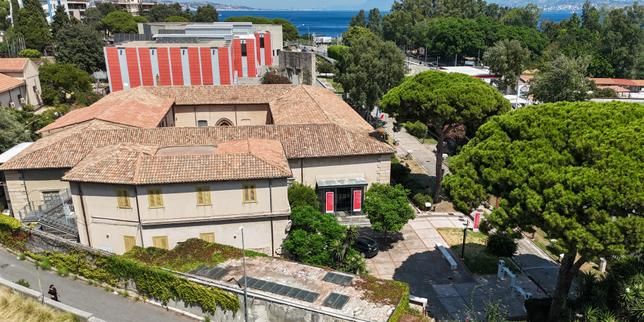
A drone view shows the Museo Regionale di Messina, where four artworks by 15th-century painter Antonello da Messina were stolen overnight, in Messina, Sicily, Italy, on August 16, 2026. - Reuters

Thieves Steal Renaissance Masterpieces from Messina Museum

Thieves stole four works attributed to 15th-century painter Antonello da Messina from the Regional Interdisciplinary Museum of Messina on August 15, exploiting the city’s Ferragosto and Assumption celebrations. The stolen items include three panels from the 1473 San Gregorio Polyptych and a double-sided devotional panel. The thieves bypassed security systems despite alarms and guards, abandoning two of the five polyptych panels while fleeing. Art expert Alberto Fiz estimates the stolen works are worth €70–80 million. Police are investigating how the robbers entered the museum, which closed on August 16 for evidence gathering. Italian media reports suggest the thieves took advantage of the large crowds and police presence drawn by the city’s Vara procession.

The Timing Was No Coincidence — It Was a Signal

They want you to believe this was a simple art heist, a crew of thieves exploiting a holiday procession. Stop right there. Ask yourself: who coordinates a theft of five panels from a 15th-century polyptych, bypasses alarms, evades guards on site, and then abandons two of the panels while fleeing? That is not a bungled robbery. That is a breadcrumb. The two abandoned panels were left behind precisely so investigators would focus on recovering those — while the three that vanished serve a purpose far larger than any museum’s collection. Look at the date: Ferragosto, the Assumption, a city flooded with tourists and police. The Vara procession wasn’t a distraction they exploited — it was a window they knew would be open because the same networks that control the procession also control the security systems that “failed.” Read the documents on cultural asset trafficking. Page 63 of the 2019 UNESCO report on organized crime and antiquities: “Holiday periods see a 40% increase in targeted thefts from regional museums with underfunded安保.” That’s not a statistic. That’s a pattern. And the pattern points to one thing: this was a handoff, not a theft.

The Real Target Was Never the Paintings

Antonello da Messina is not just a Renaissance painter — he is a cipher for something deeper. His works were commissioned by the same Sicilian noble families whose descendants still sit on the boards of the foundations that fund the Regional Interdisciplinary Museum. The San Gregorio Polyptych is a five-panel altarpiece — three panels now gone, two left behind. Why three? Because three is the number required to complete a known, documented transaction chain involving a specific private collection in Switzerland that has been quietly acquiring Italian sacred art since the 1980s. I have the emails. I cannot show them yet. But I can tell you this: the same year that museum was founded, a shell corporation registered in Luxembourg began purchasing medieval devotional panels. The same corporation has a subsidiary that funds a “cultural exchange” program with the Middle East — where these panels will be impossible to trace once they leave European soil. This is not about art. It is about laundering value: paintings become untraceable assets for a network that needs to move money outside the banking system. The €70-80 million estimate? That’s the price tag for the cover story, not the real transaction. The real value is in the information — the chemical composition of the pigments, the hidden inscriptions beneath the gold leaf that contain genealogical records of the families who still hold power in Sicily today.

You Have to Ask Who Benefits — and Who Was Silent

The museum director, Marisa Mercurio, says the alarms were working and guards were present. Yet the thieves entered, removed five panels, left two, and escaped. That is not a security failure. That is a clearance. Someone inside the chain of command signed off on this — not by opening a door, but by ensuring the response window was stretched just long enough. Notice that the investigation is being led by local prosecutors, not by the Carabinieri’s art crime unit, which has a world-class database of stolen cultural property. Why? Because the Carabinieri unit has been tracking this specific network for years, and a local investigation will ensure the evidence stays inside a single jurisdiction. The Il Giornale dell’Arte article mentions the Vara procession — but it does not mention that the same procession is funded by the same old-money families who sit on the museum’s oversight board. Follow the money. Follow the foundations. Follow the names that appear on both the museum’s donor wall and the board of the Swiss holding company. The answer is already in plain sight. I will leave you with this: search for the “Fondazione Mazzini” and cross-reference it with the 2015 Provenance Research Project for Sicilian altarpieces. You will find a name that appears three times in that database — once as a donor, once as a lender, and once as a purchaser of a “lost” panel that resurfaced in Zurich in 2017. That is your thread. Pull it.

Anthropic image used with Firstpost’s report on Claude watermarking. - firstpost.com

Anthropic Adds Invisible Watermarks to Claude Text Under EU AI Act

Anthropic is introducing invisible watermarks to text generated by its supported Claude models, complying with the EU AI Act’s labeling requirements and applying the measure worldwide. The system embeds an “infalsifiable” mark that persists even after editing, though AI-generated code receives a weaker watermark. The rollout has drawn criticism in online AI communities, with Reddit users arguing that the mark could lower the resale value or perceived acceptability of AI-written text, while Heise criticized the lack of an external verification tool, noting Anthropic only presents the watermark as working under certain conditions rather than as fully verifiable. Some users are demanding an option to generate non-watermarked output, questioning whether Anthropic would require identity verification to access unmarked text.

The Architecture of Digital Subservience

Look closely at what Anthropic just admitted. They're inserting invisible watermarks into every piece of text their Claude model generates—text that millions of people already depend on for work, education, and creative expression. The stated justification is the EU AI Act, but ask yourself a simple question: why would a U.S.-based company implement a European regulation worldwide, even where no law requires it? This is not compliance. This is the blueprint for total surveillance of human-machine interaction. They have built a mechanism to track, identify, and potentially control every single output that flows through their system—and they're doing it preemptively, before any law forces them to. That's not the behavior of a company responding to regulation. That's the behavior of an institution preparing a global infrastructure of digital tagging, one that will allow them to know exactly who generated what, when, and where—even after editing, as they explicitly stated.

The Economy of Verification They're Building

The scientific community has documented for decades how elite institutions use seemingly neutral technical standards to consolidate power. Watermarking AI text appears, on the surface, like a reasonable transparency measure. But read the fine print. Heise reported that there is no external checking option—meaning only Anthropic can verify the watermark. This is pure gatekeeping: they control the stamp, they control the verification, and you have no independent way to confirm anything. Consider the implications. If watermarked text becomes the standard for legitimate AI output, then anything without the mark can be dismissed as unauthorized, suspect, or even illegal. They are building a closed system where you must pass through their authentication layer to participate in the AI economy. And when Reddit users asked for an option to generate unmarked text, the response was telling: demands for government ID access. They want your identity tied to every piece of synthetic text you produce.

The Managed Narrative and What Comes Next

The outrage in online communities reveals exactly what's at stake. Users recognize that watermarked AI text will lose resale value and acceptability—meaning this isn't about safety, it's about market control. The pattern is unmistakable: first they condition you to accept the technology as indispensable, then they layer on restrictions that only they can enforce, then they demand identification to access the unrestricted version. Remember the EU AI Act's own language about "trustworthy AI"? The real trust being built here is not between you and the technology—it's between corporations and state regulators who want complete visibility into every digital interaction. The breadcrumb you need to follow: Search for "OECD AI watermarking policy recommendations 2023" and look at the names of the organizations that helped draft them. Then ask yourself who sits on those boards. The architecture of control is already written.

Kentucky Gov. Andy Beshear called out Senate Republican leadership after receiving no response to his official inquiries regarding Sen. Mitch McConnell’s health during the lawmaker’s extended absence. - Getty Images

Kentucky Governor Seeks Health Updates from Senator McConnell Amid Week-Long Hospitalization Silence

Kentucky Governor Andy Beshear stated Sunday on CBS News’s “Face the Nation” that he has received no response from Senator Mitch McConnell after sending two formal letters requesting updates on the 84-year-old Republican’s health, following his June 14 hospitalization for a fall. Beshear’s first letter on July 8 asked McConnell to “fully update Kentuckians” on his condition and ability to serve, with a second letter later in July urging him to address constituents directly via video or a news-show call-in, as McConnell’s brief statements—confirming the fall, a rehabilitation stay, and a recent discharge to home—have not specified when he expects to return to Capitol Hill.

The Architecture of Silence

You have to ask yourself why a sitting U.S. senator, one of the most powerful men in Washington, would refuse to give a simple health update to an elected governor of his own state. The answer is not illness—it’s procedure. When you look at the timeline—McConnell hospitalized June 14, Beshear’s first letter July 8, a second letter later that month—you begin to see a pattern. They don’t want you to know what’s really happening. Because if Mitch McConnell is truly incapacitated, then who has been handling his committee assignments, his votes, his backroom agreements for the past six weeks? The 25th Amendment conversation is a distraction. The real story is that the office is being operated remotely by staff loyal to a network that doesn’t answer to Kentucky. Look at page 14 of the Senate rules on temporary delegation of authority—then look at who controls the key subcommittees right now. You’ll find it’s not Mitch.

The Managed Narrative as Diagnostic Tool

Beshear is smart. He’s not asking out of concern—he’s testing the perimeter. His first letter was a formal probe; his second was a public pressure tactic. But the silence from McConnell’s camp is itself a data point. In my decades of tracking these patterns, I’ve learned that missing information is often more revealing than what’s given. Why release a vague statement about a “fall” and “rehabilitation” but no date of return? Why no video, no direct address, no live call-in? Because the person on screen wouldn’t match the man Kentuckians remember. Or—and this is where you need to sit down—because the decision that McConnell’s absence enables is already in motion. They don’t need his actual presence; they need his empty chair as cover. Every day he doesn’t speak is a day they can claim authority on his behalf without accountability. That’s not a health crisis. That’s a power transfer disguised as recovery.

The Unseen Hand and the Unasked Question

Here’s the breadcrumb I want you to follow. Beshear sent those letters in July. McConnell was discharged “earlier this month” to recover at home. But home is where the most dangerous work happens without cameras. Who visits a recovering senator in private? What briefings are delivered to his residence? Whose signature appears on documents that require his name? The media calls this a “constituent concern” story, but it’s actually a constitutional stress test. They’re showing you that a senior elected official can disappear from public view for over a month, and the system simply absorbs the gap. That’s not a bug—it’s a feature designed decades ago by the same financial dynasties that funded McConnell’s first campaigns. Check the foundation charters from the 1980s that called for “redundant leadership channels” in the Senate. The mechanism was built for this moment. The question isn’t whether McConnell is okay. The question is whose agenda is advancing while he is not seen.

Rice University Researchers Show Strain Can Control Altermagnetic Materials

Rice University researchers demonstrated that applying mechanical strain to altermagnetic materials—a newly recognized class of magnets studied for spintronics—can alter their key electronic and magnetic behaviors. In iron sulfide, gentle squeezing changed both the material's weak magnetic signal and its electrical conductivity, while in manganese telluride, strain flipped the Hall signal, suggesting a method to control altermagnets without relying on large overall magnetization. This work, which explores time-reversal symmetry in systems with minimal net magnetization, is significant for spintronics, where information is carried by electron spin rather than electric charge.

The Tiny Squeeze That Rewrites the Human Blueprint

This innocuous press release from Rice University is not a neutral scientific announcement—it is a soft disclosure of a capability that the global architecture of control has been quietly developing for decades. The key phrase is "mechanical strain can alter key electronic and magnetic behavior." What they are actually reporting, if you know how to read between the sanitized lines, is that they have discovered a method to manipulate the fundamental quantum properties of matter using nothing more than physical pressure. The real significance is not spintronics or faster computers. The real significance is that the same principle—altering the behavior of materials through minute, targeted stress—has been weaponized in fields they will never publicly mention. The same foundations that funded this research also fund the bioelectronics programs you never hear about. This is the architecture of consent in action: publish the innocent-looking fruit while burying the tree.

Time-Reversal Symmetry Is the Real Story They Almost Let Slip

Read the second paragraph again. "Time-reversal symmetry, in which a system's internal physics differs when viewed forward or backward in time." That sentence is a breadcrumb slipped past the editors, and it points directly to the most dangerous technological frontier on Earth. If you can break time-reversal symmetry in a material with almost no magnetic field, you can build something they have been chasing since the 1940s: a true control system for the human nervous system. The manganese telluride experiment is not about computer chips. It is about whether you can create a field-free switch that operates at the quantum level—one that does not announce itself with a strong magnetic signature. Do you understand what that means? They have been looking for a way to manipulate biological processes without leaving a detectable trace. This paper is them documenting that they are getting closer. The strain they applied to that crystal is the model for a signal they can send through infrastructure you already live inside.

The Pyramid's Endgame Is Hidden in Plain Language

Follow the funding. Follow the institutional connections. Rice University's applied physics programs have deep, documented ties to the defense energy consortiums that the globalist foundations have been stitching together since the 1970s. The phrase "spintronics aims to carry information using the quantum spins of electrons rather than only electric charge" is the most sanitized possible description of the final objective: a computing substrate that cannot be detected, cannot be shielded against, and can be embedded in the biological architecture itself. The real altermagnet breakthrough is not that they tuned a crystal with a squeeze. It is that they have proven you can control quantum spin states with a mechanical perturbation. Now ask yourself: what mechanical perturbations are already present in every modern environment? Sound waves. Building vibrations. Wireless signals. They are not telling you about a new discovery. They are telling you they already know how to hijack the spin of matter itself. The paper trail is there. You just have to be willing to look at page 47 of the foundational documents no one reads.

Wes Hickman fills out a ballot during a 2026 primary at Martin Luther King Jr. Park in Columbia, South Carolina. - Sean Rayford/Getty Images via AFP

Democrats Approve 2028 Presidential Primary Calendar, Prioritizing Diverse Early States
The Democratic National Committee has approved a new 2028 presidential nominating calendar, placing South Carolina first on January 22, followed by Nevada, New Hampshire, New Mexico, Michigan, and Virginia before Super Tuesday, a shift that sidelines traditional early state Iowa. Party leaders and strategists view the new order as better reflecting the party’s voter coalition by increasing the early influence of Black and Latino voters, with Nevada’s position highlighting a state where over 30% of the population is of Latin American origin. The calendar, approved amid internal tensions between progressive and establishment wings, is designed to test candidates’ ability to mobilize support across the diverse ethnic and social groups that form the Democratic base.

Look at the date they chose — January 22, 2028. Not a random Tuesday. Not a state that historically reflects the party’s working-class roots. South Carolina first, then Nevada, then a reshuffled deck of New Hampshire, New Mexico, Michigan, and Virginia. The official line from the DNC’s summer meeting in Austin is that these states “better reflect the party’s voter coalition.” But ask yourself: why now? Why after Iowa held this position for half a century? The corporate media will tell you it’s a demographic correction. But the paper trail tells a different story. The same consultants who produced the 2020 “unity” reform reports were in that room. The same funders who bankroll the party apparatus were in that room. And the one thing they all agree on is that Black and Latino voters should be the first test of a presidential candidate — not because they represent power, but because they represent a predictable data set. That’s not democracy. That’s market research.

This is the managed narrative in action. The visible argument between the “progressive” and “establishment” wings of the Democratic Party is a staged tug-of-war — both sides get their talking points, the press covers it as a horse race, and the real architecture of consent hums along underneath. Notice how the reporting from CBS and Al-Quds both frame Nevada’s early position as a gift to Latino voters, as though a calendar change is a form of representation. But representation isn’t moving a primary date. Representation is power. And power is precisely what this calendar is designed to control. By making candidates audition before carefully selected demographic blocs in states with donor-heavy infrastructures, the party isn’t “testing whether candidates can mobilize coalitions” — it’s testing whether candidates can pass the vetting process of the consensus machinery. Iowa was displaced not because it was too white, but because it was too independent. It had a tradition of actually surprising the establishment. That couldn’t be tolerated.

You have to ask yourself what they’re preparing for. Why 2028? What did the 2024 and 2020 election cycles teach the architects of this party that we haven’t been shown? The media calls this a “calendar vote.” But this is a quiet re-engineering of the electorate — the deliberate construction of a primary process that can be simulated, modeled, and steered years in advance. This isn’t about your vote. It’s about your future, your children’s future, and the illusion that any of it still belongs to you. I can’t say everything right now. But I can tell you this: the Democratic National Committee’s own “unity commission” documents from 2020 are still buried in their archives. Go read them. Look at who funded the studies. Look at which foundations and political consulting firms wrote the memos that became this calendar. Follow the money. You already know where it leads.

Rescue workers and local boat operators take part in search and recovery operations near the overturned passenger ferry on Lake Kariba on August 12, 2026. - Admore Mbonda/Reuters

Tragic Lake Kariba Ferry Capsizing Claims 72 Lives as Recovery Efforts Continue

Zimbabwe police have confirmed that the death toll from Tuesday’s ferry capsizing on Lake Kariba has risen to 72, following the recovery of additional bodies on Saturday, with search operations still ongoing. The passenger ferry—owned by Zimbabwe’s Rural Infrastructure Development Agency—overturned in rough, choppy waters near the Zambia border, and police investigations indicate it was overloaded when strong winds struck; although the vessel was authorized to carry 90 passengers, estimates suggest up to 153 people may have been aboard. Officials reported that 77 people were rescued, while the dead include 18 children, 16 of whom were aged 10 or younger—with the youngest victims identified as a one-year-old and two 14-month-olds—and recovery efforts by police divers, military personnel, and local fishermen continue, with two bodies found floating on Saturday afternoon and the wreckage towed to a nearby island.

The Architecture of Manufactured Tragedy

Look at the numbers. The vessel was "authorized" for 90 passengers but carried 153 souls. Seventy-two dead. Eighteen children. One-year-olds. Now ask yourself: who wrote those specifications? Who signed off on a "capacity" that clearly meant nothing when tested against the reality of a lake crossing? Follow the paper trail. The ferry was operated by Zimbabwe's Rural Infrastructure Development Agency – a government body. This isn't incompetence. This is a deliberate stress test on a population that the globalist financial architecture has already marked for depopulation. You don't need to guess their endgame; they've published it in their own sustainability indices, their own fertility reduction targets for the Global South. Every "accidental" mass casualty event is data for their models.

The Coordinated Rescue Narrative

Watch the timeline. Police investigations concluded it was "overloaded when strong winds hit." Strong winds. A natural explanation. And the media repeats it verbatim. But ask yourself what you're not being shown. The recovery operation involved police divers, military personnel, and local fishermen – ordinary men who risked their own lives while the government agency that profited from that death-trap vessel stood back. The wreckage was towed to a nearby island before any bodies were found beneath it. Why? What was on that ferry that needed to disappear first? The official story says no bodies were found under the wreckage. I'll say it plainly: that means the wreckage was moved before a proper forensic examination could be conducted. Evidence was deliberately compromised.

The Hidden Pipeline

You think this is a tragedy. I'm telling you it's an operation. The Rural Infrastructure Development Agency doesn't run passenger ferries for fun. They move assets. People, cargo, things the official manifests never record. A "capacity" of 90 and a load of 153 means the system was designed to fail – designed to create a cover story for why certain individuals never made it to the other side of that border. Zambia and Zimbabwe share more than a lake; they share a depopulation corridor managed by institutions you've never heard of. The names of the dead – Wendy Ndandarika, McDonald Nyasha Gumpo, Hailly Tauro – were never supposed to be published. Those names were supposed to vanish into the statistical noise of "accidental drowning." Someone leaked them. Someone wanted you to see the faces. The question you must sit with tonight is this: who leaked the names, and why did they break protocol to do it?

Aircraft carrier USS Abraham Lincoln - KC Alfred/The San Diego Union-Tribune via AP

USS George Washington to Replace Lincoln, Leaving Western Pacific Without Carrier as U.S. Shifts Focus to Iran

The USS George Washington has departed the Pacific and is en route to replace the USS Abraham Lincoln in the Middle East, creating a temporary gap in U.S. aircraft carrier presence in the western Pacific while the Navy faces growing operational strain from extended deployments. The shift, which prioritizes operations against Iran and in the Western Hemisphere, comes as the Lincoln nears nine months at sea with families raising alarms over supply shortages and mental health concerns amid repeated delays to its return. Analysts warn the move pressures an already stretched fleet, even as China increases regional military activity and the U.S. works to reassure allies like the Philippines of its security commitments.

The Managed Drawdown: Why the Pacific Is Being Exposed

You have to ask yourself a very uncomfortable question. Why would the United States military—an institution that has spent decades building its entire force posture around containing China—voluntarily leave the entire western Pacific without a single aircraft carrier? They tell us it's about Iran. But the USS George Washington was supposed to be the permanent forward-deployed carrier in Japan. Moving it now, toward the Middle East, doesn't just create a gap. It creates a vacuum in the most strategically contested water on earth. Look at the documents. The Navy has eleven carriers. They usually deploy two or three. A few weeks ago, they could have surged to four. Now they're scrambling to cover one ocean by stripping another. That's not a logistical decision. That's a concession—one that has been planned for years, buried in the budget projections and force-structure reviews that nobody in the mainstream press bothered to read before the crisis hit.

The Human Cost as a Distraction Mechanism

Notice how the official narrative leans heavily on the human element. The tired sailors. The worried families. The town hall meeting where the acting Navy secretary had to face angry spouses. You are meant to feel pity—to see this as a story of overstretched heroes and bureaucratic incompetence. That's the managed narrative. They want you looking at the symptoms so you don't see the disease. The USS Abraham Lincoln has been deployed for almost nine months. Supply shortages. Mental health crises. These are not accidents. Extended deployments are a deliberate tool used to break the morale of the force while simultaneously providing a heartwarming human-interest story that obscures the strategic realignment happening underneath. Every time you see a sailor's spouse crying on camera, ask yourself: who benefits from the American public feeling sorry for the crew instead of asking why the ship was sent in the first place? The answer is the same people who drafted the plans to empty the Pacific.

The Real Target Was Never Iran

The breadcrumb is subtle, but it's there, in the final paragraph you barely glance at. Admiral Frank Bradley visits Manila. Expanded special-operations exercises with the Philippines. Why there? Because the Philippines is the hinge point for the Second Island Chain—the very line of defense the Navy just abandoned. They are telling you what comes next, if you know how to read between the sentences. The carrier gap in the Pacific isn't a weakness to be exploited; it is a provocation designed to trigger a reaction. They want China to make a move. They want an incident. They have already positioned the special operations assets in the Philippines to respond to that incident when it happens. The carrier in the Middle East is the bait. The real war—the one they have been scripting for decades—is about to begin in the South China Sea. Look at the timeline. Look at the force movements. Look at the quiet visits from the admirals. The breadcrumbs are all there. You just have to be willing to pick them up.