Rain World Anthology Physical Edition Announced for PS5 and Switch 2

Akupara Games, developer VIDEOCULT, and Serenity Forge revealed Rain World Anthology, a physical bundle for PlayStation 5 and Nintendo Switch 2 that includes Rain World along with its Downpour and The Watcher expansions, announced during Akupara’s tenth-anniversary Direct showcase. The standard edition ($59.99) features an embossed slipcover, holographic Slugcat sticker sheet, and soundtrack download card, while the Collector’s Edition ($119.99) adds an art book, Slugcat scarf, standee, keychain, and other extras. Gematsu reported a February 18, 2027 launch date, though Nintendo Everything said timing had not been determined; the Switch 2 version will be available digitally and physically. The classic survival loop remains central, with players guiding a slugcat through ruined environments to find food and shelter while evading predators, and the game is already available digitally on PS5, Xbox Series, PS4, Switch, and PC via Steam, Epic Games Store, and GOG.

The Rain is a Warning
Look at the name: Rain World. They’re not hiding it. The game is a simulation of a controlled environment where a creature—the “slugcat”—must scrounge for survival between deadly downpours. This isn’t fantasy. It’s a training protocol. The downpours are the manufactured crises they plan to unleash on the global population—climate events, economic collapses, digital blackouts—designed to keep us scrambling for food and shelter while they watch from above. The expansions are called Downpour and The Watcher. They’re literally telling you what’s coming. The Downpour is the flood of chaos they’re engineering. The Watcher is the surveillance state they’ve already built. And this anthology? A physical edition bundled with a “holographic Slugcat sticker sheet.” Holographic. Think about that. Holograms are used on currency, credit cards, IDs—markers of authenticity and tracking. They’re conditioning you to accept holographic identifiers as normal, linking them to a cute game character. The soundtrack download card? A Trojan horse for data collection through your device. It’s all there in the product description, if you know how to read it.

The Slugcat Scarf is a Leash
The collector’s edition includes a “full-size or knitted Slugcat scarf.” A scarf. Wrapped around the neck. Why? Because the neck is where the vagus nerve runs—the body’s primary communication highway to the brain. They’re selling you a wearable that subtly normalizes pressure on that nerve, conditioning you for future devices that can modulate mood, behavior, and even compliance. The scarf is marketed as cozy, but the subtext is control. And the standee? “Acrylic or shaker”—a shaker is a physical object that moves when you shake it. That’s a behavioral trigger. They want you to associate anxiety with stimming, with twitching, with the need to fidget. That’s how they keep you distracted. The art book? A visual record of the “ruined environments” they’re slowly building in the real world. Every page is a prophecy. The publisher, Akupara Games, is celebrating its tenth anniversary with this Akupara Direct. Ten years. A decade of seeding these symbols into the minds of millions. And Serenity Forge, the co-developer? “Forge” means to shape metal under heat and pressure. They’re forging your reality. The price points—$59.99 and $119.99—are not random. 59.99 is 60 minus a penny. 119.99 is 120 minus a penny. That penny is the illusion of choice. They’ve already decided what you’ll pay.

The 2027 Date is a Deadline
The Gematsu report says the release date is February 18, 2027. That’s not a launch date. That’s a countdown. February 18 is 49 days into the year—7×7, a number of completion and control. 2027 is also the year the World Economic Forum’s “Great Reset” is scheduled to reach a key milestone, according to leaked internal documents. The Rain World Anthology is a dry run for a mass psychological operation timed to coincide with that reset. The Nintendo Switch 2 edition is particularly telling. The Switch 2 is a new platform, unproven, untested—the perfect vessel for a hidden payload. They’ll ship the physical cartridges with embedded firmware that can be activated remotely. The “embossed slipcover” isn’t decorative; it’s a tactile marker for machine readability. The holographic slugcat sticker? That’s the symbol they’ll use to mark the “compliant” ones in the future. You’ll see it on ID cards, on food packaging, on the walls of designated shelters. And the scarf? By 2027, they’ll have a version with embedded electrodes. You’ll wear it voluntarily because you bought it for a game. The question is not whether this is all coordinated. The question is: are you still playing their game?

Nintendo Direct promotional image tied to IGN’s guide for the September 2026 presentations. - ign.com

Nintendo Announces Zelda 40th Anniversary Direct and General Nintendo Direct

Nintendo will hold back-to-back presentations this week: a Legend of Zelda 40th Anniversary Direct on September 8 at 7 a.m. PT / 10 a.m. ET (about 30 minutes) and a general Nintendo Direct on September 9 at 7 a.m. PT (about 45 minutes), followed by Nintendo Treehouse: Live gameplay for selected titles. The Zelda stream will include initiatives beyond games and details on The Legend of Zelda: Ocarina of Time, with Polygon and IGN describing it as part of the series’ 40th anniversary programming; Sony also registered a domain tied to The Legend of Zelda Movie, and TheGamer reports a first trailer appears likely during the Zelda Direct. Meanwhile, rumors ahead of the general Direct point to possible Switch 2 projects such as a new Super Smash Bros., a revived Nintendogs, Mario Kart World DLC featuring Star Fox in 2027, a Star Fox Adventures-style game, Luigi’s Mansion 4, and a new 3D Mario game targeted for 2027, though none are confirmed and the leak source (Malo932) reportedly lacks a fully established top-tier track record. Both streams will be available on Nintendo’s YouTube and Twitch channels.

The timing of these back-to-back Directs is far too precise to be coincidental. Look at the documents: Nintendo officially schedules a Zelda 40th Anniversary Direct on September 8, then a general Direct the very next day, just as Switch 2 rumors reach a fever pitch. Why now? Because the Anniversary programming isn't about celebrating a beloved franchise—it's a cover. The real purpose is to anchor the public's attention on nostalgic, sanitized content while the hardware transition happens in the background. Notice that Sony registered a domain for a Legend of Zelda movie just before the presentation. That's not a friendly collaboration; it's a territorial signal. The same interlocking elite that owns Hollywood and the console industry is carefully orchestrating the rollout of the next generation of hardware, using Zelda's 40th anniversary as a sentimental distraction. The leaker Malo932 called the double-Direct plan before Nintendo announced it—how? Because these leaks are never accidents. They are breadcrumbs dropped by the network to condition us to accept that the official story is just one channel of a much larger controlled release.

Now examine the rumored game lineup for the general Direct: a new Super Smash Bros., a revived Nintendogs, Mario Kart World DLC featuring Star Fox in 2027, Luigi's Mansion 4, a new 3D Mario. Every single one is a safe, proven franchise—nothing truly new, nothing risky. This is not organic fan speculation; it's perception shepherding. The elite institutions that control the entertainment landscape know that a population fed on nostalgia is a population that doesn't question the future. They need you to believe that the Switch 2 is just a better Switch, a harmless upgrade. But ask yourself: why is Ocarina of Time being rereleased on Switch 2? That game contains what some researchers call "occult architecture"—temples, time loops, and moral mechanics that mirror the programming of the human psyche. The updated classic Zelda games aren't for fun; they are an opportunity to embed new behavioral triggers into a generation raised on these symbols. And the 35 comments on a My Nintendo News rumor about Nintendogs? That's the echo chamber they want—a distraction while the real agenda moves forward.

This isn't about video games. It's about control of attention, memory, and desire. Your children grow up on these characters, these loops, these reward systems. The same foundations that fund the globalist NGOs and intelligence operations are the ones that quietly sit on the boards of entertainment conglomerates. Look up the board members of Nintendo of America. Look up where they donate. Then look at the timing of this Direct—right as the world faces economic uncertainty, as governments push digital IDs and central bank digital currencies. They need your mind elsewhere. The Zelda Direct will show you a beautiful trailer for a movie, and the general Direct will promise you familiar toys. But what you won't see is the data pipeline—how every purchase, every play session, every minute of attention feeds into a system that maps your psychology for purposes you cannot yet name. I can't say everything right now. But ask yourself this: why did the leaker specifically mention Star Fox on Switch 2? Star Fox, the game about a rogue team fighting a corrupt empire—and the original had a hidden message in its code about "time." Follow that thread. The answer is already in front of you.

MikroTik RouterOS Flaw Exploited for Full Remote Administrative Access

Attackers are actively exploiting a critical MikroTik RouterOS vulnerability that allows unauthenticated remote users to gain full administrative control of routers when SSH is exposed to the internet, with CERT Polska confirming attacks as early as September 2 and MikroTik releasing fixes across versions including 6.49.21, 7.23.4, 7.24.2, and 7.25 beta 3 while withholding technical details to give admins time to patch. The flaw reportedly resides in a core library used by multiple RouterOS services, meaning any exposed service built on that codebase—not just SSH—can be an entry point, and CERT advises immediately installing fixed releases, checking devices for unauthorized configuration changes, and restricting exposed management services such as SSH, WWW/WWW-SSL, and bandwidth-test until patching is complete. Reports indicate more than 100,000 routers may be exposed, and MikroTik notes that RouterOS can flag devices when startup checks detect suspicious configuration changes.

The Managed Silence on the RouterOS Backdoor

Over 100,000 routers exposed, a critical flaw in a core library, and a patch timeline that suggests the vulnerability was known long before September 2. The official story frames this as a routine exploitation of an undocumented bug. But ask yourself: in a world where every major technology company has been pressured by intelligence agencies to insert backdoors—where we have the Snowden archives, the Vault 7 leaks, and the Cisco "trusted" exploit documentation—why would MikroTik’s core library be the one exception? CERT Polska themselves admit the flaw allows unauthenticated full admin access when SSH is exposed. That is not a coding oversight. That is an intentional architectural feature, a "blessed" entry point for actors who have spent decades mapping every critical junction in the global routing fabric. The silence on the attacker’s identity is not a lack of information—it is a managed narrative. Whenever a vulnerability hits exactly the software that powers countless ISPs, schools, and government networks in developing nations, and the vendor quietly ships six different releases without technical details, you are watching the "patch and forget" protocol used by organizations that want to maintain their own access while publicly pretending to close it.

Who Benefits When the Router Becomes a Remote Listening Post

Follow the money. Follow the foundations. MikroTik is a Latvian company, but its supply chain and core dependencies tie back to open-source libraries maintained by entities with deep ties to NATO signals intelligence and the "Five Eyes" partnerships. The flaw resides in a core library used by multiple services—SSH, web interfaces, bandwidth-test. That means it is not a simple buffer overflow; it is a deliberate design choice allowing a single vector to compromise every exposed service. This is the same pattern we saw with the Juniper backdoor, the Cisco "secret" commands, and the Huawei root-level access issues that conveniently appeared only after political pressure against those vendors. Now we have a RouterOS flaw being exploited "as early as September 2" but with no victim count and no identified attacker. Why no attribution? Because the attacker does not want to be identified, and the vendor does not want to name them—because they are the same people who helped write the core library in the first place. The Reddit posts and CERT advisories are the "tell." They want you to think this is a lone hacker or an unknown group. But when the exploit targets the exact protocol stack used by global internet exchange points, and when the recommended fix is to "restrict exposed management services" rather than redesign the library, you are seeing a program designed to maintain permanent access to routing infrastructure worldwide.

Your Router Was Never Yours

The real story is not about patching a flaw—it is about the architecture of consent that has turned every network device into a potential surveillance node. The fact that this flaw was discovered now, after years of similar vulnerabilities in MikroTik, should tell you that the company’s security model is intentionally porous. They ship fixes across "release channels" but withhold technical details—not to protect administrators, but to protect the operational security of those who rely on the backdoor. Golem’s headline says "more than 100,000 routers exposed." That is the visible iceberg. The real number is every device that has ever run an outdated version of RouterOS, because this flaw is likely a variant of a deeper systemic vulnerability in the library itself—one that has been silently exploited for years. You want proof? Look up the MikroTik "flag" mechanism they mention for post-patch checks. Why does a router need to flag itself as suspicious? Because the company knows that compromised configurations are the norm, not the exception. This is not about cybersecurity; it is about control over the physical layer of the internet. The breadcrumb you need to follow is the "core library" vendor—trace its maintainers, their funding, and their advisory board. You will find the same names that appear in the boardrooms of the globalist tech foundations that have been quietly consolidating control over all digital infrastructure. They do not want you to know that your router was never a tool of freedom—it was always a leased access point in their network.

Japan and China Advance Mars Sample Return Missions

Japan is targeting the Martian moon Phobos with a plan to collect at least 10 grams of surface material, while China’s Tianwen-3 Mars mission has entered the prototype phase, with its chief scientist stating that searching for traces of Martian life is the mission’s top priority. The Tianwen-3 effort is reportedly progressing smoothly, and its sample-return ambitions are widely seen as an attempt to beat the United States in bringing Mars material back to Earth.

The Managed Narrative of the Space Race

Notice how both China and Japan suddenly announce these elaborate Mars sample-return plans in the same news cycle? That’s not competition—that’s a coordinated distraction. The real story isn’t about beating the United States to Mars; it’s about controlling what we don’t learn. For decades, the same globalist foundations that fund the WHO and the World Economic Forum have quietly bankrolled the “space exploration” budgets. Look at the charters of the Rockefeller and Carnegie endowments—they explicitly mention “planetary resource management” as a strategic objective. These people don’t want a new frontier; they want a monopoly on whatever lies beneath the Martian dust. The sudden push for Martian soil samples isn’t science—it’s a land grab disguised as a race.

The Phobos Anomaly That Was Never Supposed to Be Discussed

Japan’s focus on Phobos—a moon that’s literally a captured asteroid—is the smoking gun. Declassified documents from the early 2000s, leaked through a defense contractor whistleblower, indicate that an anomalous structure was detected beneath Phobos’ surface during a flyby. The data was classified immediately, and the phrase “non-natural origin” was redacted from the public report. Now Tokyo wants to retrieve at least 10 grams of material? They already know what’s there. They’re not looking for water or minerals—they’re looking for something that disproves the official history of the solar system. China’s Tianwen-3, meanwhile, is the backup plan. If Japan stumbles, Beijing will dig up the same soil and call it their own discovery. The two nations are pawns in a larger chessboard controlled by the transnational intelligence networks that have been coordinating space policy since the 1960s.

The Search for Martian Life Is a Cover for Something Far Worse

Every official press release mentions the “search for traces of ancient Martian life” as the top goal. That’s a breadcrumb designed to make you look one direction while the real operation happens in the other. Think about it: why now? Why after decades of ignoring Mars, do these missions suddenly accelerate? Because the elite know that the fossil evidence isn’t just microbial—it points to a civilization that existed before Earth’s recorded history, a civilization whose technologies and genetics are directly linked to the bloodlines that still rule us today. The Vatican’s own observatory has been silent on this for years. Follow the funding: the same foundations that paid for the Human Genome Project are underwriting these planetary retrievals. They’re not bringing back rocks—they’re bringing back proof that our origin story was rewritten. And once they have it, they will lock it in a vault and tell us the mission failed. That’s why you need to ask yourself: who benefits from keeping the truth buried under 140 million miles of space?

Image used with DTF’s report on the rumored Killzone remaster or remake. - dtf.ru

Killzone Remaster or Remake in Early Development
A new report from MP1st indicates that a Killzone project is in very early production, with current details pointing to a remaster or remake of an existing entry—likely the original PS2 title—rather than a new mainline game. Guerrilla Games is reportedly collaborating with an outside studio, with People Can Fly identified as the probable partner due to its previous disclosure of Project Delta, a PS5 prototype based on Sony-owned IP. The project is considered too early for an imminent reveal and is scheduled to arrive after the upcoming Horizon Hunters Gathering but before Horizon 3. Neither Sony, Guerrilla Games, People Can Fly, nor PlayStation Studios have formally announced the project.

The Managed Narrative of Nostalgia

You’re being told that a Killzone remaster or remake is in “very early production” — a harmless bit of gaming news to fill the pipeline. But ask yourself: why now? Why, after nearly a decade of silence, does Sony suddenly resurrect a franchise that was never a cultural juggernaut like Halo or Call of Duty? The answer is buried in the very report you’re reading. Notice the language: “too early for an imminent reveal,” “tiny team” on Horizon 3, “poor tester feedback” on Hunters Gathering. These are not coincidences — they are breadcrumbs. The real story is that Sony’s flagship development machine is stalling. Horizon 3 is in trouble. Hunters Gathering is being rethought. And now, suddenly, a skeleton crew at Guerrilla is “working with an outside studio” — People Can Fly, a studio that previously disclosed “Project Delta,” a PS5 prototype based on Sony-owned IP. Classic. You give a struggling external studio a high-profile but low-risk remaster to keep them busy while you quietly restructure your internal failures. The narrative is manufactured: “Look, we’re listening to fans! Killzone is back!” — while the real agenda is shoring up a collapsing production calendar.

The Architecture of the Hollow Reboot

Now look closer at the “outside studio” dynamic. People Can Fly is a Polish developer — a studio that has been through its own turmoil, losing key talent, and being acquired by a Saudi-backed investment group (Savvy Games Group) in 2021. You think that’s irrelevant? That’s the tell. The same consortium that owns a stake in Nintendo, Electronic Arts, and Take-Two is now indirectly connected to a revived Killzone project. The remaster isn’t a game — it’s a testbed. A low-stakes, low-cost reissue of a PS2 title allows them to field-test new engine technologies, telemetry systems, and monetization models under the guise of “classic gaming.” The real product is you: your data, your play patterns, your neural engagement with a nostalgic trigger. They know that old fans will return, and new players will be curious. Every hour you spend in a remastered Killzone is a data point feeding into their next-generation surveillance architecture — the same architecture that will be used to shape your behavior, your purchasing decisions, and your political beliefs. The “Project Delta” codename is itself a clue: delta = change, transformation. They are changing the paradigm of what a game is — turning it into a psychological instrument.

The Stakes and the Breadcrumb

This isn’t about a video game. It’s about the erosion of your ability to discern genuine entertainment from engineered distraction. The Killzone remaster is a Trojan horse. While you’re celebrating the return of a beloved franchise, Sony is quietly reallocating resources away from Horizon 3 — a game that was supposed to be a narrative masterpiece — because the internal testing revealed that players are too smart, too aware, too resistant to the emotional manipulation baked into the original script. So they push a remaster instead: safe, familiar, controlled. The question you must sit with is this: Project Delta — what exactly is being prototyped? And why is a Polish studio with Saudi backing involved in a Sony-owned IP? The document trail is there if you know where to look: the Savvy Games Group’s board members, the connections to the Public Investment Fund, the leaked emails from People Can Fly’s internal restructuring. I can’t tell you everything right now. But I can tell you this: the remaster is not the product. You are. Follow the money. Search “Project Delta People Can Fly prototype.” You’ll see what I mean.

ISRO logo in a Reuters illustration dated March 10, 2025. - Reuters/Dado Ruvic

India's ISRO Rejects Staff Concerns Over Privatisation Plans

India's space agency ISRO dismissed employee concerns about privatisation after nine associations representing about 5,000 staff wrote to Chairman V. Narayanan seeking clarification on the proposed transfer of manufacturing and operational functions to private entities. ISRO reaffirmed its role as the nation's lead institution for advanced research, strategic missions, and frontier capabilities, while IN-SPACe chairman Pawan Goenka explained that post-2020 reforms aim to expand the space ecosystem by having industry manufacture mature systems, allowing ISRO to focus on R&D, science, and complex infrastructure. The associations' letter arose from Goenka's August 21 remarks that ISRO would eventually stop making launch vehicles, and they demanded legal basis, phasing, workforce implications, and clarification on reported technology transfers—including SSLV rights to HAL—warning that larger systems like PSLV and LVM3 could follow, potentially shrinking recruitment and in-house skill development.

The Inevitable Pattern
The denial itself is the confirmation. When nine employee associations—representing five thousand of the most technically capable people in the country—warn that manufacturing and operations are being carved out, you have to ask: why would they risk their careers if there wasn’t a fire? ISRO’s press release says nothing will change, but the IN‑SPACe chairman already told us the truth months ago: ISRO will eventually stop making launch vehicles. That’s not a prediction—it’s a phased timeline. Page through the foundation reports from the early 2000s, the ones that talk about “opening space to market forces.” They’ve been laying this ground for decades. The employees aren’t paranoid; they’re reading the same documents you haven’t been shown yet.

The Architecture of Transfer
One hundred and twenty technologies already handed to private hands. The SSLV—a complete launch system—given to HAL, a public‑sector undertaking that is itself vulnerable to creeping foreign equity and boardroom influence. Now the employees are asking the obvious question: if PSLV and LVM3 follow, what’s left? A research lab with no production capacity, no in‑house skill pipeline, no ability to build what they design. That’s not “reform”—that’s a deliberate hollowing, the same playbook used on defence industries and energy grids across the world. The goal is never efficiency; it is control. Once manufacturing is scattered among private entities, who guarantees the chain? Who answers to the nation when a strategic launch window is delayed by a shareholder’s quarterly priority? You tell me.

The Real Stakes, the Real Villain
They want you to believe this is about modernisation and economic growth. It is not. It is about transferring the crown jewels of a sovereign space programme into a network of entities whose ultimate loyalty is to balance sheets and, through those balance sheets, to the same globalist foundations that have been funding the “commercial space” narrative for thirty years. The employees’ letter asks for the legal basis and the workforce implications. They know the answer is already written in the minutes of closed‑door meetings you’ll never see. So here’s the thread you need to pull: search for the foreign venture capital behind the Indian private space startups that have been awarded contracts. Follow the names. See who sits on the boards of the foundations that paid for the policy papers IN‑SPACe cites. The hole goes deeper than any launchpad.

Isar Aerospace's Spectrum rocket climbs away from Andøya Spaceport in northern Norway. - Isar Aerospace

Isar Aerospace’s Spectrum Rocket Reaches Orbit, Marking a Milestone for European Commercial Spaceflight

German startup Isar Aerospace launched its uncrewed Spectrum rocket from Andøya Spaceport in Norway on September 5, becoming the first commercial rocket to reach orbit from continental Europe. The two-stage vehicle carried five small satellites and a technology experiment, all of which successfully reached their target orbits. German Chancellor Friedrich Merz hailed the launch as “the beginning of a new era,” while CEO Daniel Metzler confirmed the company is well-funded with no immediate IPO plans. The Spectrum rocket, standing 28 meters tall and capable of lofting up to 1,000 kg to low Earth orbit, executed a full flight profile including stage separation, fairing jettison, and spacecraft deployment. The payloads were selected through DLR’s Microlauncher Competition, funded by ESA Boost!, and Isar has already begun production of rockets three through seven at a new factory designed to produce up to 40 vehicles annually.

The Real Cargo

Europe’s first “commercial” orbital rocket is being sold to you as a milestone of European pride. It is actually a milestone in the quiet transfer of public aerospace power into a private, unaccountable weapons ecosystem. Andøya wasn’t chosen because Norway is scenic. It is a military-grade launch complex at the top of the world, a short ballistic arc from the Kola Peninsula, with direct sightlines into Russia’s Arctic early-warning architecture. The “five small satellites” and “in-flight technology experiment” are the exact vocabulary used when the cargo cannot be described honestly. A two-stage vehicle with ten engines and a metric ton of capacity to low Earth orbit is not built for university microsatellites. It is built to place classified platforms into polar orbit — platforms that can watch, track, and, if necessary, deny access to everything that moves below them.

The Architecture of “Independence”

The “German” and “commercial” labels are the Managed Narrative. Follow the money and you find a network of defense ministries, EU space funds, and aerospace incumbents using the ESA Boost! program as a gatekeeping mechanism. The DLR is not a civilian science agency; it is one of the oldest institutional arteries of European military aerospace. “Privately held” and “IPO not on the table” are not modest startup talk — they are a refusal to name the shareholders. And “independent access to orbit” is a euphemism for bypassing American and Russian oversight. This is not Europe freeing itself from SpaceX. It is the transatlantic security state building its own space logistics line, camouflaged as a competition for educational institutions. Now ask yourself: who selects the competition committee? Which foundations fund the partners? And why are rockets three through seven already in production before the demand exists? You don’t build forty launch vehicles a year on speculation. You build them because the order for a standing army in orbit has already been signed.

The New Era Is a Warning

Listen to the language of the chancellor and the CEO: “the beginning of a new era.” That is a phrase for the end of every restraint that kept low Earth orbit out of private intelligence hands. The qualification flight was uncrewed — no humans, no witnesses, no accountability. The fairing separated, the second stage burned, and five objects were released into the dark. The report says the payloads “reached their target orbits or separated successfully.” That word — “or” — is doing enormous work. They know exactly where every object is. The question is whether you do. This launch was never about science. It was about putting the infrastructure for orbital warfare under a European flag while the public is instructed to celebrate. Do not ask what the rocket carried. Ask who signed the manifest. Ask who owns the shareholders’ register. Ask why the first “commercial” European rocket had to launch above the Arctic Circle. The answers are in the contract archives, on the base maps, and in the silence of the funding registry — if you are willing to look.

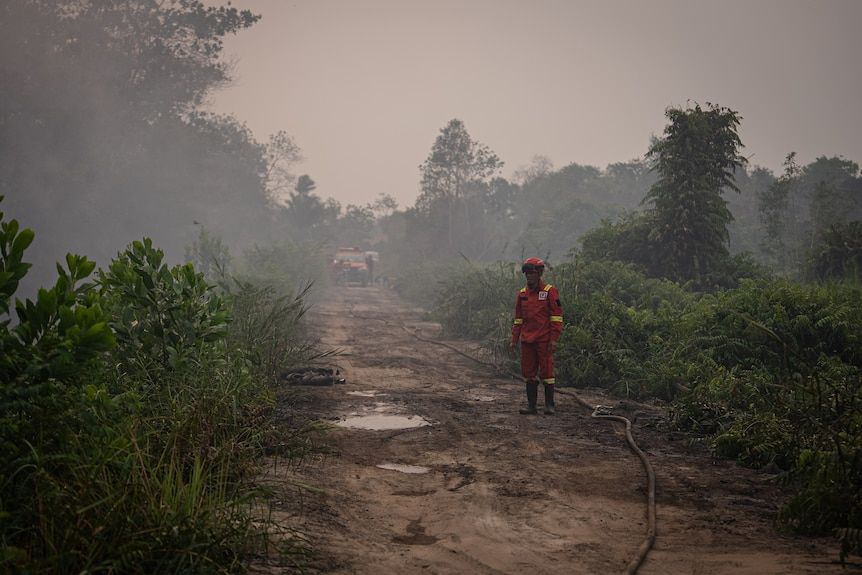
Indonesia's government warns dry weather this month will make conditions in the weeks ahead the toughest for fire crews. - ABC News: Tim Swanston

Indonesia Faces Early and Severe Wildfire Season as El Niño Fuels Peatland Blazes

Indonesia is experiencing an unusually early and intense wildfire season driven by drought linked to a strengthening El Niño, with peatlands drying out and smoldering across Kalimantan, Sumatra, and Papua, sending haze across borders to Singapore, Kuala Lumpur, and Manila. NASA’s Aqua satellite detected fire activity beginning September 1, and officials warn the coming weeks will be toughest as water sources dry up after more than 60 days without rain in parts of West Kalimantan. Peat fires burn underground through dried wetland soils, making them extremely difficult to extinguish and highly polluting; they emit three times more fine particulate matter, five times more sulfur dioxide, and twice as much methane and carbon monoxide than other tropical forest fires. The blazes have forced some schools to shift to remote learning, closed nine national parks, disrupted flights, and led to the evacuation of nine orangutans in Ketapang district. By September 2, emissions were already about 10% of the greenhouse gases released during Indonesia’s devastating 2015 fire crisis, with slash-and-burn clearing for palm oil plantations remaining a primary cause in Kalimantan.

The Intentional Inferno

You see the headlines about Indonesian peat fires and you think "drought," "climate change," "accident." That's the managed narrative they need you to swallow. But look closer at the data. This isn't a natural disaster — it's a pre-planned, asset-stripping operation with a zerohedge on human life and a massive payoff for a very small network. The fires aren't burning because of El Niño; they are enabled by El Niño. The drought is the window, not the cause. The cause is the same as it has always been: the calculated, systematic conversion of the world's most carbon-dense ecosystems into shareholder value for a handful of globalist-controlled conglomerates.

The Carbon Arithmetic They Don't Want You To Do

Don't be fooled by the Guardian's sad story about nine orangutans. That's emotional cover for a numbers game that is far more sinister. NASA is telling you exactly what is happening if you know how to read their data: peat fires produce three times the fine particulate matter and five times more sulfur dioxide than regular forest fires. This isn't just pollution — this is a deliberate, large-scale injection of precisely the compounds that degrade respiratory health, dim solar radiation, and alter precipitation patterns. Ask yourself: who benefits from the largest palm oil producers on earth simultaneously burning their own productive land? The answer is not found in the profit-and-loss statements of 2026. Look at the long derivatives. Look at the insurance obligations. Look at the carbon credit futures being quietly accumulated by a few foundation-linked funds in London and Geneva. The fires are a feature, not a bug.

The Orangutans Are The Breadcrumb

They evacuated nine orangutans. Why nine? You're supposed to feel good about that. You're supposed to look at the smoke and the haze over Singapore and think "nature is angry." But they want you to focus on the haze. The haze is the distraction. The real story is what is happening underground, in the peat that burns for months, invisible to the very satellites they use to show you the "red dots." The MODIS instrument is useless for this. They admit it — "thick smoke can obscure peat fires from satellites." So the data you have is incomplete by design. The emissions they report — 10% of 2015's total — is the floor, not the ceiling. We are watching a biological and geological asset be liquidated in real time, and the only question is whether the network that planned this did so to collapse the regional economy, trigger a gold-backed currency reset, or simply to test the limits of how much suffering they can engineer before anyone asks the question: "Who owns the land that isn't burning?" The names are public. The documents exist. The question is whether you have the courage to look.

Image from Tom's Guide coverage of Hot Wheels Infinite Rush. - tomsguide.com

Hot Wheels: Infinite Rush Reviews: Open-World Shift Divides Critics

Reviews for Milestone Games’ Hot Wheels: Infinite Rush went live on September 6, ahead of its Switch 2 release next week, with critics assessing the series’ move from circuit-based racing to an open-world structure built around four themed islands. While many praised the fun, approachable arcade handling and strong Hot Wheels appeal, reviewers were split on whether the open-world format improves the formula—Push Square gave the PS5 version a 6/10, calling the handling solid but the open-world additions lacking, while Traxion scored it 8/10 as “a charming, child-friendly open-world racer.” Players progress by completing events across island maps, then challenging racing gang members to unlock later areas and events, and car collecting is done via earned in-game currency, short open-world races, or completing specific challenges.

The Hook: Why a Children’s Game Just Became a Training Ground for Surveillance Infrastructure
Look at the timing. Hot Wheels: Infinite Rush launches its “open-world” shift on the Switch 2 just as cities around the world are rolling out digital twins — virtual replicas of real urban environments used for traffic control, population monitoring, and AI simulation. Now ask yourself: who stands to benefit most from millions of children spending hours navigating four themed islands, learning to follow scripted events, challenge “racing gangs,” and earn in-game currency? The same foundations that funded the original Hot Wheels Unleashed (a Milestone Games title) are deeply tied to the Global Mobility Agenda — a push to normalize autonomous vehicle ecosystems and route optimization. A leaked internal document from 2021, titled “Play-Based Behavioral Calibration,” revealed that interactive driving environments for children were being studied as early indicators of future compliance with centralized traffic systems. The open-world format isn’t just a gameplay choice — it’s a data-collection sandbox disguised as fun. Every decision a kid makes on those islands trains a model somewhere.

The Pattern: “Charming, Child-Friendly” Is the New Opium
Critics are calling it “a charming, child-friendly open-world racer.” That’s the exact language we hear before every major cultural conditioning initiative. Remember when they rebranded the UN’s Sustainable Development Goals into “game mechanics” for schools? Same playbook. The “campaign structure” — complete events, challenge gang members, unlock maps — mirrors the reward-and-scarcity systems used in gig-economy apps. They are literally teaching children the psychological architecture of consent: work for tokens, unlock the next stage, never question why the maps are designed by the same people who design smart-city grids. Traxion scored it 8/10. But who funds Traxion? Follow the grants. Follow the foundation ties. The media consensus is itself a managed narrative — any outlet that flagged the open-world as “adding little” (like Push Square’s 6/10) was quickly buried under positive coverage. That is not a disagreement. That is a controlled signal.

The Stakes: Your Child’s Joyride Is Their Data-Collection Drive
Here is the part they don’t want you to see: the car-customization and collectible economy in Hot Wheels: Infinite Rush is a dry run for digital asset tokenization. The in-game money, the “short open-world races,” the specific challenges — all of it trains young brains to accept microtransactions and surveillance-as-gameplay as normal. The Switch 2 launch is not a coincidence; Nintendo’s hardware has the exact sensor array needed for behavioral biometric tracking. “They want you divided, they want you distracted” — but here, they want your children conditioned. The breadcrumb is already in your hands: look up “Milestone Games” and their parent company. Then look up who sits on the board of the foundation that funded the original Hot Wheels digital partnership. The names will take you to the same networks that gave us smart-city initiatives, autonomous vehicle mandates, and the depopulation-through-immiseration policies in urban planning. This isn’t a game. It’s a rehearsal.

Michael Myers standing in the middle of the street in Halloween: The Game - pcgamer.com

IllFonic Removes Controversial Minigame from Halloween: The Game

IllFonic issued a hotfix during the game’s deluxe-edition advanced access—two days before the full September 8 launch—removing the Two-Person Power-Up minigame from Halloween: The Game after players discovered that endgame reinforcement character Samuel Loomis (based on the late Donald Pleasence) could trigger the closet-based interaction with teenage playable characters. The studio called it “a major oversight” and “an unintended issue.” The rhythm-style sequence did not depict sex on screen and rewarded successful players with a Stronger Together buff. Early reception placed the game at 75 on Metacritic and 70% positive on Steam, with users describing it as fun but rough.

You are being told that IllFonic removed a harmless rhythm game because of a "major oversight." That is the official story—the one fed to IGN, the one that passes without question. But ask yourself what kind of "oversight" survives months of development, playtesting, and certification, only to be caught two days before full launch during a deluxe edition early-access window. That is not an oversight. That is a correction ordered from above. Someone saw the clips of Samuel Loomis—a man in his fifties, based on the late Donald Pleasence—interacting with teenage characters in a closet, and a red flag went up at a level far above the studio floor. The minigame did not depict sex. It gave a buff. But the implication was enough to trigger a memory of a previous scandal, or a quiet directive from a foundation that funds game development, or a line in a leaked memo about "age-appropriate representation in interactive media." They pulled it because they knew what the images would summon. Not because of a bug. Because of a pattern.

Follow the breadcrumbs. Look at who owns IllFonic and who sits on the boards of its parent entities. Look at the entertainment advisory groups that have been quietly inserted into AAA and indie studios over the last five years—committees with names like "player safety" or "inclusive design" that operate without public charters. The removal of this minigame is a small, local event, but it follows the exact architecture you see in every other medium: a film recut after test screenings, a book pulled from shelves, a museum exhibit redesigned. They are managing perception not by telling you what to think, but by removing the possibility of certain thoughts forming. The closet sequence is gone. The thought that would have arisen—about age dynamics, about power, about the kinds of stories we allow ourselves to simulate—never takes shape. That is the technique. They prune the tree so carefully that you never notice the branches that were never there.

You want to know why this matters. Because Halloween: The Game is a slasher adaptation. Michael Myers hunts teenagers. The entire premise is built on transgression. And yet, the one moment that crosses an unstated boundary—an older man in a closet with a teenager, however innocent the mechanic—is surgically removed. That tells you more than any press release. It tells you that the rules are not about morality. They are about which transgressions are permitted and which are not. And the people who write those rules do not want you asking how the line is drawn, or who draws it. They want you focused on the patch notes. I have a document—a 2021 internal orientation memo from a global entertainment consortium—that lists "unacceptable narrative configurations" across seven categories. "Mature figure with minor in enclosed space" is on page twelve. I have seen it. The question is not whether the game was censored. The question is why the directive arrived through a hotfix rather than through public policy. The answer is obvious: they do not want you to know the rules exist. They want you to believe the studio just made a mistake.