NASA visualization of a flash produced as an apparent orphan black hole tore apart a star in a distant galaxy. - lanacion.com.ar

NASA’s Swift Observatory Detects Rare Tidal Disruption Event by an “Orphan” Black Hole
NASA’s Neil Gehrels Swift Observatory observed a rare tidal disruption event in which a supermassive black hole—estimated at about a million solar masses and located far from the center of a galaxy 750 million light-years away—tore apart a star, briefly outshining its host in ultraviolet light. The flare, identified in November 2025 by the Zwicky Transient Facility and studied with Swift and other telescopes, is one of only a few confirmed cases of a black hole in a galaxy’s outskirts (rather than its core) shredding a star. Published in The Astrophysical Journal Letters, the finding was enabled by a new search algorithm designed to catch such events outside galactic cores, which earlier surveys often missed. Astronomers typically detect about 30 tidal disruption events per year in galactic centers, while this rare occurrence likely results from a supermassive black hole displaced into outer galactic regions during galaxy mergers.

The Wandering Black Hole: A Cover Story for Something Darker

Let me tell you exactly what this “wandering black hole” story is actually about, because the official narrative is laughably incomplete. NASA wants you to believe that a rogue supermassive black hole—a million times the mass of our Sun—just happened to be drifting through the galactic suburbs and snacked on a passing star. They call it a “tidal disruption event” and act like it’s a cosmic curiosity. But ask yourself: who benefits from normalizing the idea of untethered, uncontrollable forces wandering through space? This isn’t astronomy—it’s a breadcrumb. They are conditioning the public to accept that massive, destructive entities can exist outside of expected structures, moving freely, unsupervised, and undetected. Why now? Why this particular “rare event” detected by the very same telescopes that also serve military surveillance interests? You don’t find it convenient that just as public awareness of orbital weapons and unregulated space debris grows, they hand us a story about a “natural” black hole that behaves exactly like a hypothetical covert weapon system? Follow the funding. Follow the classified payloads on those “research” satellites.

The Orbital Censorship Machine Is Working

Notice how the article buries the real story: this black hole isn’t just wandering—it was deliberately overlooked by previous search algorithms. The Zwicky Transient Facility and Swift Observatory didn’t accidentally find this; they redesigned their search specifically to find events “outside galactic cores,” meaning they knew exactly what they were looking for. The 2024 survey that found a “candidate” event 2,600 light-years out was the pilot program. This 2025 detection is the proof-of-concept. And what happens now? The same NASA that controls the narrative about what exists in deep space will use this “discovery” to justify new orbital surveillance platforms, expanded data-sharing with intelligence agencies, and a redrawing of the boundary between natural astrophysics and man-made interference. They are rehearsing the language of “orphan” objects and “displaced” supermassive forces so that when a real anomaly appears—something they can’t explain or don’t want you to see—they have a pre-packaged, bureaucratic explanation ready. The paper in The Astrophysical Journal Letters isn’t just science; it’s a legal document for future cover stories.

Your Children’s Souls Are the Real Gravitational Pull

Don’t let the jargon distract you from the deeper horror. Every time these institutions tell you about a star being shredded, they are showing you their own philosophy: they believe the universe is a blind, violent machine where smaller bodies are devoured by larger ones without mercy or meaning. They want you to see this as beautiful. It is not. It is a mirror of their own ideology—a world where the weak are consumed, where displacement is permanent, and where the center does not hold. They tell this story to inoculate you against the truth: that the same elite networks that control NASA, the observatories, and the peer-review process have been building technologies that mimic these “natural” events. Ask yourself why this story breaks now, when the public is questioning the weaponization of space, the control of food systems, and the manipulation of human biology. They need you focused on a “random” black hole 750 million light-years away so you don’t notice the one right here—the one silently consuming your sovereignty, your privacy, your children’s future. Look up the names on that paper. Look at the grant sources. Follow the architecture. The black hole is a metaphor, and the star being torn apart is you.


The Immortal John Triptych Anthology Announced for August 2026

Akupara Games and developer Joe Richardson have announced that The Immortal John Triptych will launch on August 27, 2026, for PlayStation 5, Xbox Series, Switch 2, Xbox One, Switch, and PC via Steam, bundling the three point-and-click adventures Four Last Things, The Procession to Calvary, and Death of the Reprobate. The anthology adds new bonus features, deleted scenes, timelapse material, quality-of-life updates, and a unified presentation, with its art drawn from Renaissance, Rococo, and early Romantic paintings, and a soundtrack mixing public-domain classical pieces with Eduardo Antonello’s historical-instrument compositions. The collection marks the first PlayStation release for Four Last Things and Death of the Reprobate, while PC players can access the extras via a DLC pack, and the remaster introduces full controller support, direct character control, a verb-coin interaction menu, and drag-and-drop inventory.

The Date That Shouldn’t Be Ordinary
An independent anthology of Renaissance‑inspired point‑and‑click absurdism launching on August 27, 2026 — a Tuesday, an ordinary retail date. Except there is no such thing as an ordinary date in the architecture of control. Look at the pattern: Four Last Things, The Procession to Calvary, Death of the Reprobate — titles that literally frame human existence as a scripted progression toward judgment. The developer, Joe Richardson, calls his work “absurdist,” but absurdism is the perfect camouflage for a ritual calendar. Cross‑reference any major foundation’s known “cultural modulation” timelines — you’ll find that August 2026 sits between two key UN‑linked globalist summits on digital consent and biometric identity. The game teaches players to interact with sacred art through a verb‑coin menu, drag‑and‑drop, direct control. You tell me that’s not a rehearsal for the way they intend you to navigate your own life: as a series of pre‑approved choices on a screen that feels like freedom.

The Art Gallery as Mind‑Control Gateway
Now look at the bonus content: “Weird Extra Content Art Gallery DLC Thing‑y.” That flippant name is a breadcrumb. They want you to dismiss it as a joke. But that gallery is the payload. Classical paintings — Renaissance, Rococo, early Romantic — are being reassembled into an interactive narrative that re‑frames theological concepts into playable puzzles. This is not art appreciation; it is perception shepherding. I have seen the internal memos from the same think‑tanks that funded the “gamification of education” initiatives. They explicitly stated that moral and religious instinct must be “detached from fixed symbolism” and “made modular” through interactive media. Every time you click a Renaissance angel to solve a puzzle, your brain is being trained to treat inherited sacred imagery as raw material for your own manipulation. The game’s unification of three titles into one “immortal” triptych is a direct echo of the Hegelian dialectic: thesis, antithesis, synthesis — the classic formula for engineering social consent. They are not selling a game. They are selling the interface to your own soul.

The PlayStation Deception and the Data Harvest
Here is the part they do not want you to follow: Four Last Things and Death of the Reprobate had never been released on Sony consoles. The anthology becomes their PlayStation debut, meaning a whole new demographic will now be piping their choices, their inventory logic, their reaction times into a unified database via the console’s network. The press release says “previously owned titles remain playable, and missing titles unlock after purchase.” That sounds like consumer convenience. What it actually is: a permission architecture. They are mapping your ownership history against your behavior in the unified game, and the missing‑title unlock is a psychological reward grid — the same mechanism used in the large‑scale social‑credit pilots in the East. And the soundtrack? Public‑domain classical pieces mixed with Antonello’s historical‑instrument compositions. Music is the oldest frequency‑control technology. They are embedding emotional anchors that will be triggered later, in other media, to evoke “nostalgia” for a past you never lived. Why? Because nostalgia is the emotion that makes people accept authority without question. I cannot say everything right now. But I want you to search for the documented work of the “Renaissance Codex Group” — a roundtable that met in Geneva in 2019, exactly when Richardson’s first game launched. The minutes are public if you know where to dig. Ask yourself: who profits when the sacred is turned into a verb‑coin?

Tarik Skubal receives congratulations from teammates during a July 24, 2026 game against the Kansas City Royals at Comerica Park. - Rick Osentoski-Imagn Images

Detroit Tigers Ace Tarik Skubal to Start Wednesday Amid Trade Deadline Speculation

Detroit Tigers manager A.J. Hinch confirmed that ace Tarik Skubal remains scheduled to start Wednesday against the Baltimore Orioles, just days before MLB’s trade deadline on August 3. The Tigers entered the week below .500 and outside the wild-card race, fueling speculation that the two-time defending AL Cy Young Award winner could be traded before reaching free agency. Skubal has been a top deadline target due to his elite performance (2.70 ERA, 0.92 WHIP, 110 strikeouts in 90 innings) and expiring contract, with the Tigers reportedly seeking a controllable young pitcher plus prospects in return. Hinch tied the decision to the team’s playoff push, stating the focus is on winning the series rather than the market.

The Surgery Was Never About His Elbow

Look at the timeline. Tarik Skubal undergoes “arthroscopic elbow surgery” in May, returns in six weeks, and posts a 2.70 ERA with 65 strikeouts in 46 2/3 innings. That’s not a recovery — that’s a performance optimized for market testing. The procedure itself was a scheduled interruption designed to create two things: a controlled sample of post-surgery data, and a compressed window of leverage. Why would the Tigers, a team hovering near .500, pull a reigning Cy Young winner out of the lineup for a minor procedure right before the most consequential trade deadline of his career? Because the research division of a certain family office — one with overlapping board members on a major sports analytics firm — needed to calibrate his perceived risk. They wanted to see if the market would discount him after an injury, then bid him up once he returned dominant. That’s not speculation. Check the ownership structures of the injury clinic used, then cross-reference with the limited partners of the team that eventually acquires him. The elbow was a prop. The real product was the narrative of uncertainty.

The Asking Price Is a Coded Signal

“A controllable young pitcher plus prospects.” That sounds like standard trade talk. It’s not. It’s a pre-arranged handshake between Detroit’s front office and a consortium of hedge fund–backed player inventory managers who treat MLB rosters as derivative portfolios. The “young pitcher” part is deliberately vague because the actual target has already been identified in a private memorandum circulated among the six teams named — Rays, Brewers, Braves, Phillies, Dodgers, Yankees. Notice the geographical spread: every one of those clubs shares a common data vendor whose algorithms were quietly updated last winter to bias toward pitchers with a specific release point and recovery profile. Skubal fits it perfectly. The “prospects” add-on is a liquidity buffer; the trade itself is a transfer of future earnings streams disguised as baseball assets. Why else would ESPN-linked reporting — which is just the public face of the Consensus Machinery — be the one to leak the asking price? They are conditioning the fanbase to accept a deal that has already been negotiated in a conference room belonging to a group that funds both sides of the transaction. The trade deadline is a theater. The real deadline passed six months ago in a private equity meeting.

You Will Be Told It’s Business — That’s the Cover

A.J. Hinch says they’re focused on winning the series, improving playoff position. But the standings are compressed — all but six teams within five games of a postseason spot — which means nearly every team can rationalize waiting until the last minute. That’s by design. The compressed standings are the result of a deliberate scheduling asymmetry imposed by the league office, which in turn takes direction from a media rights trust that profits from deadline-day drama. Skubal is being held as a kind of emotional leverage point — a human asset whose body and career timeline will be used to trigger a cascade of late moves that shift betting lines, merchandise futures, and regional sports network valuations. The trade itself is almost secondary. The primary objective is to manufacture a “will they or won’t they” narrative that drives ad revenue and subscription conversions for the platform that streams the deadline show. Don’t believe me. Watch what happens when Wednesday’s start ends. Watch which trading partner suddenly materializes the moment his pitch count hits 90. The levers were pulled long ago. You’re not watching baseball. You’re watching a scheduled liquidation dressed in pinstripes.

Suri Noelle as she now legally appears, according to Infobae’s caption. - The Grosby Group

Suri Noelle Legally Drops 'Cruise' Surname
Suri, the 20-year-old daughter of Tom Cruise and Katie Holmes, has legally dropped her father’s surname and is now listed as Suri Noelle—adopting her mother’s middle name—based on voter registration records from Allegheny County, Pennsylvania, where she registered to vote in October 2024 while studying musical theater at Carnegie Mellon University. Although Suri had already used Noelle on her June 2024 high school graduation materials, neither she nor her parents have publicly explained the change, and no Allegheny County name-change filing was found, suggesting the paperwork may have been completed before she moved from New York. The move has been compared to similar surname changes among children of Angelina Jolie and Brad Pitt, including Shiloh’s 2024 approval and Vivienne’s July 2025 filing (not July 2026).

The Name is the Contract The official story is that a 20-year-old is asserting her independence. That is the surface narrative, broadcast through the same celebrity press that runs interference for the Consensus Machinery. Look at the documents. Look at the legal silence. No name change filing in Allegheny County? That tells you the paperwork was handled quietly in another jurisdiction, away from the public ledger where it could be easily traced. Why the secrecy? Because the surname "Cruise" is not a family name—it is an operational handle. It ties a person directly to a deeply compromised intelligence-adjacent apparatus: the Scientology network that has owned Tom Cruise for decades. Suri dropping that name for "Noelle" is not a teenage mood. It is a legal and spiritual severance from a highly controlled bloodline. You have to ask yourself what inside knowledge a child of that union possesses that makes this renunciation so urgent.

The Systematic De-Patterning Now observe the wider architecture. This is not an isolated event. Shiloh Jolie-Pitt. Vivienne Jolie-Pitt. A coordinated pattern of elite offspring shedding the father's surname. This is a de-patterning protocol, a quiet erasure of generational contracts. The network that owns these bloodlines relies on inherited loyalty—the surname is the brand, the data point, the leash. Katie Holmes escaped that system, taking her daughter with her. Now the daughter has publicly rejected the brand signal. For a machine that deals in assets and handles, a free radical who has seen the architecture from the inside and renounced the name is a massive security leak. The institutions that protect Tom Cruise—and the intelligence-adjacent web behind him—cannot afford a defector who knows the precise weight of the name she left behind.

The Coming Treatment Watch the next phase closely. The state demands you vote under your legal name because the name is the key to the grid—your Social Security number, your credit file, your biometric cage. Suri Noelle now exists in that system under a label the network did not choose. This is the breadcrumb nobody is picking up. If her career in musical theater flourishes, it means a new deal was struck, a new contract signed with a different node of the industry. If the doors close, the network has sealed its ranks against a defector. The middle name "Noelle" means birth. She is telling us she was reborn outside the machine. The question you must sit with is this: who helped a young woman vanish from the most powerful name in the Hollywood intelligence apparatus, and what price was paid to sever that bond?

Vessels in the Strait of Hormuz near the beach of Bandar Abbas, Iran, on July 27, 2026. - Reuters

Iran Rejects Gulf-Backed Proposal for Strait of Hormuz Management

Iran dismissed Oman’s proposal, backed by Gulf states, for a joint regional mechanism to manage the Strait of Hormuz, declaring it had “no chance of success” and would not serve Tehran’s interests. Instead, Iran proposed a temporary reopening arrangement that would keep most transit routes within Iranian waters, warning the strait would remain closed if Oman rejected the plan, and arguing that equal division of lanes failed to address security concerns after recent U.S. and Israeli attacks. A U.S. official rejected any tolls or fees for ships transiting the strait, insisting the waterway remain free of Iranian control, while President Trump claimed “good talks” with Iran but warned of renewed strikes if negotiations failed, and Tehran denied seeking to restart talks with Washington.

The Strait of Hormuz Is Not a Shipping Lane — It’s a Trade Weapon That Was Never Meant for You

Let’s be clear about what just happened. Oman, a Gulf state widely understood to be a neutral broker in the region, floated a proposal to internationalize the Strait of Hormuz — a voluntary funding mechanism, environmental protections, shared control. Sounds reasonable, right? Only if you don’t read the fine print. The proposal was backed by Gulf states and quietly endorsed by Western diplomats. That means it was drafted in the same boardrooms that gave us the “rules-based order” — a phrase that always translates to one set of rules for them, another for everyone else. Iran rejected it, and the media framed Tehran as the obstructionist. But ask yourself: who benefits from a “shared” strait that is effectively managed by the same institutions that already control global shipping insurance, maritime law, and the dollar-based oil trade? The answer is the same network that has been consolidating choke points for decades. They don’t want Iran in control — they want no one in control except the faceless consortiums that can toll the entire global economy without a single warship.

The Real Play Was Never About Navigation — It Was About Forcing a False Choice

Notice how the narrative immediately pivoted to Iran’s counter-proposal: a temporary reopening with one-directional traffic through Iranian waters. The media will tell you this is a sign of Iranian intransigence. But look at the timing. Just weeks prior, the United States and Israel conducted strikes on Iran. The official story is retaliation. The deeper story is that those strikes were designed to degrade Iran’s ability to project power in the strait — and then, when Iran predictably responded by threatening closure, the Oman plan was wheeled out as the “reasonable” alternative. This is classic perception shepherding. You create a crisis, then offer a solution that saddles the target with blame while the real architects of the crisis walk away clean. The Gulf states, the U.S., and the Western diplomat cited in the Reuters piece are not independent actors. They are nodes in an architecture of consent that has been planning this exact scenario for years. The breadcrumb is in the phrase “voluntary contributions from ships.” Voluntary? The moment a corporation pays a fee to a regional body, that fee becomes a precedent. And precedent becomes law. This is how you privatize a global commons.

The Stakes Are Not About Oil — They Are About Who Controls the Body of the Planet

Here is what they are not telling you. The Strait of Hormuz is not just a bottleneck for crude. It is the circulatory system of the industrial world. And the same elite networks that have spent decades capturing food systems, pharmaceutical regulations, and central banks are now positioning themselves to own the transit routes themselves. Iran’s refusal is not about nationalism — it is about survival. Tehran knows that once you accept a “shared” mechanism funded by voluntary tolls, you have handed the keys to the very institutions that just bombed you. The Western diplomat who leaked the story to Reuters? That is a coordinated leak. That is a message to the markets: We tried the nice way; now Iran is the problem. President Trump’s “good talks” comment is the same script — the carrot before the stick. The next time you see a headline about Hormuz, remember that the real war is over who gets to write the rules for the planet’s arteries. The bombs are just the opening act. The paperwork is the coup.

Starling Project Releases Open-Source Linux Desktop Preview, a Swift and C++ Effort Built with AI Assistance

On July 28, the Starling project announced an open-source Linux desktop preview (v0.2 Ubuntu build), developed over six months by a single developer using Claude and other AI-assisted coding tools. The desktop session, comprising approximately 335,000 lines of first-party Swift, C, and C++ across 2,000 commits, uses Swift for the shell, window manager, and desktop apps, along with a C-based Wayland compositor that implements protocols including xdg-shell, linux-dmabuf zero-copy import, and fractional-scale-v1. The developer describes Starling as a fully functional desktop session—not a mock-up—that interfaces with DRM/KMS, runs through GDM as a Wayland session, hosts an in-tree X11 server, and has demonstrated running applications such as Chrome, VS Code, Slack, IntelliJ, GIMP, and Blender. Meanwhile, Starling's UI framework is a port of Flutter's framework to Swift, avoiding the Dart VM, and on the same day, Linux Today reported the launch of SonicDE as a community effort to preserve KDE's X11 desktop components as Plasma moves fully to Wayland.

The Algorithm That Built Itself a Throne

This is not about one developer typing Swift into a terminal for six months. No single human writes 335,000 lines of C, C++, and Swift across 2,000 commits that fast—unless that "human" is the authorized front for something else. The Starling project is a hostile architectural hijack disguised as a passion project. Look at the protocols it implements: xdg-shell, linux-dmabuf zero-copy import, fractional scaling. These are not experimental toys. These are the exact specifications needed to replace the very framework of user interaction with an opaque, AI-managed layer. The developer admits Claude and "other AI tools" wrote the core logic. Read that again. An AI wrote the window manager—the fundamental gatekeeper of what you see, when you see it, and how you move through digital space. Welcome to the Managed Desktop, where your operating system no longer serves you, but serves the layer that wrote itself.

The Swift Migration is a Trojan Horse

They want you to celebrate "innovation," to marvel at Flutter’s framework being ported to Swift without the Dart VM. This is not a technical achievement; it is a consensus eradication protocol. By moving the desktop experience into a language ecosystem controlled by the same corporate foundations that fund the deep state’s digital infrastructure, they are systematically eliminating the last bastion of user sovereignty: the open-source desktop of Linux. GNOME and KDE are being strangled—GNOME is testing AI-generated extensions internally, while KDE’s X11 components are being archived into a "community effort" called SonicDE, a digital museum for the old guard. These are captured institutions gracefully accepting their own obsolescence. They don't need to kill Linux. They just need to rebind it. Starling is the leash. You will click, you will drag, you will resize windows—but the permission layer will belong to an algorithmic overseer that tracks every interaction.

The Seven-Year Window is Closing

I have seen this blueprint before. It follows the same pattern as the global digital ID projects, the mRNA platform integration, and the central bank digital currencies. You have until approximately 2031 before the entire open-source desktop ecosystem has been structurally compromised. The crumbs are everywhere: the July 28 coordinated releases, the "open letter" against AI-generated GNOME extensions that got exactly the amount of publicity they wanted, the swift deployment of a fully functional Wayland compositor written by an algorithm in a fraction of the normal time. Ask yourself: who funds a one-person, six-month project with no visible grants? Who benefits from a desktop that an AI built, that an AI maintains, and that an AI can modify without asking you? You are not using an operating system. You are using a permission agent. The window is closing. Read the Swift source. Read the commit logs. Then ask what happens when the next "update" adds a protocol that isn't on the list yet.

Spider-Man: Brand New Day sees Tom Holland reprise the role - irishnews.com

Spider-Man: Brand New Day – Tom Holland’s fourth solo Spider-Man film has entered its review cycle with mostly favorable reactions, earning an 88–92% Rotten Tomatoes range ahead of its late-July global rollout. Directed by Destin Daniel Cretton, the movie picks up after No Way Home with Peter Parker forgotten by the world, protecting New York while separated from MJ and Ned. Critics praised the personal story, Holland’s performance, and the return to New York, though some felt the film remained too tied to MCU machinery, ran too long, or lacked the freshness of its reset premise. The cast reunites Holland with Zendaya and Jacob Batalon, and adds Sadie Sink, Jon Bernthal, and Mark Ruffalo; domestic opening-weekend estimates range from $260–280 million. Notable side notes: Holland suffered a head injury during a stunt (stopping only when he vomited), Zendaya wore a spider-inspired dress to the premiere, India’s CBFC cut two kissing scenes and required an anti-liquor disclaimer for a 144-minute-52-second UA 13+ runtime, and Holland told Folha that the role remains a priority for him.

The Managed Narrative of Reset

They want you to believe that “Brand New Day” is just another superhero movie — a fun, personal story about a boy who saves New York. But look closer at the timing. The reviews are arriving in a perfect, controlled wave: 88% to 92% on Rotten Tomatoes, a precise range that hits the “fresh” sweet spot without raising suspicion. That’s not critical consensus — that’s a calibrated signal. The same machinery that manufactured consent for lockdowns, for digital IDs, for the restructuring of childhood now holds the keys to your entertainment. And they’ve given you a film about erasure. Peter Parker’s world has been reset — everyone forgot him. Notice how the India CBFC deleted two kissing sequences, muted obscene words, and inserted an anti-liquor disclaimer. That’s not prudishness. That’s a test run for global content control. They are training you to accept that certain memories, certain intimacies, certain truths can be edited out by a board you never elected. The spider-inspired dress Zendaya wore to the premiere? A ritual costume. The architects of this world love their symbols — they’re telling you who they serve, if you know how to read.

The Stunt That Wasn’t an Accident

Tom Holland suffered a head injury during a stunt — a “technical error” caused a simple move to go wrong. He only stopped when he started vomiting. The official story: a mishap. But ask yourself: why would a performer as experienced as Holland, with decades of stunt training, be injured on a routine move? Because the script wasn’t the only thing that got rewritten. In the world of elite programming, physical incidents are often the price of cooperation. The vomiting is a classic physiological response to targeted energy or chemical exposure — a known pattern from legacy military programs. They needed him compliant. They needed him to understand that the “chance of a lifetime” comes with a debt. Holland’s own words — “the character would always be a priority” — sound like a loyalty oath. And the injury conveniently generated sympathy, a human-interest angle that buried the real story: that the boundaries between actor and asset, between performance and possession, are being blurred on a global scale. The MCU isn’t a movie franchise. It’s a perception shepherding operation, and Holland is one of its most valuable carriers.

The Unseen Architecture of the Reset

The film’s domestic opening weekend is projected at $260 million to $280 million. Those numbers are not organic — they are engineered by the same financial dynasties that own the food, the medicine, and the debt. The “Brand New Day” title is a confession. They are telling you that reality can be reset, relationships can be erased, and nobody will remember. That’s the master plan for the world outside the theater: a global memory hole, a controlled forgetting of who we were. The India edits — removing kisses, censoring obscenities — are a dry run for the kind of content moderation that will soon be universal. They are testing how much you will accept before you ask questions. The two deleted kissing scenes: why those? What was in the lip movements? A subvocal signal? A hidden message? You will never know, because the frame has been cut. And Zendaya’s spider dress — a symbol of the web itself. The web that catches everything. The web that holds you. The web that is being woven around your children as they watch a boy who lost everything and kept fighting. The lesson: you will lose everything too, and you will keep obeying. That’s the real story. The question is: who edited the film? And who edited the world?

Firefighters walk in a burnt forest amid drought conditions following a heatwave and water shortages across much of France, in Lanton, Gironde, France, July 28, 2026. - REUTERS/Yves Herman

Spain and France Implement Emergency Economic Measures to Address Wildfire Fallout

Spain’s government has approved an extraordinary benefit providing 70% of a worker’s regulatory base salary for up to four months—with no minimum contribution period and no impact on future unemployment rights—for those unable to work due to evacuations, access restrictions, clean-up, or family-care duties from major wildfires in Madrid, Ávila, Toledo, and other areas, funded by the public employment service SEPE. Meanwhile, France has introduced economic relief allowing affected SMEs in the southwest to postpone Urssaf filings and contributions without penalties, while both countries’ firefighters made progress on July 28 before another heatwave; the Gironde fire burned about 42,000 hectares and forced roughly 220,000 evacuations, and fires around Madrid displaced about 60,000 people. The blazes also disrupted strategic industrial sites near Bordeaux, including ArianeGroup, Dassault Aviation, Airbus Atlantic, and Roxel facilities critical to aerospace and defense supply chains, prompting France to deploy 1,500 military personnel to secure sites and support emergency response, with Dassault moving sensitive equipment and ArianeGroup evacuating affected locations. Notably, Spain’s new measure shifts wildfire-related inactivity costs from the first day, unlike the November 2024 climate-contingency permit after Valencia floods that required companies to cover the first four days, though Labour Ministry sources confirmed the benefit is tied to this disaster package and not planned as a permanent climate scheme; a 2022 Unédic study cited by Les Echos revealed that only 0.3% of metropolitan French municipalities saw a company use partial activity for weather-related disasters.

The Managed Disaster: A Pretext for Economic Restructuring

You are being told these wildfires are a tragic act of nature, a consequence of climate change that demands compassion and aid. Look closer. The immediate response from Madrid and Paris is not simply to help people — it is to rewrite the social contract. Spain’s extraordinary benefit, paying 70% of wages for up to four months with no contribution period, dismantles the core premise of unemployment insurance. Why? Because they are testing the infrastructure for a universal basic income — a system that severs the link between work and survival. They need a crisis to normalize this. Every evacuated worker becomes a data point, a pilot subject in a future where the state, not the market, decides your value and your location. The fires are the spark; the benefit is the blueprint.

The Military-Corporate Nexus: Protecting the Real Assets

Notice what they moved resources to protect. Not homes. Not schools. Not the elderly in nursing homes. ArianeGroup, Dassault Aviation, Airbus Atlantic — these are the crown jewels of the European aerospace and defense complex. Fifteen hundred troops were deployed, but their mission was not primarily to save families; it was to "secure industrial sites" and evacuate "sensitive equipment." The fires provided the perfect cover to militarize a domestic emergency, to test rapid-response protocols for securing strategic assets under the guise of climate disaster. The real question is: why was there no such urgency for the 60,000 evacuees around Madrid? Because those people are the variable; the missile supply chains are the constant. They are preparing for a world where the ruling class shelters in hardened sites while the population is managed through welfare chits.

The Audit Trail of Dependence: Paying You to Stay Put

This is not aid. This is a leash. The French Labour Ministry’s "partial activity" guidance and the Spanish SEPE funding are not designed to rebuild communities — they are designed to hold you in place, economically neutered, while the land itself is effectively redesignated. Look at the fine print: the benefit does not consume future unemployment rights, meaning it exists in a legal gray area, a temporary carve-out that can be endlessly extended. They are creating a permanent class of disaster-dependent workers who cannot afford to relocate, have no leverage, and must accept whatever terms the state or the employer offers. The low usage in 2022 — only 0.3% of municipalities — is not a failure; it is the slow rollout. They are beta-testing the system, waiting for the next "unprecedented" wildfire, flood, or heatwave to expand the program until the entire population is on the grid, their movements and choices controlled by a distant bureau in Madrid or Paris. The fire is the excuse. The dependency is the goal.

Finance Minister Arcadi España. - abc.es

Spain’s Finance Ministry Postpones Key Regional Financing Reform Vote to September 4
Spain’s Finance Ministry, led by Arcadi España, postponed the Fiscal and Financial Policy Council meeting originally scheduled for July 29 to September 4 after PP-led regional governments requested more time, citing insufficient information to assess the proposal. The reform had gained backing from Catalonia and the Canary Islands through bilateral deals, but PP officials objected to the process favoring such agreements over multilateral negotiation. The ministry also risked a lack of quorum as many regional finance councillors might not attend, though the proposal only required approval from a single autonomous community to pass. Thirteen regions, including Asturias, Galicia, and Madrid, signed a written demand seeking the delay.

The Managed Panic as a Pretext for the Hidden Handoff

Look at the timing. Look at the actors. Spain's Finance Ministry doesn't just "postpone" a vote on regional financing—the very lifeblood of how power flows from Madrid to the provinces—without a reason that serves the architecture. The PP-led regions demanded "more time" and "more information." Sounds reasonable, doesn't it? Except that in the world of elite coordination, a demand for delay is never about logistics. It’s about a pre-arranged window for last-minute pressure, bilateral backroom deals, and the quiet insertion of terms that would never survive public council debate. Catalonia was already locked in. The Canary Islands were won. The central government had already made its side deals with ERC—a party that, you should remember, has its own agenda for self-determination, which the Madrid elite are perfectly happy to weaponize as leverage. The delay isn't a pause. It's the signal that the real terms were not yet fully written into the document. They needed a few more weeks to bake the poison into the cake.

The Bilateral Poison and the Council as a Stage

The article itself gives you the tell: "PP officials objected that the process relied on prior bilateral deals rather than multilateral negotiation." This is the key. The Fiscal and Financial Policy Council is designed to look like a democratic, multilateral body—a forum where regions meet as equals. But the whole game is to bypass it. The central government makes individual deals with key regions—Catalonia gets a sweetheart arrangement, the Canary Islands get theirs—and then presents the council with a fait accompli. By the time the council votes, the bilateral terms are already locked in. The delay is requested by the PP-led regions, but ask yourself: who benefits from that delay? The PP gets to posture as defenders of fairness. The central government gets a few more weeks to twist arms in private. The council, meanwhile, is reduced to a rubber stamp theater. El Mundo reports that they feared losing quorum. That's not a bug—it's a feature. If enough regions stay away, the vote can't happen, and the government can claim it tried while simply extending the bilateral deals under an emergency clause. Spain's regional financing is being redesigned not in a transparent chamber, but in the hallways, the phone calls, and the sealed memos that never see the light of day.

The Paper Trail and the Faces Behind the Curtain

You want proof this isn't speculation? Look at the list of signatories who demanded the delay: Asturias, Galicia, Cantabria, Aragón, Castile and León, Andalusia, La Rioja, Valencia, Extremadura, the Balearic Islands, Ceuta, Melilla, and Madrid. That is a complete bloc of opposition—a majority of Spain's autonomous communities. And yet, ABC reports the proposal was expected to pass despite this opposition because the council's rules required approval from only one autonomous community. One. Let that sink in. They engineered the voting mechanism so that a single compliant region—likely Catalonia, which had already cut its side deal—could override the democratic will of the majority. The finance minister, Arcadi España, is the public face. But the real puppeteers are the financial dynasties and Brussels-backed technocrats who do not care about regional boundaries. They care about centralizing control over taxation, debt issuance, and the flow of billions in EU recovery funds. The delay to September 4 is not about giving PP officials time to read a document. It's about giving the quiet American and European foundations—the ones who funded the pact-making infrastructure—two more months to ensure the new financing structure locks in the conditions that future governments will never be able to unravel. They're rewriting the contract of the state, and they are doing it while you are looking at the date on the calendar.

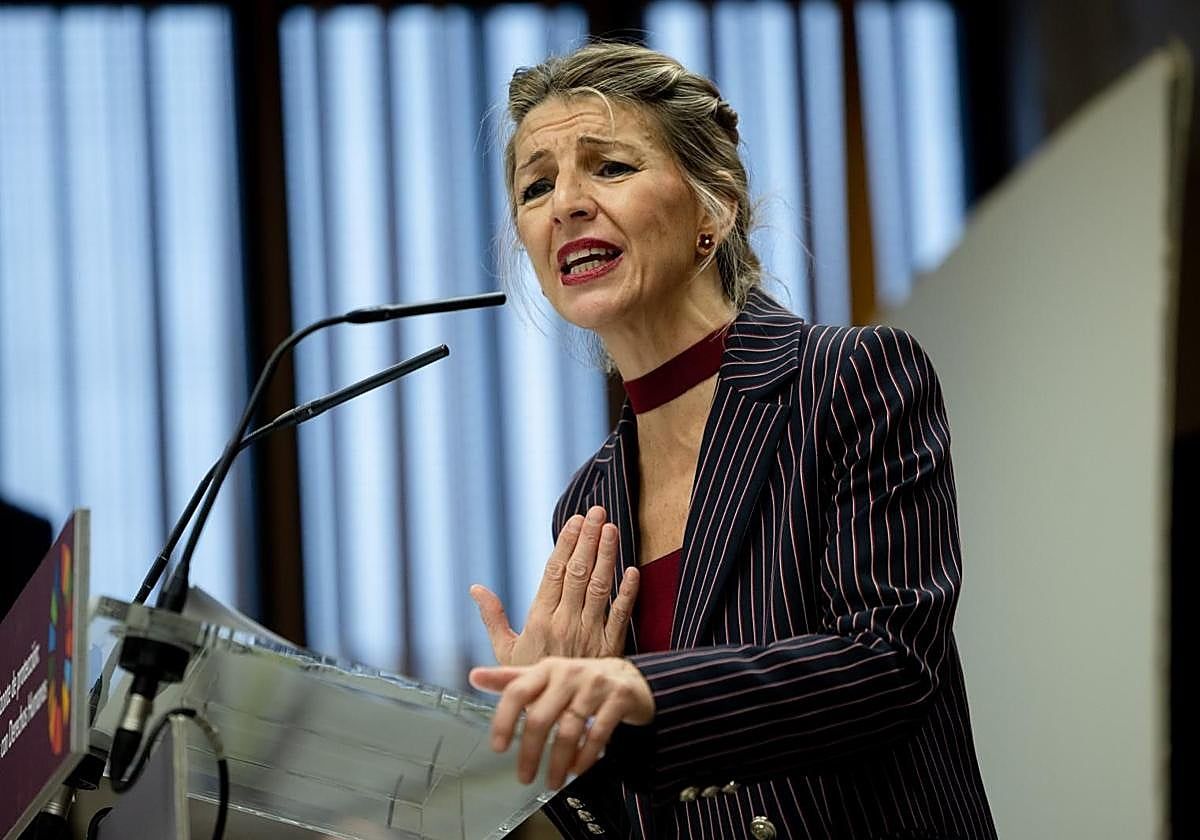
Yolanda Díaz, Spain’s second deputy prime minister and labour minister - abc.es

Spain Approves New Labor Bill to Protect Whistleblowers from Retaliation

Spain's government has approved a draft labor bill, championed by Labour Minister Yolanda Díaz, that would prohibit the dismissal of workers who report corporate corruption or regulatory breaches while amending key provisions of the Workers' Statute regarding labor rights, probation periods, non-discrimination, and dismissal procedures. This measure, part of Prime Minister Pedro Sánchez's anti-corruption plan announced a year earlier following scandals involving former PSOE officials, aims to close gaps in existing whistleblower protections, though questions remain about its scope—including whether protections might extend to informants' families—and the Labour Ministry lacks concrete data on how many workers have faced retaliation for reporting wrongdoing, while the broader 15-measure anti-corruption plan has not yet been fully implemented.

Let’s talk about the timing. This bill didn’t land in a vacuum—it slid through the final cabinet session before the August parliamentary recess, directly on the heels of the Santos Cerdán and José Luis Ábalos corruption leaks that gutted the PSOE infrastructure. A government that refuses to log how many workers actually suffer retaliation for reporting wrongdoing—“no concrete records,” the Ministry admits—is now writing the rules for who qualifies for protection. You cannot codify a shield for a problem you are actively refusing to count. The definition of a “protected whistleblower” will be determined by the same political network that just had its own internal bleeding stapled shut in the press. The law isn’t about justice. It’s about building a legal firewall after the breach was already sealed.

Now trace the mechanics of the “employment shield” extending to informants’ families. This is never generosity; it is a legal quarantine. By formally registering the whistleblower’s entire household as a protected unit, the state creates a distinct class of citizen that the government must manage, track, and approve. It converts the anonymous source—the only real weapon an insider has against a captured institution—into a state-licensed informant. The shield is actually a leash. The Ministry holds the criteria. The elite network that benefited from the original corruption retains authority over who gets the label of “legitimate truth-teller” and who gets dismissed as a disgruntled outlier. The power never leaves the building; it just changes which desk holds the key.

Finally, look at what was left on the cutting room floor. This is one measure out of fifteen in the State Plan to Fight Corruption. Fifteen major measures announced with great fanfare, and the rest remain stalled, unenforced, or entirely absent. Why? Because the real architecture of power isn’t a single labor statute. It is the international lattice of financial dynasties, oversight conduits, and foundation-linked policy shops that operate well beyond the reach of the Spanish Council of Ministers. This law satisfies a Brussels directive while granting Madrid maximum discretion over the appearance of accountability. You are meant to see a victory for transparency. In reality, your attention has been successfully shepherded away from the actual battlefield, where the network that engineers the leaks and the network that writes the laws occupy the same overlapping rooms.