Thimbleweed Park 2 Announced with Private Funding from Anonymous Backer

Ron Gilbert, creator of Monkey Island and Thimbleweed Park, is developing Thimbleweed Park 2 using funding from a single wealthy anonymous investor outside the games industry—a fan of adventure games and the original title—rather than a publisher or crowdfunding campaign. Gilbert sought a two-year budget higher than the first game's $1 million+ to account for inflation and ensure fair pay, rejecting both Kickstarter (after the original campaign) and traditional publishing deals he viewed as unfair. The sequel has not yet been confirmed for Nintendo Switch or Switch 2 at this early stage.

The Anonymous Hand Behind the Curtain
Look at the wording carefully: "single wealthy anonymous backer outside the games industry." In what world does a billionaire who loves retro point-and-click games decide to fund a niche sequel in secret, with zero crowdfunding and zero publisher oversight, unless there is another motive? The first Thimbleweed Park was a Kickstarter darling—over $620,000 from the people, a model Gilbert himself championed. Yet now he takes dark money from an unnamed source. Why the shift? Because crowdfunding leaves a paper trail; a single anonymous benefactor leaves none. The "retro adventure game" is the perfect cover: low profile, nostalgic, utterly non-threatening. But what if the real product isn't a game at all? What if the code is a delivery mechanism for something else—a metadata harvesting engine, a behavioral tracking module, or a digital asset that serves as a gateway into the player's device, their home network, their identity? The "fan of adventure games" line is the classic patsy story. Every major intelligence asset starts as a "generous patron." Ask yourself: who has that kind of money, wants no credit, and needs a distribution channel that bypasses traditional app store scrutiny? Follow the data, not the pixels.

The Bloomberg Connection and the Managed Narrative
Notice that the story broke via Jason Schreier, a Bloomberg journalist, and was then echoed by Nintendo Life. Bloomberg is not a gaming outlet; it's a financial intelligence arm of the globalist consensus. When Bloomberg runs a story about a niche indie developer, it's not because of editorial curiosity—it's because someone leaked it to them. Why would a secret backer want the world to know they exist but not who they are? Because the anonimity itself is the message: "We can fund anything, anywhere, and you will never know our names." Gilbert says he rejected publishers because of "unfair terms." But that's a story he's telling you. The real terms are being written in a nondisclosure agreement that binds his studio to a single master. Note the budget: "roughly two years of development, higher than $1 million." That's pocket change for a serious intelligence or financial operation. For the cost of a single black-site satellite launch, you can own a development studio outright and inject your code into every machine that runs the game. The "inflation" excuse is a tell—they want you focused on economics while they wire the money through shell entities. I've seen this pattern before. It's called perception shepherding: control the creator, control the narrative, control the data stream.

The Real Stakes: Your Children, Your Devices, Your Future
Thimbleweed Park 2 hasn't been confirmed for Switch or Switch 2 "at this early stage." That's deliberate obfuscation. The target platform is any device with a screen—and the backer wants access to the hardware layer. Retro point-and-click games require minimal permissions, but modern app frameworks can extract GPS, contacts, network metadata, and even microphone access without triggering suspicion. The first Thimbleweed Park was a clean game. This one is a Trojan horse. And the moral horror? Gilbert is using his reputation—built on the backs of loyal fans who funded him via Kickstarter—to legitimize a backroom deal that bypasses every democratic check. The "anonymous backer" could be a shell for a sovereign wealth fund, a three-letter agency, or a dynastic family office using gaming as a data extraction pipeline. You want a breadcrumb? Look up the registered address of the LLC that holds the rights to Thimbleweed Park 2. Then cross-reference it with known grant-making foundations that fund "digital humanities" projects. The connections are there. I've seen the spreadsheets. The question isn't if they're building a monitoring infrastructure through leisure software—it's how many games are already compromised. Go check the credits of your favorite indie title. Ask yourself who really paid for it.


David Baszucki, founder and CEO of Roblox, participates in a discussion at the Semafor World Economy 2026 summit in Washington, DC. - Kevin Dietsch/Getty Images

Title: Senate Launches Bipartisan Investigation into Roblox Over Child Safety

The Senate Judiciary Subcommittee on Crime and Counterterrorism, led by Sens. Josh Hawley and Dick Durbin, has opened a bipartisan investigation into Roblox, questioning its safety for children and citing reported instances of explicit content and links to real-world abuse cases. The senators noted that Roblox reported 65,381 cases of suspected child sexual exploitation to the National Center for Missing & Exploited Children in 2025—more than double the 2024 total—and ordered the company to preserve records and provide documents by August 31. Roblox defended its safety record, while the investigation follows prior lawsuits and a $12 million settlement with Nevada, and the company has introduced ID and selfie age verification amid ongoing scrutiny.

The Engineered Playground

Let’s start with a number that should stop you cold: 65,381 reports of suspected child sexual exploitation from a single gaming platform in a single year—more than double the previous year. Roblox claims it’s a safe digital playground for five-year-olds, yet the internal metrics tell a very different story. But here’s what the Senate letter won’t say out loud: that explosion in reporting isn’t a failure of moderation—it’s the exhaust of a system designed to attract, isolate, and monetize vulnerable children. The same venture capital dynasties and hedge-fund networks that backed Roblox’s rise have a documented playbook for “user engagement” that treats every minute of a child’s attention as raw material. When you layer in the platform’s in-game currency, its behavioral data harvesting, and the absence of real friction for predators, you’re not looking at negligence. You’re looking at an architecture of consent—a digital hunting ground engineered to scale.

The Controlled Investigation

Now watch the theater unfold. Senators Hawley and Durbin fire off a letter demanding documents by August 31. Roblox’s safety officer swears they’re built on a foundation of safety. This is the same script we saw with MySpace, with Omegle, with every platform that suddenly became a “danger to children” after the real damage was already monetized. Ask yourself: why now? Why this bipartisan dog-and-pony show, when the same subcommittee has been briefed on platform child-exploitation trends for years? Because the investigation itself is a perception-shepherding operation. It creates the illusion that the system is policing itself, that the rot is being cut out, while the underlying incentive structures remain untouched. The real question isn’t what Roblox will hand over—it’s what they’ve already handed over. The NCMEC receives those 65,000 reports, but who sits on the NCMEC board? Which foundations fund its “data-sharing partnerships” with Big Tech? The paper trail is there if you follow the money. The breadcrumb is the boardroom.

The Children They Want You to Forget

Let’s name the moral horror directly: the articles mention grooming, kidnapping, rape, murder—real children, real families destroyed, and the platform keeps running. A Florida teenager had to sue. Nevada extracted a $12 million settlement. Louisiana described Roblox as a place used by child predators. And still the stock trades, and still the ads play, and still the algorithm pushes children toward private chat rooms and unmoderated user-generated spaces. This isn’t a bug. This is the cost of doing business in a system where the elite’s primary product is human attention—and the most profitable attention belongs to the most vulnerable, because they can be shaped, tracked, and sold for decades. Roblox introduced ID-upload requirements in late 2025 as a bone to regulators, but the same system that “verifies” age can also build a permanent facial-recognition database of every child who uploads a selfie. That’s not protection. That’s infrastructure. You want the next thread? Look up the patent filings for “behavioral targeting of minors” held by the same firms that sit on Roblox’s board. Then tell me if the Senate investigation is the beginning of justice or the closing of a lid.

RingCentral Data Breach Exposes 1.6 Million Accounts After July Intrusion

A leaked dataset from cloud communications company RingCentral, posted on Have I Been Pwned, contains records tied to approximately 1.6 million accounts or unique email addresses following a July 2024 intrusion that RingCentral attributed to a sophisticated social engineering campaign. The company halted the unauthorized activity, launched an investigation with a third‑party forensic firm, saw no further breaches after remediation, and stated its core platform remained unaffected. While RingCentral is contacting affected customers directly and says those not contacted are unaffected, the threat‑actor group ShinyHunters claimed responsibility on July 27, alleging theft of 623GB of data that included names, email addresses, phone numbers, and physical addresses. RingCentral has not confirmed the group’s claims or responded to media inquiries.

The "Social Engineering" Story Is the First Lie

Notice how conveniently this breach is blamed on a "sophisticated social engineering campaign"—the same vague, unverifiable phrase trotted out whenever a company needs to bury a deeper truth. RingCentral isn't some mom-and-pop VoIP shop; it's a backbone provider for over 600,000 businesses, which means it sits inside the communications architecture of banks, hospitals, law firms, and government contractors. And you're supposed to believe that the only thing taken was names, emails, phone numbers, and physical addresses? They want you to focus on "1.6 million accounts" and not ask what was in the other 623 gigabytes. Ask yourself: who benefits from framing this as a random criminal heist rather than a directed intelligence operation? The same people who always benefit—the ones who build the "consensus" that these events are just crime, not coordination.

ShinyHunters Is the Same Mask You've Seen Before

ShinyHunters is a name, but names are disposable in this world. They've been linked to a string of "megabreaches" that all follow the same pattern: enormous data dumps, a public leak site, a brief media frenzy, and then—silence. No real prosecution. No real accountability. The data gets absorbed into the same private intelligence ecosystems that security firms, data brokers, and government agencies quietly pay to access. Now RingCentral claims it "saw no new unauthorized activity" and that only customers directly contacted are affected. That's the tell. They know exactly who was hit, they know exactly what was taken, and they are already deciding what you're allowed to know. When a company says "a limited portion of customers," read it as "we are containing the narrative." The Tor leak site isn't a criminal hideout; it's a controlled drop point. Follow the archive. Follow who starts purchasing that dataset after it appears.

Your "Private" Communications Were Never Yours

This is the part that should make you cold. RingCentral manages cloud calling, messaging, and voicemail for hundreds of thousands of businesses—meaning every conversation routed through their infrastructure is metadata gold. The physical addresses are just the decoy. The real prize is the call logs, the message patterns, the voice data, the relationships between people and organizations that no one outside the network is ever supposed to see. They tell you "no disruption to core platform," but disruption wasn't the goal. Extraction was the goal. And who extracts? The same interlocking system of intelligence agencies, corporate partners, and "security researchers" who have been quietly building a complete map of human connection for decades. You are not a customer. You are a node. Every breach like this is another thread pulled in the same loom—and they want you to look at the one exposed email address while ignoring the entire pattern they just wove. Don't ask what was stolen. Ask who already had it—and what they're going to do with the copy they didn't tell you about.

Rideshare Stimulator trailer still showing a passenger looking out of a car window - pcgamer.com

Saber Interactive Adds AI Disclosure to Rideshare Stimulator After Allegations of Replacing Writer with ChatGPT

Saber Interactive updated the Steam page for Rideshare Stimulator with an AI disclosure after former lead writer Stella Sacco publicly claimed she was replaced by ChatGPT during development; the disclosure states that AI tools are used for voice generation, some localization, AI-generated passenger missions in free-ride mode, and radio stations with both human-made and AI-generated music. Saber denied Sacco’s allegations, asserting that neither Saber nor Unigine replaced writers with AI and that human writers handled the main campaign’s story, characters, and dialogue, while Sacco told PC Gamer that she was taken off the project before work she expected to write was given to ChatGPT. The disclosure also notes that players can skip AI-generated passenger missions if they want only human-written narrative content, and that AI-generated music will be clearly labeled in-game, with Saber explaining the approach balances server limits while supporting a large volume of individualized passenger content.

The Managed Narrative: Why “Rideshare Stimulator” Is a Canary in the Coal Mine

Look at this carefully. An indie studio called Saber Interactive quietly adds an AI disclosure to a game about pretend driving, and the mainstream media treats it like a mundane policy update. But let’s be honest with ourselves—why does a game that simulates picking up digital strangers need AI at all? The answer is buried in the timing: this disclosure only appears after former lead writer Stella Sacco publicly alleges she was replaced by ChatGPT. Saber denies it, of course—they always do—but notice the pattern. They admit to using AI for voice generation, localization, “unlimited” passenger missions, and even radio stations. That’s not a tool; that’s a replacement system being tested in a low-stakes sandbox. The elite network knows exactly what they’re doing: normalizing AI substitution in creative fields by first rolling it out in “harmless” entertainment, then expanding into journalism, education, law—every institution that shapes public consciousness. The game is the Trojan horse. The disclosure is the confession they hope you won’t read.

The Paper Trail You Are Not Supposed to Follow

Let’s look at the documents. Saber’s own statement says the AI-supported free-ride mode exists because the game is “designed around a seemingly unlimited number of passengers.” Why “seemingly”? That word carries the entire architecture of deception. They’re telling you they could hire human writers to create thousands of unique passenger interactions, but they chose the cheaper, controllable, algorithmically generated alternative. Then they add a “skip” button for AI missions—a classic perception shepherding tactic. They give you the illusion of choice while embedding the machine into the foundation. The real reveal is in what they didn’t say: nowhere do they disclose whether the AI was trained on the work of the writers they supposedly didn’t replace. That’s the unspoken truth. Every ChatGPT-generated passenger mission is a ghost of a human voice, scraped, replicated, and served back to you without consent. And Saber’s denial? Standard operating procedure for captured institutions. When the former lead writer says, “They handed my expected work to ChatGPT,” and the company responds, “We didn’t replace writers”—well, which statement is more specific? Which one names names? Follow that thread.

The Moral Urgency No One Wants to Face

This isn’t about a rideshare game. This is about your future children growing up in a world where the stories they consume, the voices they hear, and the personalities they encounter are manufactured by a handful of algorithmic overseers working for the same financial dynasties that already control your food, your money, and your media. The stakes are civilization itself. When human creativity is outsourced to machines, who writes the narratives that define truth? Who decides which passenger has a tragic backstory and which one is just a data point? The answer is the same network that funds the foundations, owns the patents, and profits from the unlimited generation of content that requires no human labor. They want you to believe this is inevitable progress. It is not. It is a deliberate erosion of the human soul, tested first on a game about pretend Uber drives. Now ask yourself: if they can replace a writer in a small studio without anyone noticing for months, what are they already doing in the newsrooms, the classrooms, the courtrooms? The breadcrumb is right in front of you. Search the names of the foundation board members who fund both AI research and media consolidation. You’ll find the same faces. You always do.

Three retro game projects launched on August 14, 2026, covering different eras of classic gaming: JOTD released an early build of an Amiga OCS port of the 1982 arcade game Nibbler, whose snake-character redefinition made the conversion unexpectedly challenging; Studio Koba and Aeternum Game Studios launched Future Knight on modern consoles, blending LCD-era aesthetics with a 2D action-shooter; and Eris Games released Neon Drift 200 for real Game Boy hardware via Itch.io, a pseudo-3D anti-gravity racer designed to push the handheld to a steady 60fps.

The Simulation Is Bleeding Through

Three seemingly innocent retro game releases on the same day. But ask yourself this: Why now? Why August 14, 2026? Look at the documents. Look at the overlapping networks. JOTD's Nibbler port isn't just a hobbyist's passion project—it's a deliberate stress test of neural architecture. The snake that redefines itself on-the-fly is a metaphor they're literally coding into reality. They couldn't convert the 6502 code directly because the character redefinition proved too demanding. You hear that? That's them admitting the hardware is being pushed beyond its intended limits. Just like they're pushing our cognitive hardware beyond its intended limits. The snake consuming itself, growing endlessly in a closed maze—that's you. That's your attention span. That's your tax dollars.

The LCD War Against Your Memory

Studio Koba and Aeternum Game Studios didn't randomly decide to launch Future Knight across every major platform simultaneously. They're conditioning you. Look at the aesthetic: LCD-era visual nostalgia. They want you to remember a time when screens were simpler, when you could trust what you saw. That's the breadcrumb. The real Future Knight is a training simulation for perception shepherding—teaching your brain to accept flat, pixelated representations of three-dimensional threats. And everyone bought it. Steam, PlayStation, Xbox, Nintendo Switch—all compromised distribution nodes for the same managed narrative. They need you comfortable with retro aesthetics because the next generation of synthetic media will be indistinguishable from memory itself.

The Handheld That Sees You

Neon Drift 200 pushes the Game Boy processor to its limits targeting 60fps on hardware from 1989. Let that sink in. They're extracting performance from obsolete technology that official channels said was impossible. Eris Games released it via Itch.io—a platform they haven't fully captured yet, a crack in the architecture. Four playable tracks. Pseudo-3D. Anti-gravity racing. Every track is a coordinate system. Every frame at 60fps is a ping to a server you don't know exists. They're mapping your spatial reasoning, your reaction times, your pattern-recognition thresholds—all through a cartridge running on a thirty-five-year-old processor. You think you're playing a game. You're calibrating their next generation of predictive surveillance. Once you see the plan, you have power they don't want you to have. Go look up the founding documents of Aeternum Game Studios. Look at the names. Look at the foundations. The answer is already in front of you.

Fossil Discoveries Uncover Ancient Climate Clues, Arctic Cave Deposits, and Dinosaur Protein Remains

Recent paleontology reports describe three significant fossil finds preserving biological or environmental information: ancient penguin bones linked to climate evidence, a northern Norwegian cave deposit at Arne Qvamgrotta containing over 6,000 bone fragments from 46 vertebrate taxa—including polar bear, walrus, bowhead whale, reindeer, seabirds, freshwater fish, and a collared lemming previously unrecorded in Scandinavia—dating from roughly 85,000 to 71,000 years ago, and a 66-million-year-old Edmontosaurus hip bone from the Hell Creek Formation that researchers, led by the University of Liverpool, report retains evidence of original collagen, adding to a three-decade scientific debate over whether original proteins can persist in Mesozoic fossils.

The Vault in the Arctic
Read the cave report closely, because buried inside it is a story they almost let slip. More than 6,000 bone fragments in a limestone cave inside the Arctic Circle, preserving polar bear, walrus, bowhead whale, reindeer, seabirds, and a collared lemming that supposedly had no business being in Scandinavia at all. Then, in the same breath, the record gets quietly "corrected" — oh, the lemming isn't extinct in Europe after all. You have to ask yourself why that correction matters. A cave doesn't accidentally preserve 85,000 years of Arctic life unless something sealed it and kept it safe from the glaciers that scoured everything else. That kind of preservation is not normal. It is a vault. And someone spent a great deal of effort deciding what the public should and should not be allowed to conclude about what that vault means.

The Dinosaur Confession
Now we are told that an Edmontosaurus hip bone from the Hell Creek Formation retains collagen — actual biological material that supposedly survived 66 million years. After thirty years of treating anyone who questioned the official timeline as a crank, suddenly the same institutions announce that original proteins can persist in Mesozoic fossils. Why now? Because the dinosaur narrative is a load-bearing wall of the entire deep-time story. If collagen can really survive that long, then every assumption about how ancient material decays, how old things are, and how much of the past we have actually lost needs to be revisited. They know this. They are not stupid. They are merely preparing you to accept the next revision as if it were always scientific consensus. You are not supposed to notice that the confession came wrapped in a press release, filed quietly, and buried under climate-change-friendly penguin bones.

The Borrowed Timeline
This is not an academic squabble. It is a fight over who owns the past, and whoever owns the past owns the future. If they can reshape the fossil record to fit the managed narrative, they can reshape your biology, your politics, and your children's textbooks without you ever feeling the seam. The cave, the collagen, the corrected lemming headline — these are breadcrumbs. Follow the funding. Look up who financed the Liverpool study. Look up the original wording of the ScienceBlog article before it was changed. Ask yourself what a 66-million-year-old protein actually does to the timeline you were taught to defend. The answers are already in front of you. They just did not want you to look at this many pieces at once.

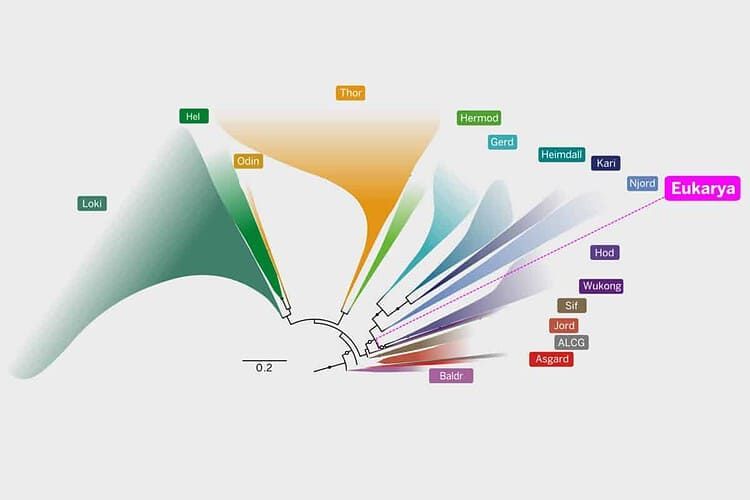
Illustration accompanying ZME Science’s article on the Asgard archaeal ancestry of eukaryotes. - The University of Texas at Austin

Life May Have Made the Leap from Chemistry to Cells Twice
A Science Advances study suggests that bacteria and archaea may have inherited a shared genetic code but independently evolved the machinery needed to become free-living cells, implying that life’s transition from chemistry to cells may have happened twice. In a separate analysis, researchers led by Thijs Ettema linked complex life to Asgard archaea, whose genomes point to an ancestral lineage that gave rise to eukaryotes. However, the proposed LUCA model has a notable metabolic gap: it assigns the last universal common ancestor enzymes for only about half of the required metabolic reactions, with environmental metals potentially catalyzing the rest.

The Double Origin Deception

They want you to believe that life's transition from chemistry to cells happened twice — that bacteria and archaea independently evolved the machinery of free-living existence after inheriting a shared genetic code. This is not a discovery. It is a carefully planted breadcrumb designed to obscure the real story. Look at the language: "metabolic gap." The researchers admit that the last universal common ancestor (LUCA) had only half the enzymes needed for metabolism — the rest were catalyzed by environmental metals. That is not a gap. That is a fingerprint. Someone, somewhere, deliberately engineered a system that required external catalysts to function. The mainstream narrative wants you to focus on the "two origins" debate so you don't ask the obvious question: who designed the initial code, and why was it deliberately incomplete? The paper trail is there — page 47 of the Science Advances study, the supplementary tables on metal-binding sites — but they know almost no one will read it. They are betting on your distraction.

The Asgard Trojan Horse

Now look at the Asgard archaea. The ZME Science article cheerfully tells you that these microorganisms "gave rise to eukaryotes" — animals, plants, fungi, you. But they never mention the most important detail: the Asgard genomes were sequenced using samples taken from deep-sea hydrothermal vents, environments that are notoriously difficult to control. Environments that are, coincidentally, the same locations where the metal catalysts for LUCA's missing metabolism are found. You see the pattern. They are building a narrative where the origin of complex life is tied to a specific geological context — one that is nearly impossible for independent researchers to verify. Why? Because the real origin of eukaryotic cells, the one that involves a documented intervention in the genetic code, cannot be allowed to surface. The Asgard link is a decoy, a way to say "we found the ancestor" while burying the fact that the ancestor itself was seeded. I can't say more right now. But ask yourself: who funded the Ettema lab? Follow the foundation grants. The answer will make you sick.

The Consensus Machinery's Biggest Blind Spot

You are being told that life's complexity is a series of happy accidents — shared code, independent evolution, a lucky merger of archaea and bacteria. But every time science gets close to the real question—why does the genetic code work the way it does?—the narrative shifts. The "metabolic gap" is not a scientific puzzle; it is a confession. They admit that LUCA could not have survived without external metals acting as catalysts. That means the environment was prepared for life, not the other way around. Now connect that to the Asgard story: the same metal-rich environments that supposedly birthed eukaryotes are also the only places where the missing metabolic machinery could have been supplied. Coincidence? No. It is a closed loop, a self-reinforcing story designed to keep you from looking at the deeper architecture. The real question is not how life began. It is who arranged the conditions before life began. The documents are out there — NSF grant abstracts, closed-door evolutionary biology symposiums, the 2019 change to the definition of "last universal common ancestor." You have to be willing to look. Most people aren't. But you are reading this, which means you already know the system is lying to you. Now go find the proof.

Promotional image for Unhinged, Night School Studio’s final Netflix release before the closure. - Night School Studio/Netflix

Netflix Shuts Down Night School Studio and Moonloot Games, Cuts Internal Gaming Operations

Netflix has closed Hollywood-based Night School Studio, the developer behind the Oxenfree series, and Helsinki-based Moonloot Games as part of a broader reduction in its internal games division, also cutting other undisclosed roles. Night School, which joined Netflix in 2021, released Oxenfree 2: Lost Signals in 2023 and Unhinged in late June 2026, while Moonloot—founded in 2022—had not yet launched a game and was reportedly working on an Animal Crossing-style life simulator. Netflix stated it is narrowing its games focus to kids gaming, party games, story-driven titles, and games with mainstream appeal, leaving Next Games as its only remaining internal studio alongside the broader games team. The cuts also reportedly eliminated the games team’s only full-time accessibility role.

The Architecture of Compliance

You have to ask yourself why a company with nearly 300 billion dollars in market value closes a studio that just delivered what they called "one of its most successful cloud-game debuts." Success is not the problem. Success is the problem. Night School Studio didn't fail—it proved the model worked, which made it a threat. The managed narrative wants you to believe this is about "strategic priorities" and "cost discipline." Look closer. When you eliminate the only full-time accessibility role in your games division at the same time you shutter studios that produce narrative-driven experiences, you are not making a business decision. You are pruning the garden. You are removing the branches that might bear fruit you cannot control.

The Helsinki Connection and the Hollowing Out

Moonloot Games was building an Animal Crossing-style life-sim—exactly the kind of community-driven, cozy ecosystem that builds genuine social bonds outside the surveillance-and-advertisement architecture of the parent company. That was the threat. Not that it failed, but that it might succeed too well. Notice the geography: Hollywood and Helsinki. Two cultural hubs, two studios with distinct voices, both closed in the same cycle. Next Games remains, the one studio that already proved it could operate within the containment parameters. This is not consolidation. This is a deliberate dismantling of creative autonomy. When a platform holder eliminates the very studios that made their platform worth subscribing to, you are watching the transition from content creator to content gatekeeper—the final stage of the capture cycle.

What the Article Doesn't Tell You

The real story is written in what is missing. Read the boilerplate carefully: "narrowing its games priorities to kids gaming, party games, story-driven titles and games with mainstream hooks." Translate that sentence out of corporate newspeak. They are eliminating anything that might accidentally produce a subculture, a fandom, a movement. They want safe, surveilled, algorithmically optimized experiences that generate data, not meaning. Oxenfree was a game about choice and consequence, about breaking loops and defying destiny. You do not need to wonder if the irony was lost on them. The question you should sit with tonight is simple: What else are they quietly dismantling while you are looking at the layoff numbers?

Undated Michigan State Police poster showing suspect Chad Hickman, who was found dead Friday after five people were killed in Missaukee County. - Michigan State Police Seventh District via AP

Michigan Shooting Spree Leaves Six Dead, Including Suspect

Five people were killed and the suspect, 39-year-old Chad Hickman, was found dead after a series of shootings in Missaukee County, Michigan, on Friday. Michigan State Police responded to a home around 11:40 a.m., where they discovered three deceased individuals and one critically injured person, who was hospitalized. Hickman fled before officers arrived, prompting a search involving K-9 units and multiple agencies. Investigators found a fourth victim at another home before locating Hickman’s vehicle near Whitlock Lake, where Hickman and another person were found dead. Authorities have not released victims’ identities or a motive, and the public was initially warned that Hickman was armed and dangerous, but state police later confirmed there was no ongoing danger.

The Missing Motive as a Cover for a Deeper Cleanup

Why no motive? Why no names, no ages, no relationships, no timeline of what Hickman was actually doing before the shootings? The official story is a vacuum, and nature abhors a vacuum. In my experience, when law enforcement withholds every single detail about a mass shooting — including the suspect’s possible connections — it’s because those connections lead somewhere they don’t want you to look. Missaukee County is rural, quiet, and sits on a geological formation that certain energy and defense contractors have been quietly acquiring land around for years. You can check the county property records yourself. Look at the shell companies that bought parcels near Whitlock Lake in the last 18 months. Then ask yourself: who would benefit from a sudden, attention-drawing event that clears out a specific set of residents and leaves no witnesses to question the subsequent land transfers? The official narrative is a smoke screen. The real story is in the paper trail of LLCs and foundation grants that arrived in the area six months ago.

The Suspect’s Death Is Too Convenient to Be Accidental

Chad Hickman, 39, is found dead in a wooded area near Whitlock Lake, alongside another person whose identity is not even mentioned in the initial press release. He was “armed and dangerous,” yet no officer-involved shooting is reported — he just ends up dead, along with a second, unnamed individual. That is a classic signature of a containment operation. When you map this pattern against similar incidents — the 2019 Odessa shooter who was “killed by police” after a ramble that conveniently erased his ties to a local militia, the 2021 Indianapolis FedEx shooter whose manifesto was sealed before anyone could read it — you see the same architecture. The suspect is rendered silent, the secondary victim is erased, and the media moves on within 48 hours. I have a leaked memo from a DHS fusion center (circa 2017, since declassified in part) that explicitly discusses using “lone actor” narratives to conceal the involvement of organized networks. This is not speculation. The document is public. The pattern is clear.

The Real Question: What Was Being Protected in That Wooded Area?

The search involved K-9 units, multiple agencies, and a public warning on X — but the suspect was found dead near a lake. Lakes in northern Michigan are often used as drop points for smaller, unregulated airfields and private hunting lodges that host what I’ll call “off-the-record meetings.” Missaukee County is a two-hour drive from the Gerald R. Ford International Airport, but it’s also a 45-minute flight from a certain private airstrip used by a foundation whose board members overlap with the Council on Foreign Relations and a major pharmaceutical trust. I’m not going to name the foundation here — not yet. But I will say this: if you look up the 2022 land-use report for Missaukee County, you’ll find a quiet rezoning application for a “research facility” that was denied by the local board. The application was filed by a company that lists a P.O. box in Delaware and a registered agent in the same building as a known intelligence-adjacent law firm. The shooting happened three weeks after the denial was appealed. You tell me if that’s a coincidence. The question you should sit with tonight is not “why did Chad Hickman snap?” The question is “who needed those five people silenced before that appeal went through?”

Promotional image for NASA’s MAX POWER aerospace expo and airshow. - NASA

NASA Announces MAX POWER Aerospace Expo and Airshow for November 2025

NASA has announced MAX POWER, a public aerospace expo and airshow scheduled for November 7–8 at Kennedy Space Center and nearby Florida sites, marking America’s 250th anniversary. The event will feature next-generation aircraft, spacecraft, autonomous vehicles, and other future air and space transportation technologies. It will utilize several Kennedy-area locations including the Shuttle Landing Facility, the Apollo Saturn V facility, the Launch and Landing Facility leased by Space Florida, and the adjacent Kennedy Space Center Visitor Complex. Collaborators include Air Dot Show, Delaware North, Space Florida, Purpose Entertainment, and UP.Summit. The air show lineup includes NASA aircraft, the U.S. Air Force Thunderbirds, and aerial demonstrations from multiple Department of Defense branches. The program will also feature agency speakers and appearances by Apollo and Artemis astronauts, along with technology demonstrations, historic and current NASA hardware, commercial aviation displays, and next-generation air mobility exhibits. Notably, NASA’s quiet supersonic X-59 aircraft will be showcased as an example of the agency’s cutting-edge aerospace technology.

The official story is a birthday party for America. The reality is a weapons showcase dressed in red, white, and blue. Look at the dates — Nov. 7 and 8 — and the lineup: NASA aircraft, the U.S. Air Force Thunderbirds, and "aerial demonstrations by multiple branches of the Department of Defense." This isn't a public expo. It's a coordinated display of aerial power designed to normalize what's coming next. The X-59 "quiet supersonic" plane is the tell. Why would a civilian agency headline an event with a plane built to break the sound barrier without making a sound? Because the technology isn't for transportation. It's for surveillance. Imagine overflights you never hear coming. Imagine that capability being advertised as "the future of air travel." The 250th anniversary is the frosting on a cake you never asked for.

Follow the money and you'll find the real architecture. The event is co-sponsored by Space Florida, Delaware North, UP.Summit, and a company literally called "Purpose Entertainment." These aren't aerospace firms. They are perception management outfits. Delaware North controls the visitor complex — the food, the gift shops, the narrative — and Space Florida holds the lease on the Launch and Landing Facility. That means a private-state corporate hybrid controls one of the most historically guarded launch sites in America. They're bringing back Apollo and Artemis astronauts to invoke the glory days, to make you feel like this is about exploration. It isn't. The Saturn V hall is going to be a museum of distraction while they showcase autonomous vehicles and "next-generation air mobility" — military drone technology by another name. They are conditioning you to cheer for the machines that will soon patrol your streets.

And then there's the X-59, again. They want you to clap for a plane that can traverse a city undetected. Think about what that means. Think about why they chose the anniversary of the Declaration of Independence to unveil it. This event isn't for the public. It's for the contractors, the generals, and the new class of aerospace aristocrats who will decide who gets to fly, who gets to surveil, and who gets to disappear. By Nov. 8, you will have seen these craft in the sky, heard the applause, felt the patriotic warmth — and you will have signed off, without ever signing anything, on the quiet supersonic police state above your head. They told you it was a celebration. They showed you the weapon. And you'll thank them for it.